The Journal · Field Notes
Two patios can use the exact same paver and look like completely different projects. The difference is the pattern. The way the stones lay down, where the seams fall, how the field meets the border, whether the joints run in the same direction as the eye walks or perpendicular to it. Pattern is the cheapest design tool available to a homeowner and the one most people never consider. After ten years of laying pavers across the Kansas City Metro, we have settled on a set of pattern principles that consistently produce patios people actually love to spend time on. Here are the moves that work, the ones that backfire, and how to think about pattern as a design decision rather than an afterthought.
Most homeowners pick a paver based on color and texture. The pattern decision usually gets made by the installer, often by default, often without much thought. That is a missed opportunity. Pattern controls how big the patio reads, where the eye lands first, whether the space feels relaxed or formal, and how well the patio ages as small movements accumulate over the years.
A running bond on a small patio reads casual and timeless. A herringbone on the same patio reads more refined and gets used for driveways because the interlocking pattern is structurally stronger. A basket weave on the same patio reads classic and is the one we use most often for clients who want a slightly more traditional feel. A 90-degree herringbone with a soldier course border reads architectural and frames the patio like a piece of furniture.
Same pavers in each case. Different patios. The cost difference between patterns is small. The design impact is huge.
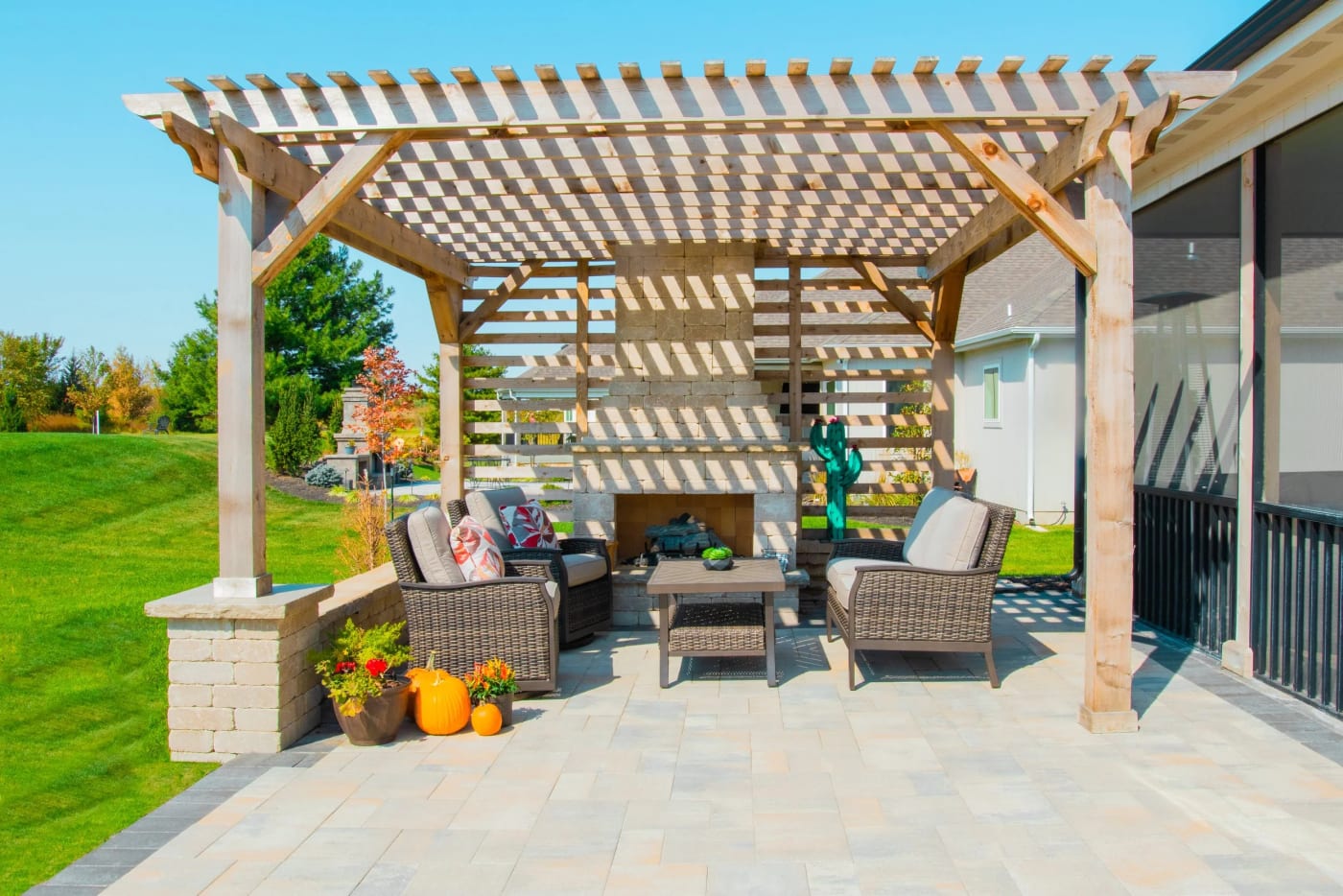
A border is a course of pavers running along the perimeter of the patio in a contrasting color, a contrasting size, or a different orientation from the field. Sometimes all three. It does for a patio what a frame does for a painting. The eye reads the field and the border together as one composition, and the border gives the whole patio a definite edge instead of letting it dissolve into the lawn.
The default we recommend on most projects is a soldier course border, which is a single line of rectangular pavers laid end-to-end around the perimeter, often in a darker tone than the field. Costs almost nothing to add and makes a 400 square foot patio feel intentional and finished instead of provisional. Skip the border and the same patio reads like a slab somebody dropped in the yard.
For larger patios we sometimes use a double border, with a soldier course outside and a different field paver as a 12 to 18 inch inner band. This works well when the field paver is small and we want to add visual weight at the edge.
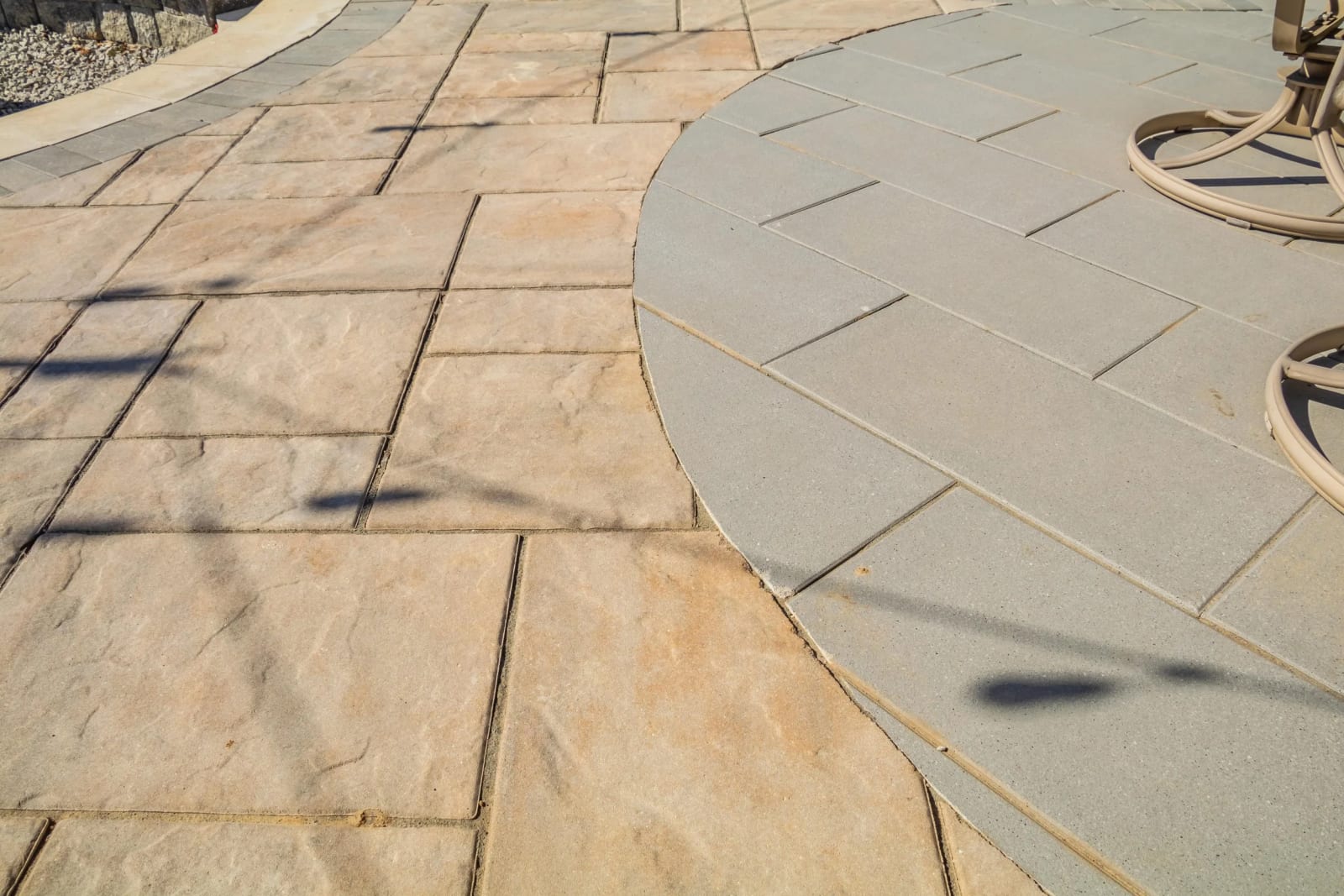
Most major paver manufacturers, including Belgard, Unilock, and Techo-Bloc, make circle kits, which are pre-cut sets of pavers that lay down as a perfect circle (or sometimes a half-circle). Diameters typically range from 8 to 14 feet.
Where a circle kit earns its keep is when the patio has a built-in fire pit or fire feature. Setting the fire pit in the center of a 12-foot circle kit creates a visual hub the patio organizes around. Seats radiate outward from it, conversation orbits it, and the eye lands on it from anywhere on the patio. The fire pit feels like the heart of the space because the pattern makes it the heart of the space.
Circle kits also work beautifully at the entry point of a patio, framing a transition from a path or a doorway. We use them less often as pure decoration in the middle of a field, because without a feature inside the circle they tend to read as an empty design moment.
The driveway is the largest paved area at most homes, and it is also the first thing visitors see. Treating it like a slab is a missed opportunity. A few design accents transform a driveway from utility infrastructure into a real entry statement.
The most effective driveway accent is a contrasting border, usually 12 to 18 inches wide, running along both edges of the drive in a darker or lighter tone. The border can also wrap the turnaround or the entry apron where the drive meets the street.
A second move is a centerline accent, which is a 12-inch-wide band running down the center of the driveway in a contrasting color. This breaks up a wide expanse of pavers and gives the driveway a sense of direction. Looks especially good on long driveways or curved drives.
A third move is the entry medallion, which is a circular or rectangular inlaid pattern at the top of the driveway where it meets the garage doors. This is the formal version, more common on larger homes.
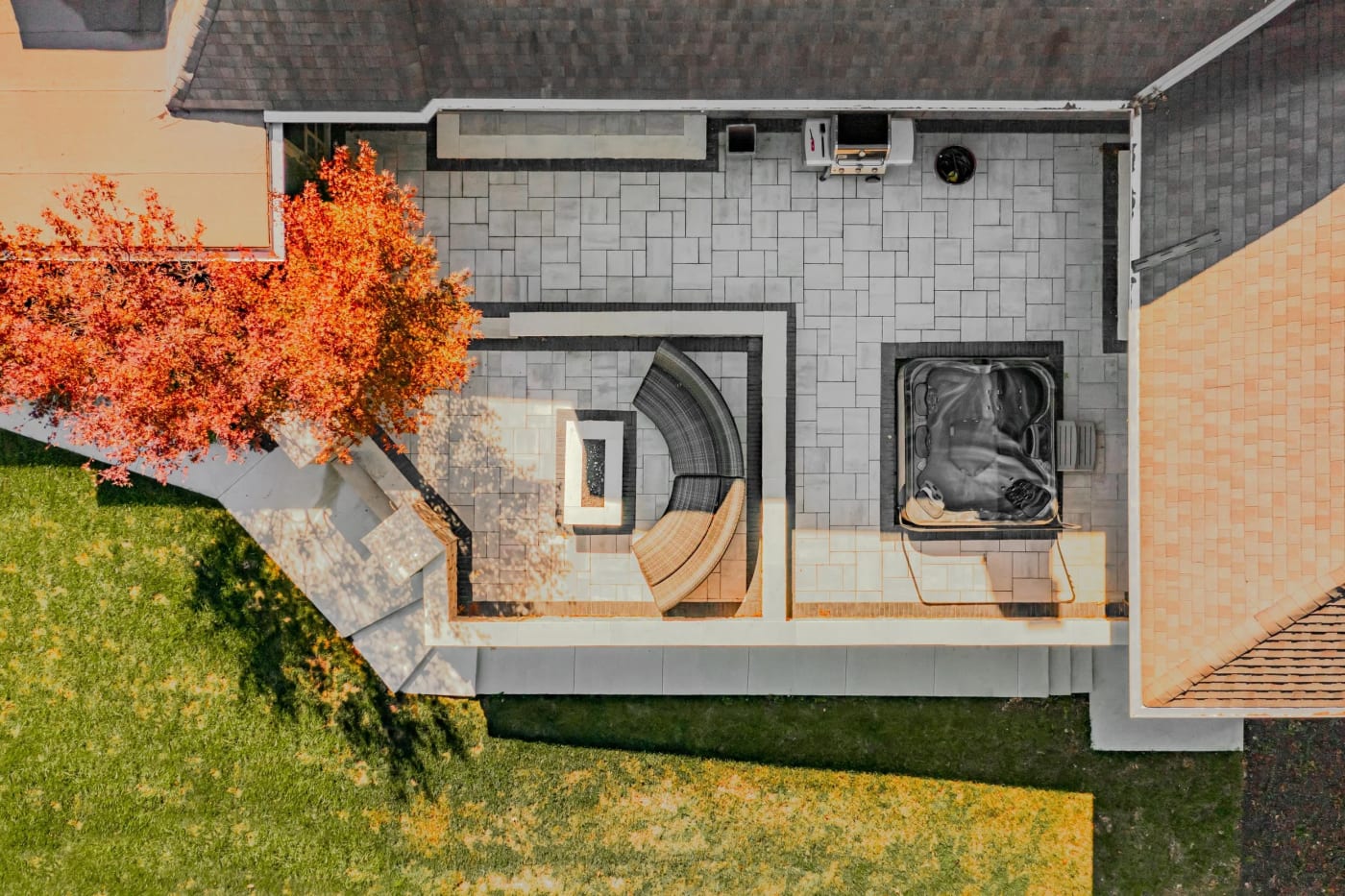
An inlaid "rug" is exactly what it sounds like. A rectangular section of the patio laid in a contrasting paver or pattern, sized roughly like an indoor area rug (commonly 8 by 10 feet or 9 by 12 feet), placed where a seating arrangement or dining table will go.
The effect is to define the function of a zone within the larger patio. The dining area sits on the rug. The living area sits on the rug. The path between them runs on the field. The patio reads as multiple rooms even though it is one continuous surface.
The rug design works best on larger patios where there is enough field around it to give the rug room to breathe. On a small patio, an inlaid rug fills almost the whole patio and the effect is lost. We typically use this technique on patios 500 square feet and larger, with the rug taking up no more than 35 percent of the total area.
Bigger outdoor living projects often have multiple zones. The grill area, the dining area, the lounge area, the fire pit area. The transitions between these zones are where pattern earns its keep.
The most common technique is a contrasting band running between zones, perpendicular to the direction of travel. The eye reads the band as a threshold and the patio reads as two rooms instead of one. Even a single course of contrasting pavers does this work.
Another technique is a shift in pattern direction at the zone boundary. A running bond in the dining area, a herringbone in the lounge area, with a soldier course between them as a transition. Same paver in both zones, but the eye reads them as distinct spaces.
A third technique is a change in elevation. A single step up or down between zones, with a contrasting riser face. The pattern and the elevation reinforce each other and the transition becomes architectural.
Almost every paver pattern relies on contrast. The question is which kind.
Color contrast is the most common, and the most forgiving. Two pavers in different tones, same shape, laid in adjacent patterns. The contrast is visible from a distance, the design feels intentional, and the patio looks finished. Color contrast works in most styles, from traditional to modern.
Shape contrast is bolder. A rectangular field paver with a square accent. A small paver border around a large paver field. The contrast is geometric, the design feels more architectural, and the patio reads more designed. Shape contrast can overwhelm a small patio. Use it sparingly and on larger projects.
Texture contrast is the most subtle. A smooth modern paver with a tumbled or aged accent. The contrast is felt more than seen. Reads beautifully in person, often disappears in photos. Best for clients who care more about the experience of being on the patio than the photo of it.
Combining all three contrasts on the same patio is too much. Pick one or, occasionally, two. Three is busy.
A few patterns we steer clients away from, because they tend to age poorly or read as dated.
Pinwheel patterns with four small pavers around a central square. They were popular in the 1990s and 2000s and now read distinctly of that era. We get rebuild calls on pinwheel patios more than any other style.
Random multi-piece patterns where 3 to 6 different paver sizes lay in an irregular pattern. They look great in showrooms and on small samples. On a 500 square foot patio, they read as visual noise.
Diagonal field with a square border. The patio looks like the pavers were rotated 45 degrees on accident. Works in very specific contexts, mostly doesn't.
Two competing patterns at the same scale. A patio with a herringbone in one half and a running bond in the other half, with no border between them, reads as confused rather than dynamic.
The safe move is one strong pattern and a clean border. The strong moves are deliberate combinations like herringbone field with a soldier course and a single inlaid rug. The dangerous moves are mash-ups of multiple patterns without a clear hierarchy.
We install pavers from three main manufacturers in the Kansas City market.
Belgard is the largest paver brand in North America and has the widest product line, with extensive circle kits, complementary borders, and color-matched accent pieces in almost every series. Our most popular Belgard products include Mega-Arbel for natural-stone-look patios, Lafitt for refined modular styling, and Cambridge Cobble for a more traditional look.
Unilock offers a slightly more architectural aesthetic and is strong on premium products like Beacon Hill and Richcliff that work well in modern designs.
Techo-Bloc is the smaller of the three but the most design-forward, with bold color blends and shapes that suit clients who want something distinctive.
Each manufacturer publishes pattern guides showing exactly how their pavers combine. We design from those guides and customize where it makes sense.
Does a contrasting border cost more? Yes. A soldier course border in a contrasting color typically adds $20 to $35 per linear foot of perimeter to the project cost once material and labor are factored in. On a typical 400 square foot patio (around 80 linear feet of perimeter), that is roughly $1,600 to $2,800 added. It is the highest-impact design upgrade per dollar on most patios.
Can I add a border to an existing patio? Usually no, without taking up the perimeter pavers and the edge restraint. The work is more involved than just laying new pavers around the outside. We have done it, but it is rarely cost-effective.
Do circle kits cost more than a square patio? Yes, the kit itself costs more, and there is more cutting and waste involved. Plan for a circle kit to add $3,000 to $8,000 over the cost of the equivalent rectangular area.
Will the pattern affect how the patio drains? No. Drainage is determined by the slope of the base, not the pattern of the pavers. Any pattern can drain properly when the base is built right.
Can I change the pattern partway through the project? During design, yes. After we have started laying, no. Pattern decisions get locked at design approval because the paver order and the cut layout depend on them.
What pattern do you recommend if I am not sure? A 45-degree herringbone field with a contrasting soldier course border. It is timeless, structurally sound, works in almost any architectural style, and rarely gets called dated.
Pattern is the easiest design lever to pull and the one most often left on the table. If you are planning a patio, driveway, or paver project in the Kansas City metro and want to think through pattern as a real design decision (not a default), we are glad to walk you through what works in your space. We bring sample boards to every design meeting and our 3D design process renders the actual pattern so you can see what it will look like before we lay a single stone. Call us at 816-499-2547 or book a free consultation through the Get Started page.
Thirty minutes on site with our designer is all it takes to see what is possible. No pressure, no hard sell.
Schedule a Design Call