The Journal · Field Notes
Almost every homeowner we work with wants fire in the backyard. The question is which kind. A fire pit is the casual one, the gathering, the thing you can buy off a shelf at Home Depot and still upgrade later to a permanent feature in the right yard. A fireplace is the architectural one, the centerpiece that decides where the seating goes and where you'll spend October evenings for the next thirty years. They look like substitutes from a Pinterest board. They are not. Here is how to figure out which one your space actually wants, what each one costs in Kansas City, and the common questions homeowners ask us before they commit.
A fire pit is a gathering. A fireplace is a room.
A fire pit invites people to circle up around it and talk to whoever is across the flames. A fireplace anchors a wall, turns the patio into something with a clear inside and outside, and points everyone the same direction the way a living room does. Both are good. They are not interchangeable. Picking the wrong one for your yard does not ruin the project, but it leaves you using the space less than you would have if you had picked right.
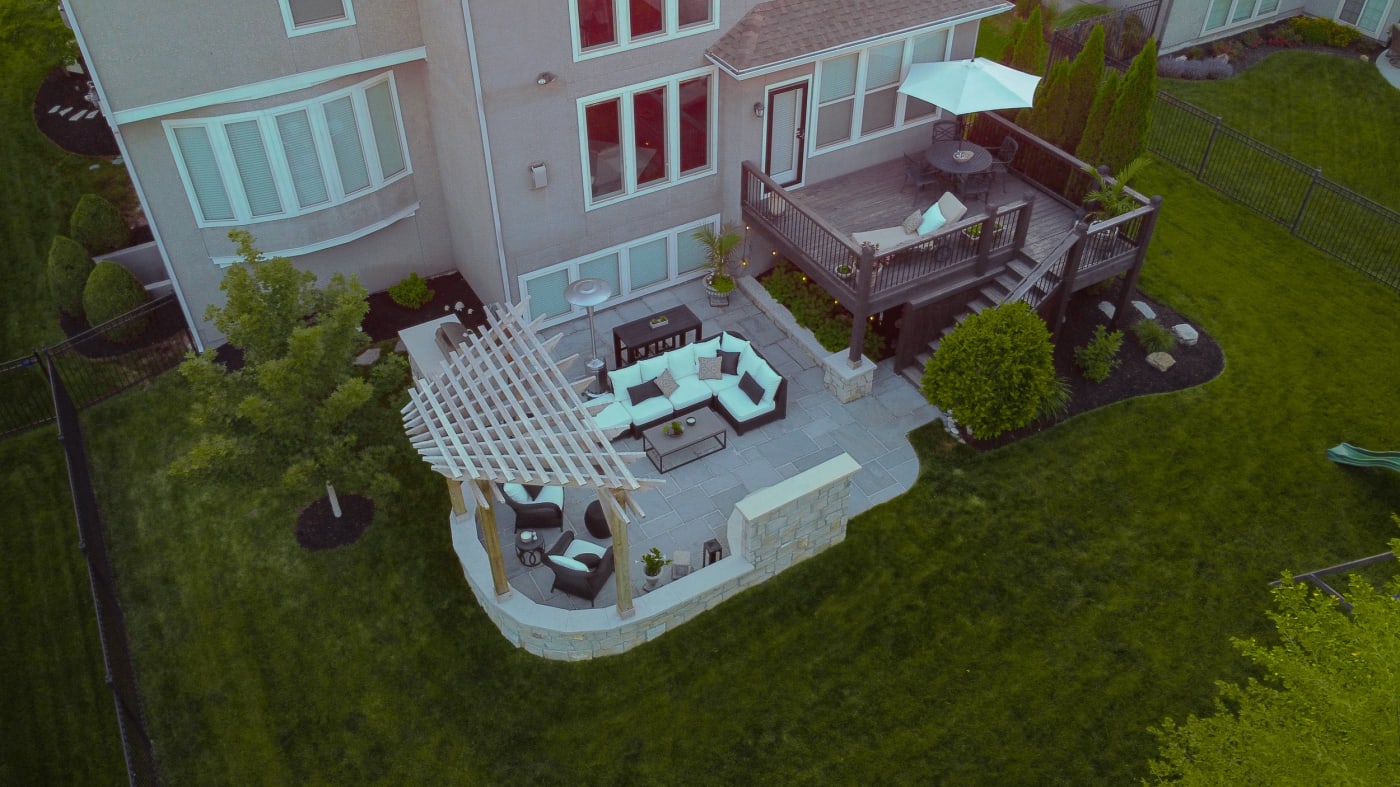
A fire pit wins when the backyard is the whole space and you do not want any one part of it to feel walled off. It works in the middle of a patio, at the edge of a lawn, set into a seating wall, or down a few steps into a sunken area. You can walk all the way around it. Nobody has a bad seat. The conversation stays in a circle, and the kids can park lawn chairs on the lawn side while the adults keep the patio side.
Fire pits are also the easier first move. You can start with a propane bowl on a finished patio for a few hundred dollars and decide later if you want a permanent one built in. A built-in gas fire pit with a real seating wall around it runs $4,000 to $8,000 in the Kansas City market and stays a meaningful upgrade to the yard for the rest of the time you own the house. Larger custom builds with stone surrounds and integrated benches push toward $12,000 to $20,000.
Wood-burning fire pits cost less, smell like camping, and produce real flame and real heat. Gas fire pits cost more, turn on with a switch, and you don't smell like smoke when you go back inside. We build plenty of both. The one we recommend depends entirely on whether you actually want to deal with wood, smoke, and ash on a Tuesday evening, or whether you want to flip a switch after dinner without thinking about it.
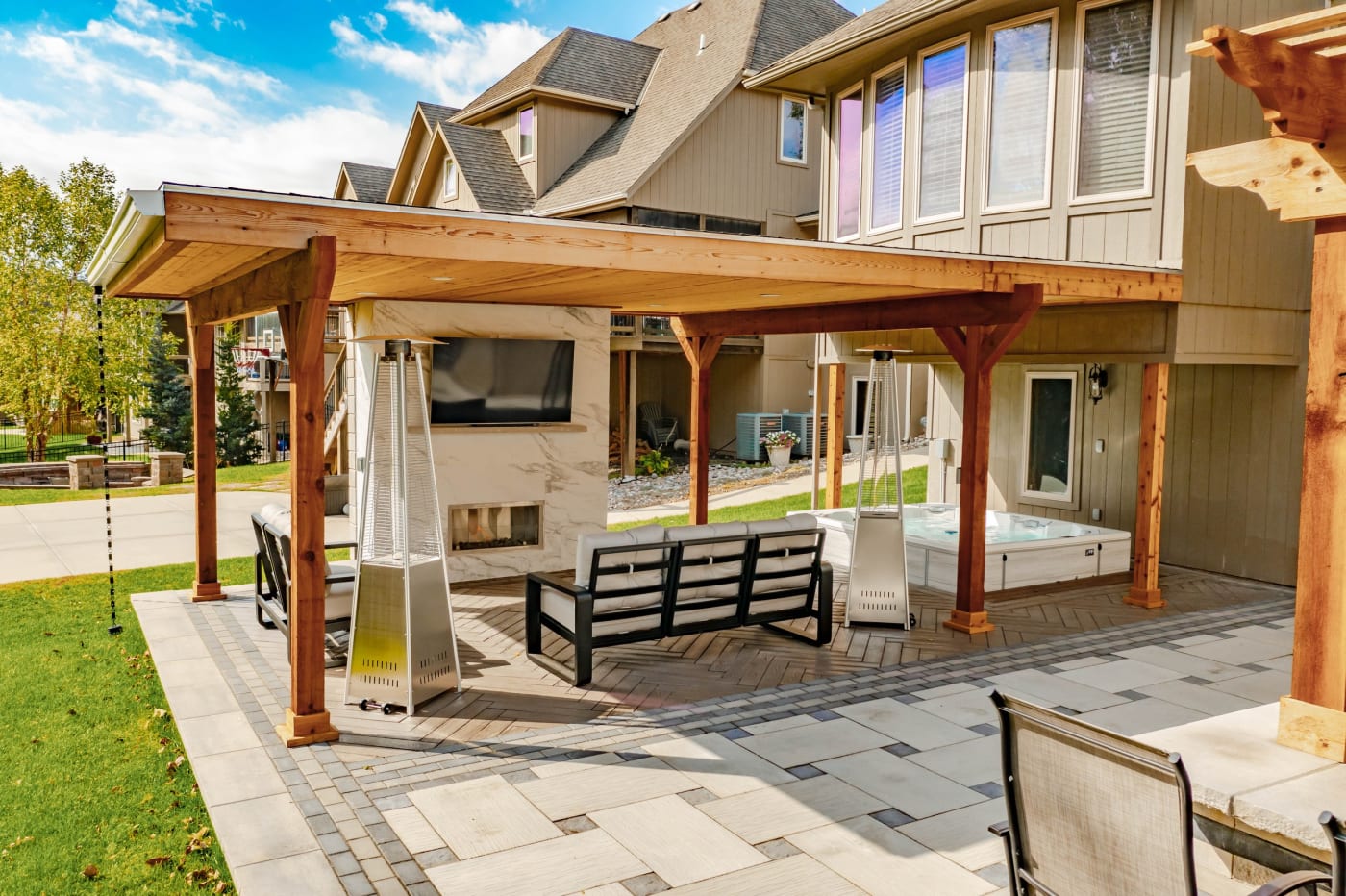
A fireplace wins when the patio wants to feel like an outdoor room. There is a back wall to the space, often the rear of a pavilion or pergola, sometimes a freestanding stone wall, and the fireplace is built into it. The seating points toward the fire the way a couch points toward a television in the living room. The space gets quieter, more enclosed, more like a place you furnish than a place you gather.
A fireplace also extends the season. The radiant heat off a stone surround keeps a patio usable into late October and back from early March in Kansas City. A fire pit pushes heat outward in a ring; a fireplace pushes heat forward into the space in front of it. If your goal is to use the patio in jacket weather, a fireplace is the bigger lever, by a meaningful margin.
Fireplaces start around $18,000 for a clean, modest stone build and run $30,000 to $40,000 for a full chimney with mantel, hearth, and integrated TV wall. Larger custom designs with imported stone, double-sided builds, or pavilion integrations push higher. They take longer to build than fire pits, require a real foundation, and need to be planned into the patio from the start. Retrofitting a fireplace to an existing patio means tearing out part of the patio to pour the footing, which is why we encourage homeowners to commit one direction or the other before the patio gets poured.
For both fire pits and fireplaces, the fuel choice is its own decision and the trade-offs are different than people expect.
Wood-burning is the romantic answer. Real flame, real crackle, real heat, and the smell that says "camping" to most of us. The downsides are real too: someone has to buy, stack, carry, and store wood. Ash has to be cleaned out. Smoke goes where the wind sends it (sometimes back into your house). Burn bans during dry summers shut you down. For a fire pit, wood is the cheaper install and the more atmospheric experience. For a fireplace, wood requires a real chimney and a real damper, which adds cost.
Natural gas is the convenience answer. A gas line runs to the feature, you flip a switch (or use a remote), and the flame is on. No wood to buy, no smoke to manage, no ash to clean. You can use it Tuesday after dinner without making a project out of it. Natural gas requires running a gas line from the house, which adds $1,500 to $3,000 to the install but saves you the fuel cost forever after.
Propane is the middle ground. Same convenience as natural gas, no plumbing run required, but you have to swap or refill tanks. Best for fire pits where the tank can be hidden in a built-in compartment, and for backyards where running a gas line is impractical or expensive.
We default-recommend natural gas for any feature within reasonable distance of the house. The convenience compounds. The feature that turns on with a switch gets used; the feature that requires loading wood gets used on the third weekend you remember to.
We have built plenty of yards that include both. The most common version: a casual fire pit in an area near the lawn for kid sleepovers and s'mores, plus a stone fireplace on the main patio for adult evenings. Different rooms in the same backyard, each one serving a different mood.
Another move that works beautifully: a fireplace as the back wall of a pavilion, with the patio extending out from there. The pavilion gives you cover from rain and sun, the fireplace gives you the warm anchor, and the open patio in front gives you flexibility. That combination is one of the most-used designs we build because it gives a homeowner three different ways to use the space depending on the weather and who is over.
We have also done sunken fire pits with a fireplace on the upper level. The fire pit becomes a conversation pit; the fireplace becomes a wall feature visible from inside the house. The yard reads like a designed space rather than a single patio with stuff scattered on it. These hybrid builds run higher, typically $40,000 to $80,000 all-in including the surrounding hardscape, but for the homeowner who genuinely uses their backyard, it is the move that delivers the most usable square footage.
When a homeowner cannot decide between a fire pit and a fireplace, the question we ask is: when you picture yourself out here in October, where are you sitting?
If the answer is "around the fire with friends, hands held out toward the flame," it's a fire pit. If the answer is "in a chair facing the fire with a drink and a blanket," it's a fireplace. The space wants whichever scene you actually live, not whichever one looked better on the Pinterest board you saved last year.
The other deciding factor is the back of the yard. If there is a natural back wall (the rear of a pavilion, an existing stone wall, the side of the house, a tall planting bed), a fireplace has somewhere to live. If the yard is open on all sides and the patio sits in the middle of it, a fire pit fits the space and a fireplace will feel out of place.
One more practical filter: how often do you actually entertain large groups versus small? Fire pits scale up to ten people sitting around them easily. Fireplaces are more comfortable for four to six people facing the same direction. If you're hosting football game-day crowds, a fire pit handles it better. If you're winding down most evenings with one or two people, a fireplace fits the rhythm.
Plan the fire feature into the patio from the start. It is the single most expensive thing to retrofit later, and the patio you are building right now is the patio that will host it. Even if your budget says "fire pit this year, fireplace later," we will pour the footing for the fireplace now while we're already digging. Pouring a $400 footing now saves $4,000 in patio rework later.
Whichever one you choose, build it in stone or brick that matches the rest of the hardscape. The fire feature should look like it grew out of the patio, not like it was set down on top of it. That's a small detail that decides whether the yard looks designed or assembled.
And if you genuinely cannot pick, build the fire pit first. It is a smaller commitment, a faster install, and it tells you a lot about how your family actually uses the backyard. The fireplace can come later, on a different patio, in a different year. We've had clients come back five years after their first project asking us to add the fireplace they almost built originally. We always say yes.
Does a backyard fireplace need a permit in Kansas City? Usually yes. Permanent outdoor fireplaces with chimneys generally require a building permit in Jackson, Johnson, Wyandotte, and Cass Counties, and may require a separate gas line permit if you're going with natural gas. Fire pits below a certain size and height usually do not require a permit. Your contractor should handle pulling whatever permits the project needs. If they tell you "we don't bother with permits," that's a red flag we cover in our hardscape contractors guide.
How much does a stone fireplace cost in Kansas City? A clean, modest stone fireplace runs about $18,000 to start. Most homeowners invest $18,000 to $30,000 for a finished fireplace with stone surround, mantel, and hearth. Add a TV wall, double-sided viewing, or pavilion integration and the project moves higher. We have full pricing breakdown on our fireplaces service page.
How much does a built-in gas fire pit cost? A built-in gas fire pit with a seating wall around it runs $4,000 to $8,000 typically. A larger custom build with stone surrounds and integrated benches can push toward $12,000 to $20,000. Wood-burning fire pits cost less to install but more to use over time once you account for firewood. Our fire pits service page has the breakdown.
Can I have both a fire pit and a fireplace in the same backyard? Absolutely, and we build this combination often. They serve different parts of the yard and different moods, the way a kitchen and a living room serve different parts of a house. Plan them in together from the start; you'll save money versus adding the second one later.
What is better for heat, a fire pit or a fireplace? A fireplace, by a noticeable margin, for the people sitting in front of it. The stone surround radiates heat forward into the space, and a fireplace extends your patio season by weeks on either end of the year. A fire pit pushes heat outward in a ring, which is fine for the people closest but less effective for warming a seating area. If extending your usable months matters, the fireplace wins.
Will a backyard fireplace work in winter? Yes, both wood-burning and gas fireplaces work fine in Kansas City winters. You'll want to make sure the gas line and any plumbing is buried deep enough to avoid freezing, but the fireplace itself runs through any temperature. Plenty of our clients use their fireplaces on snowy December evenings with a blanket and a drink. It's the most-photographed feature we build.
Whether you're leaning fire pit, fireplace, or both, the most important thing is to plan it into the patio from the start. Building the patio first and figuring out the fire feature later costs more than building them together. At Kansas City Hardscapes we design and build both, often as part of a larger outdoor living project. Browse our portfolio for finished examples, run your project through our cost calculator to see what your version might cost, or call us at (816) 499-2547 to start the conversation.
Thirty minutes on site with our designer is all it takes to see what is possible. No pressure, no hard sell.
Schedule a Design Call