The Journal · Field Notes
Anyone can lay pavers. That is true. You can rent a plate compactor at Home Depot for $75 a day, watch a YouTube video, and have a patio installed within a week. Friends-of-friends do it. Handymen do it. Landscape crews do it. DIY homeowners do it. The pavers go down. The patio looks finished. The bill is lower than what we would have charged. The question that decides whether the savings were real is the one nobody asks until two years later, when something has gone wrong, was the work actually done right, or just done? This post is about that question and the honest math behind it.
When a homeowner gets two quotes on a paver patio and one is 30 percent cheaper than the other, the temptation is to assume the cheaper contractor is more efficient, lower-overhead, or trying harder to win the work. Sometimes that is true. Often, the cheaper quote is cheaper because the work is different.
The cheaper crew is renting a plate compactor instead of owning one. They are using less base material. They are skipping geotextile fabric between the clay and the gravel. They are using regular joint sand instead of polymeric. They are laying the pavers on whatever sand they had in the truck, not a graded sharp-bedding material. They are skipping the proper edge restraint and using concrete bond instead. They are not running the compactor in lifts because their rental is for one day, not three.
Every one of these shortcuts saves real money. Every one of them shortens the patio's lifespan from 30 years to 3 to 5. The patio looks the same on the first day. The differences only show up over time.
The 30 percent savings up front turns into the homeowner's full investment ten years from now, when the patio has to be redone from scratch instead of just resealed.
A short list of the failures we get callbacks on, and what the repair actually costs.
Sinking pavers (improper base or insufficient compaction). Edges and corners drop, often where foot traffic concentrates or where heavy equipment was used. Fix: take up the affected section, rebuild the base, relay the pavers. Cost on a typical 500 square foot patio: $4,000 to $9,000 if confined to one zone, $15,000 to $25,000 if the whole patio is affected.
Heaving and frost damage (footings above the freeze line). Walls, fire pits, and structural elements lift unevenly with each winter. Fix: take down the structure, pour proper frost-depth footings (36 to 42 inches), rebuild. Cost: $3,000 to $20,000 depending on the structure.
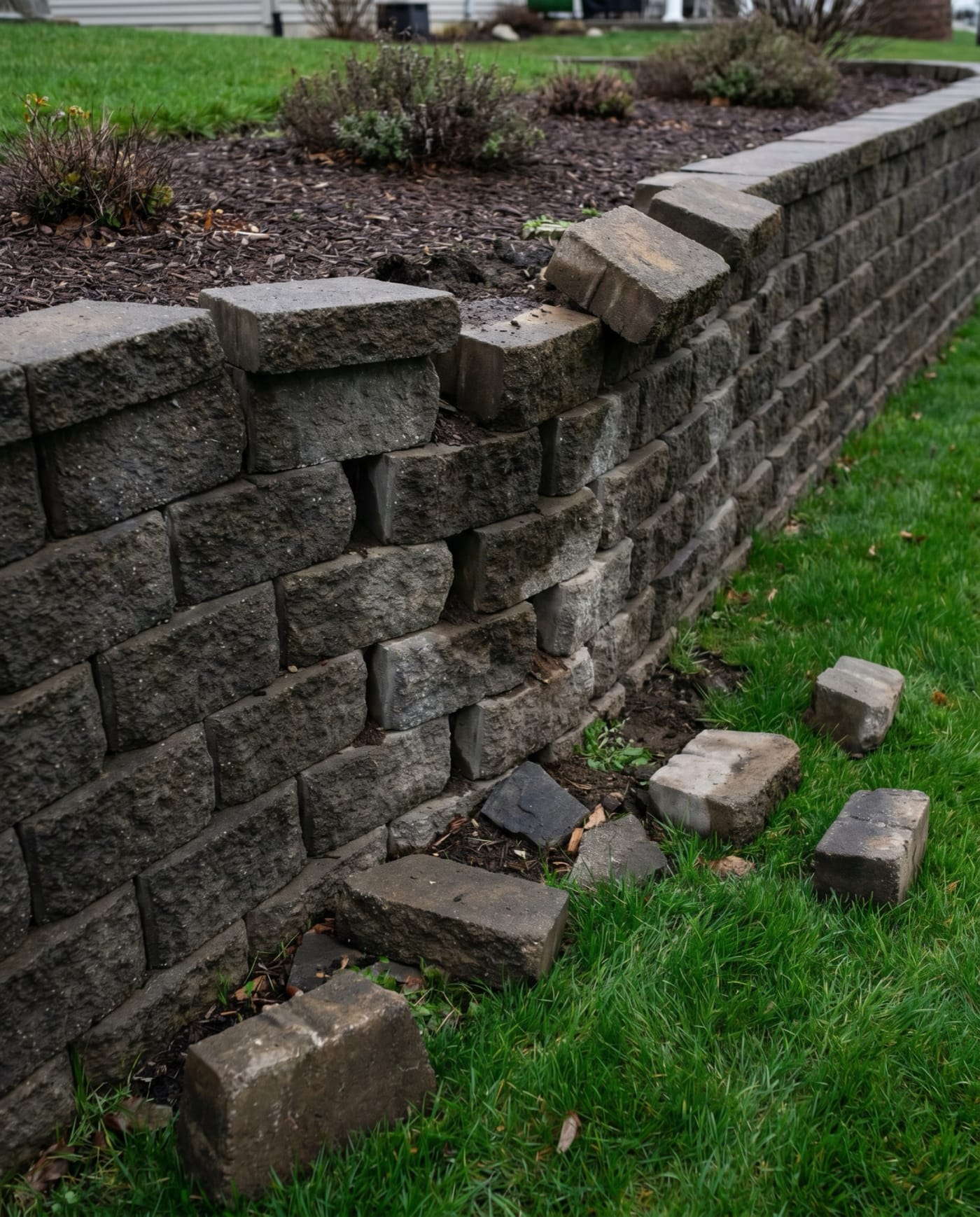
Bowing retaining wall (no rebar, no geogrid, or improper engineering). Wall lean increases each year, eventually fails completely. Fix: remove the entire wall, dig out the back, install geogrid and proper drainage, rebuild. Cost: $10,000 to $50,000 for a typical residential wall.
Cracked concrete patio (no control joints, thin slab, poor base). Random cracks across the surface. Cosmetic fixes (epoxy, color matching) are temporary. Real fix: tear out and repour. Cost: $8,000 to $25,000 depending on size.
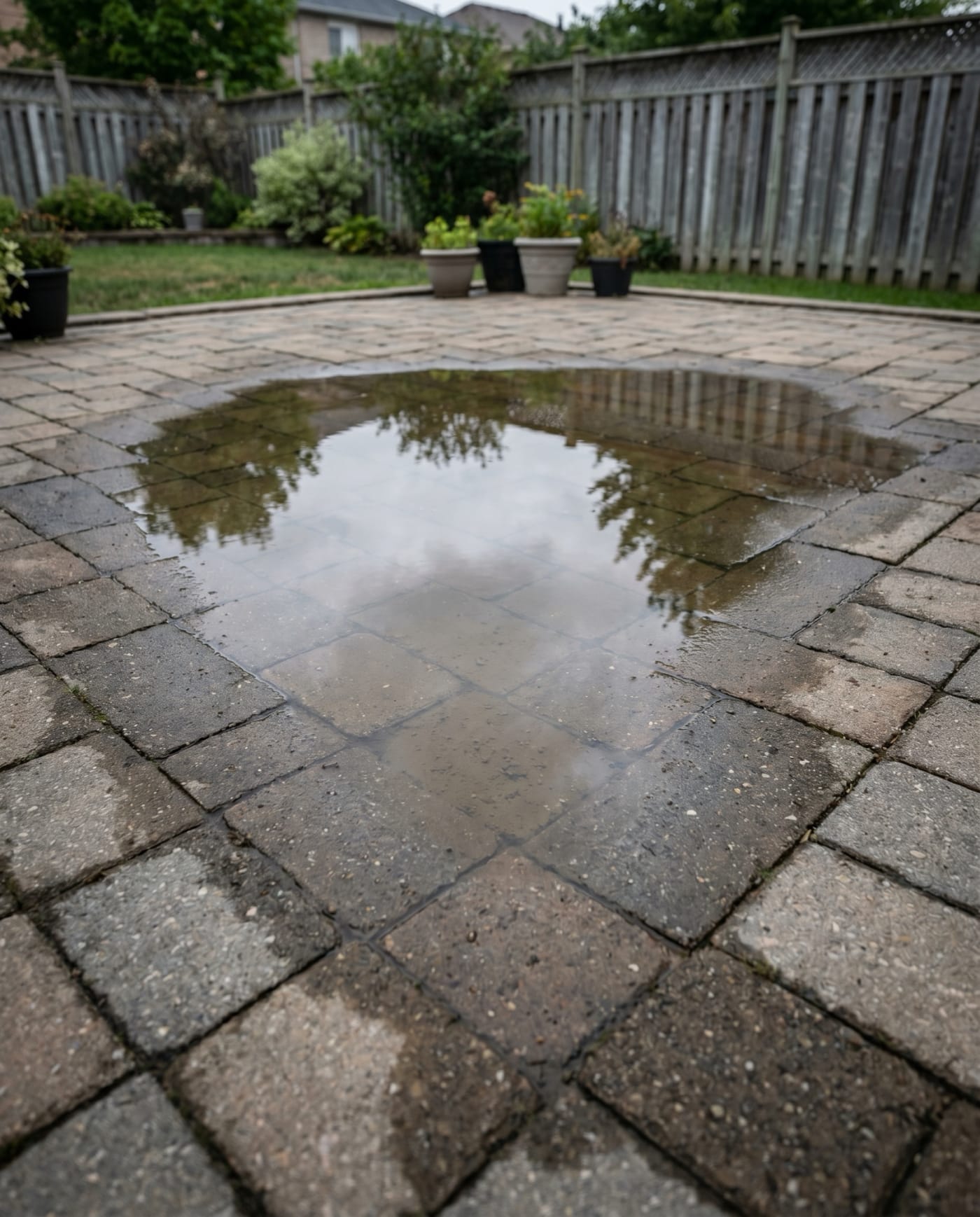
Water pooling against the house (improper slope). Patio slopes toward the home instead of away. Water finds the foundation, leaks into the basement. Fix: regrade the patio and possibly the surrounding lawn. Cost: $3,500 to $15,000, not counting any water damage repair to the home itself, which can easily be another $20,000.
Joint erosion and weed growth (plain joint sand instead of polymeric). Sand washes out, weeds and ants move in. Fix: clean joints, refill with polymeric, re-activate. Cost: $1,500 to $4,000.
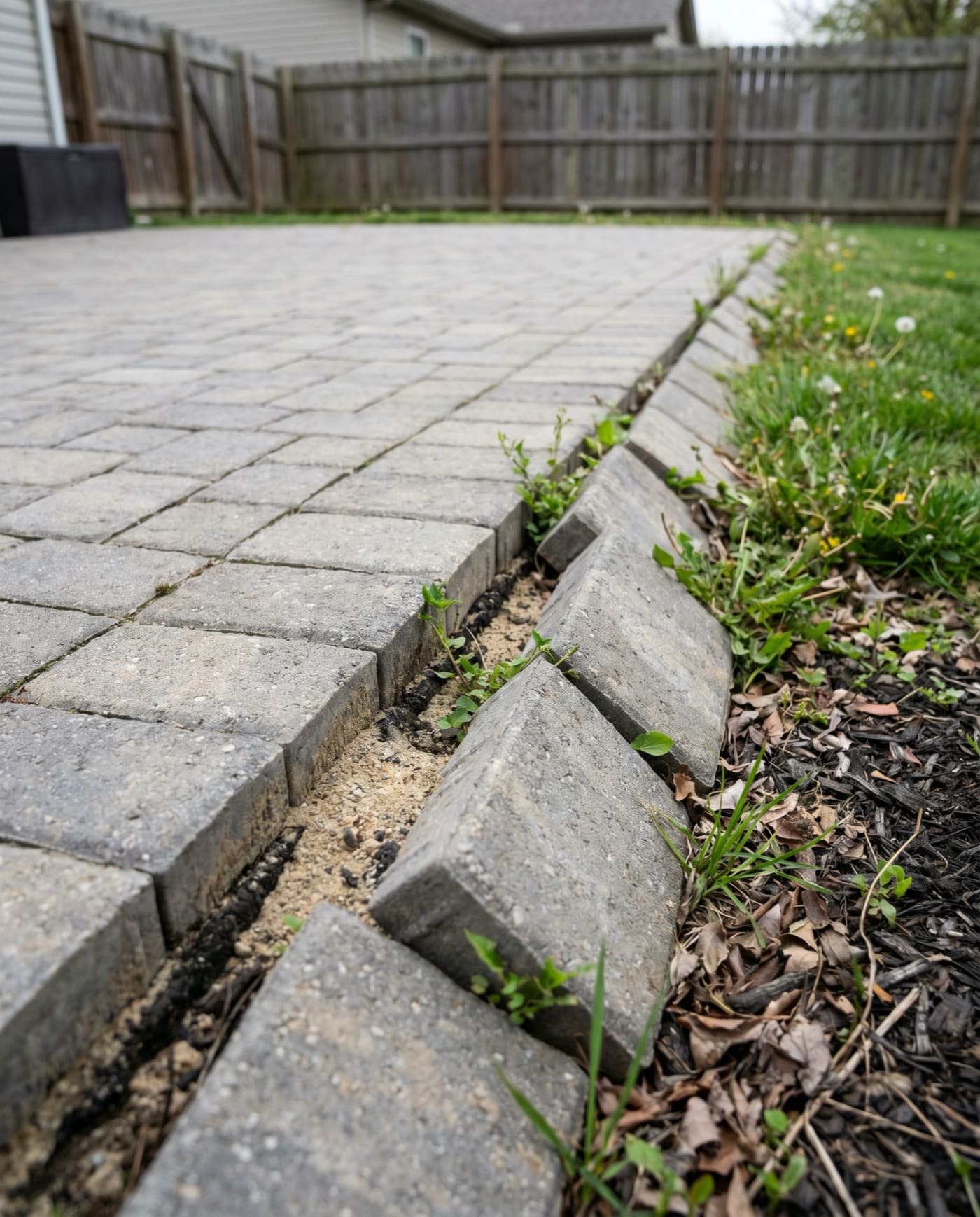
Edge creep (no edge restraint or concrete bond instead of plastic restraint). Perimeter pavers spread outward over time. Fix: take up perimeter, install proper restraint, relay. Cost: $2,500 to $6,000.
The cheapest scenario on this list is on par with the original "savings." The expensive ones eat the savings ten times over.
A specific pattern we see often enough to call standard.
Homeowner gets two quotes. Hardscape specialist quotes $22,000 for a 400 square foot paver patio with seating wall and fire pit. Friend-of-the-family contractor quotes $15,000 for the same scope. Homeowner picks the friend, saves $7,000.
Year one: looks great. Compliments at the neighborhood barbecue.
Year two: a few joints look thinner than they did. Some weeds in one corner.
Year three: a section of the patio has settled visibly. The fire pit edge stones have shifted. The seating wall has a slight outward lean.
Year four: homeowner calls us. We assess. The base is wrong (no geotextile, insufficient compaction, undersized aggregate). The footings on the fire pit and the wall are 18 inches deep instead of 42. The polymeric sand was never installed. The proper fix is a rebuild of everything except possibly the pavers themselves, which can sometimes be salvaged.
Quote: $14,000 to redo the base and reset the existing pavers, $9,000 to rebuild the fire pit and seating wall properly, total $23,000. Add the $15,000 they already spent and they are at $38,000 for a patio that should have cost $22,000 the first time. They lost four years of full use and they are now investing weekends and emotional energy in something they thought was finished.
We have done versions of this rebuild often enough that we recognize it before the homeowner finishes describing the symptoms.
Homeowners who do the patio themselves usually save more than the friend-of-the-family scenario but face a steeper learning curve.
The first DIY patio almost always has the wrong base depth, the wrong compaction, the wrong setting bed, or all three. The pavers go down looking great because the surface is the part that looks like the finished product. The structure underneath is invisible and is where the mistakes live.
The pattern: year one, the homeowner is proud. Year two, things start to look off. Year three, the family stops using parts of the patio because they have visibly sunken or shifted. By year four or five, the homeowner either lives with a deteriorating patio for the rest of the home's life or pays a real contractor to redo it.
For small, low-stakes projects (a stepping stone path, a small garden patio under 100 square feet, a fire pit ring kit on grade), DIY can absolutely work. For anything that involves footings below the freeze line, structural drainage, retaining walls over 18 inches, or surfaces with regular use, the math very rarely supports DIY once the failure rate is factored in.
You do not need to know paver chemistry to evaluate a contractor. A few practical checks separate the real from the casual.
Look at the company's portfolio of completed projects. A real hardscape contractor has at least 50 to 100 completed projects to show. Look at the photos. Compare across projects: do the joints line up cleanly, do the edges look intentional, do the seating walls have proper cap detailing, do transitions between materials look planned?
Read Google reviews carefully. Look specifically for hardscape-related reviews, not general home services. Look for patterns. Mentions of settling, drainage, callbacks, or "fixing it years later" are warning signs.
Ask about base preparation in their proposal. A serious quote will name the base depth in inches, the compaction method, the geotextile fabric, the setting bed material, and the edge restraint type. A vague quote with no specs is a sign the contractor is not used to being asked.
Verify ICPI certification or manufacturer training. The Interlocking Concrete Pavement Institute is the industry standard. Manufacturer training programs (Belgard, Unilock, Techo-Bloc) are credentialed.
Ask about warranty. Real hardscape contractors warranty their work. They are not afraid of warranty calls because they do not get many. Casual contractors avoid offering warranty because they would lose money on it.
Ask for references on projects 5+ years old. Anyone can show you a project they finished last month. A contractor whose work is still in great shape after 5 years can point you to actual past clients. Call those references and ask how the patio is holding up.
Visit a current job site. Most quality contractors will let you see a build in progress. The crew, the equipment, the methods, and the site management all show in person in ways photos cannot.
Think of the additional cost of a quality hardscape contractor not as a premium for nicer work but as insurance against the rebuild scenario.
A $7,000 to $10,000 difference between a casual and a professional quote is at the same dollar level as the cost of fixing a major failure. The professional quote is, in effect, paying the repair cost up front and getting the use of the patio along the way. The casual quote is gambling that the failure does not happen, and most of the time it does.
Insurance is rarely "exciting" spending. Nobody enjoys paying for it. But every homeowner who has watched a patio fail prematurely says the same thing in retrospect: they wish they had spent the difference and avoided the years of regret.
This is not unique to hardscape. The same logic applies to roofing, foundations, plumbing, and electrical work. The trades where the work is structural and below-the-surface are the ones where cutting corners is most expensive over time.
To be fair, not every cheaper quote is hiding shortcuts. Sometimes it is genuinely a better value.
A smaller solo contractor with lower overhead than a larger firm can deliver excellent work at a lower price. A friend-of-the-family who happens to be a retired stonemason can do real craft work as a side project. A regional company that is established in the suburbs but new to the city can quote below market while building portfolio.
The way to tell the difference is to evaluate the work, not the price. A quote with specifics, a portfolio of recent projects, clear references, and proper credentials can be cheaper than the market average and still represent quality work. A quote that is cheaper without any of those signals is the warning case.
Price alone is not the signal. The combination of price and verification is.
For more on the specialist-versus-generalist question, see our related post on landscape companies and hardscape work.
What if my current quote is actually fair and I am just nervous about the price? Verify the specifics. If the proposal names the base depth, the compaction method, the geotextile, the setting bed, the edge restraint, and the polymeric sand, and the contractor has the portfolio and credentials to back it up, you are likely getting a fair quote and the nervousness is just sticker shock on a big project.
How much should a basic 400 square foot paver patio cost in Kansas City? Most clients investing in a quality paver patio with proper base preparation land in the $25,000 to $60,000 range, per our service page. Below $20,000 for a 400 square foot patio with base prep, edge restraint, and polymeric sand is typically below what a real install costs.
Can I do part of the work myself to save money? Sometimes, yes. Some clients handle their own demolition or some of the finish work to reduce labor costs. We are happy to scope the project around what you want to take on.
What if a friend offers to do it for materials cost? Be honest with yourself about whether that friend has the skills, equipment, and time to actually finish the project to spec. The friend who offers and then is overwhelmed is the version of this story we hear about most.
Do you offer financing if the gap between quotes is the problem? Yes. See the financing page for partners.
How do I tell if my existing patio was done right? We do paid assessments and can usually tell within an hour whether a patio's base, edges, and structural elements were properly built. Worth the small fee before deciding what to do next.
If you are weighing quotes and want help understanding which one represents real value and which one represents a discount on quality, we are glad to walk through the comparison with you. We will tell you straight whether a quote you are considering looks reasonable, even if it is from another contractor. And if you are considering us, we will tell you exactly what is in the price and what is not. Call us at 816-499-2547 or book a free consultation through the Get Started page.
Thirty minutes on site with our designer is all it takes to see what is possible. No pressure, no hard sell.
Schedule a Design Call