The Journal · Field Notes
If you are a homeowner planning a makeover for your backyard, you are probably trying to decide if a deck or patio is the right choice for you. Both create a surface for outdoor seating, grills, and gathering. Both add real value to your home. And both are pitched as "the obvious answer" depending on which contractor is in front of you. The trouble is, that decision will sit in your backyard for the next twenty to forty years, and the two are not equal. After a decade of building both in Kansas City, we encourage homeowners to choose a patio over a deck almost every time. We are not biased toward patios because we build them. We build them because we believe they are the better outdoor surface for the way most people actually live.
Even with the most economical materials, a basic deck runs an average of $30 per square foot in the Kansas City market. A basic paver patio runs about half that, around $15 per square foot. On a 400 square foot project, you are looking at a $6,000 deck versus a $3,000 patio for the entry-level versions, and the gap widens as the project gets larger and more complex.
The price gap exists for a real reason. A deck needs a footing system, a substructure of joists and beams, decking boards, railings if it is more than thirty inches off the ground, and a finish that has to be applied and reapplied for the life of the deck. A patio needs a properly prepared base and the surface material itself. Fewer parts, fewer fasteners, fewer things to install and reinstall.
For the typical Kansas City backyard project where the back door sits one or two steps above grade, a patio almost always lands at a lower total cost than a deck of equal size. The bigger the project, the wider the gap. And the long-term math, which we'll get to in a minute, makes the gap dramatic.
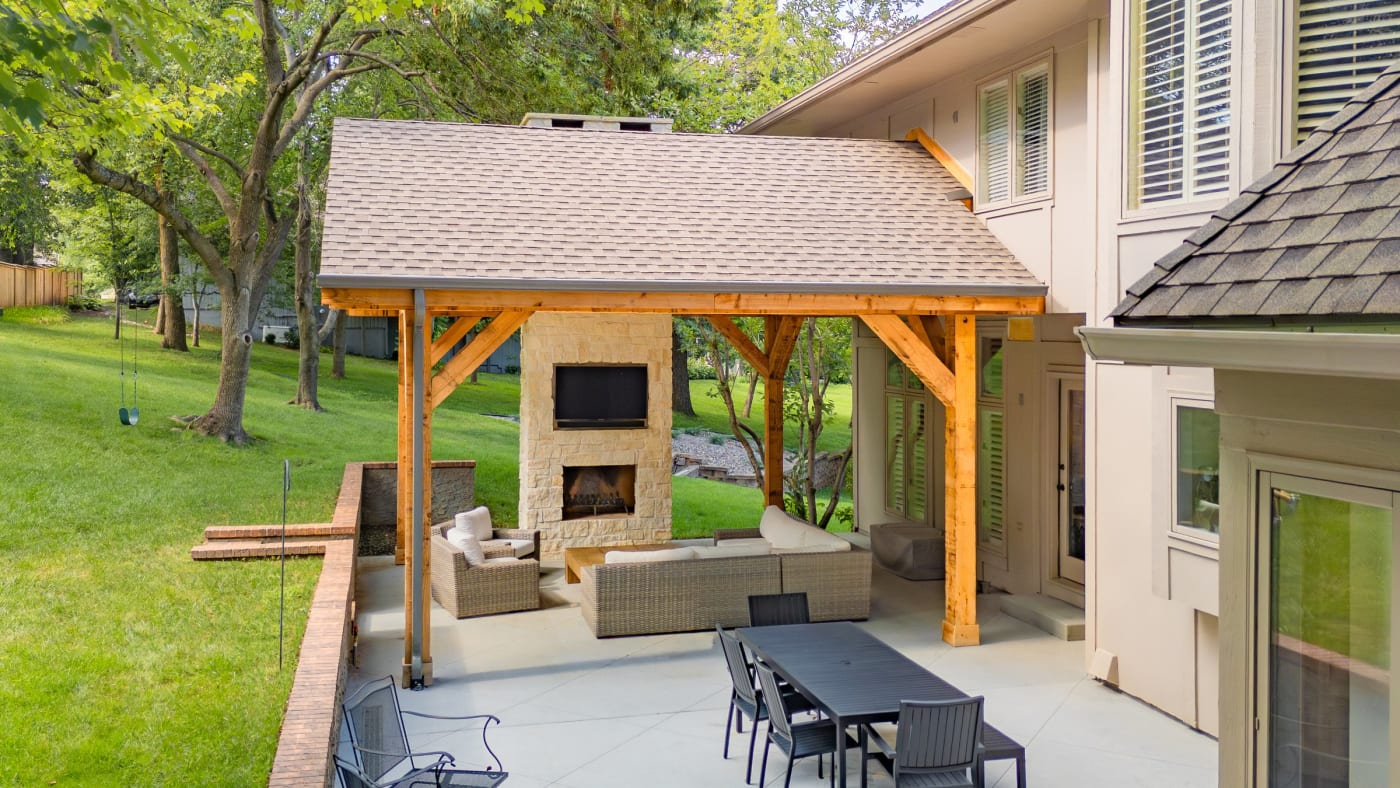
As long as your patio is installed by a contractor who knows how to prepare the ground properly, patios require almost nothing from the homeowner. A rinse with the hose every now and then. An occasional sweep. Every five to ten years, a quick refresh of the polymeric sand between the joints. That is the maintenance schedule.
Decks are a different relationship. A wood deck in Kansas City needs to be washed every spring, sealed or stained every two to three years, and inspected each season for popped fasteners, rotted boards, and railing wear. Composite decks reduce some of that maintenance but not all of it: the boards themselves hold up better, but the wood substructure underneath is still wood and still rots. Most homeowners we meet drift between "I should reseal that this fall" and "I'll get to it next year" until the deck starts visibly telling them that next year was the wrong answer.
Over the life of the surface, that maintenance is real time and real money. A few thousand dollars in stain, sealer, and labor across a decade. The hours of your weekend you would have spent sealing the deck instead get spent on the patio.
Kansas City is a brutal climate for outdoor materials. We get the full range of Mother Nature, freezing winters, drenching springs, hundred-degree summers, and the freeze-thaw cycle from November through March that pulls apart anything that wasn't built to handle it. Wood decks, even pressure-treated, hate this climate. The joists move, the boards cup, the fasteners loosen, and at some point between year fifteen and year twenty-five the whole structure starts asking to be replaced.
Patios, when built correctly, do not have this problem. The pavers themselves are concrete or clay, manufactured to a strength that does not care about weather. The base underneath, when it is a properly compacted aggregate with a concrete slab on top (the way we build), does not rot, does not move with the seasons, and does not need to be inspected. A patio built this way in Kansas City should last 25 to 40 years with no real maintenance.
Run the math out over the life of the house. A deck will get replaced once during the time you own the home. A patio you build now will outlive most of the trees in your yard.
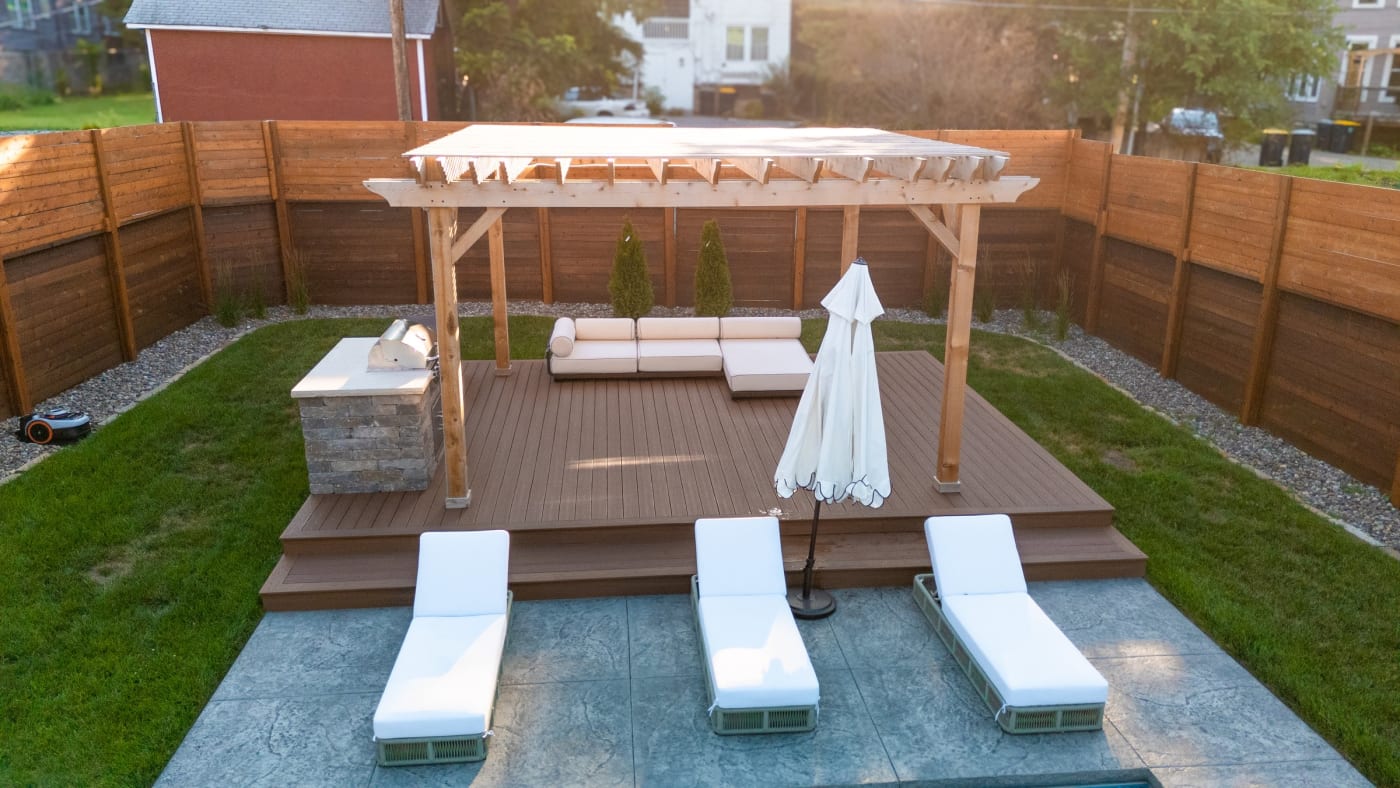
Decks come in essentially two materials: wood (with a handful of species choices) and composite (with a handful of brand choices). Within each, there are a few colors, and that is the design conversation.
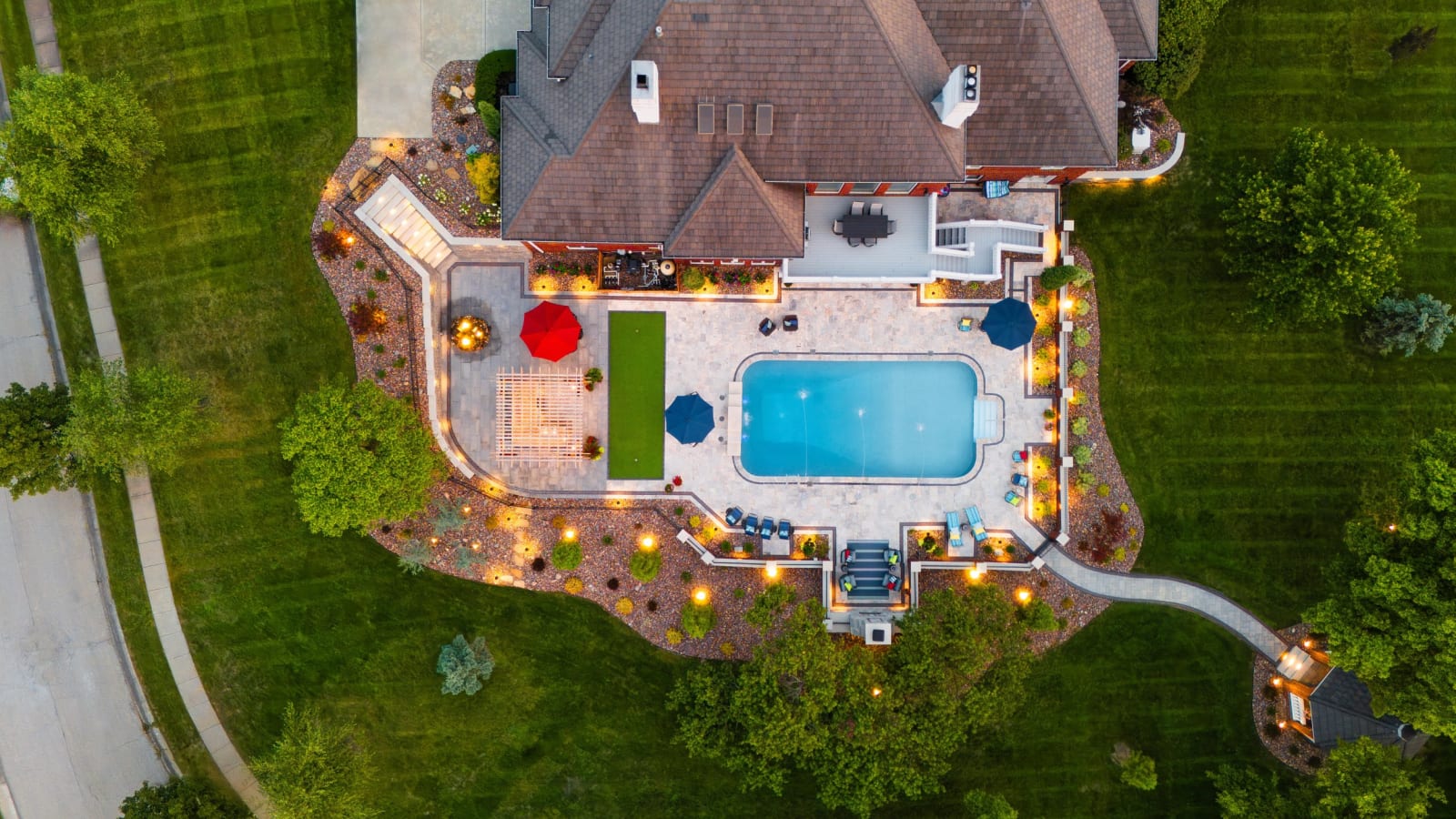
Patios open up a different scale of options entirely. Concrete pavers come in hundreds of styles, dozens of colors per style, and dozens of laying patterns within those. Travertine, bluestone, flagstone, and porcelain tile each open another whole library of choices. Borders, accents, mixed materials, custom shapes that follow the curve of a pool or the edge of a planting bed: a patio can be designed to match the architecture of the house in a way a deck cannot.
That matters more than it sounds. A patio that is genuinely designed for the home it lives behind looks intentional, settles into the yard the way it was meant to, and becomes a defining feature of the property rather than an obvious add-on. A deck, no matter how well built, mostly looks like a deck.
Both decks and patios add value to the home, and any halfway-decent real estate agent will tell you so when you list the property. The interesting part is which one returns more of what you spent.
Industry data has been remarkably consistent on this for over a decade. Decks return roughly 70 to 80 percent of their installed cost when the home sells. Patios return closer to 80 to 90 percent of theirs. On a $30,000 outdoor living project, that's $3,000 to $6,000 more equity recovered at sale time for the patio. And the longer the patio lasts (which is most of the reason for the difference), the wider that ROI gap becomes for homeowners who hold the house ten or more years.
The other side of the ROI conversation, the one nobody puts in a brochure: buyers respond to outdoor spaces that look move-in ready. A twelve-year-old patio still looks like a patio. A twelve-year-old deck looks like a project the next owner is going to have to deal with. That perception affects offers more than any spreadsheet.
We are not going to pretend a deck never makes sense. It does, in one specific situation: when the back door of the house is so far above grade that connecting it to a patio at ground level would mean a long staircase the homeowner has to descend every time they want to step outside. In that case, an elevated deck off the house is what gives you a usable outdoor space within ten feet of your kitchen.
The right move when the back door is high is often both: an elevated deck off the house for grilling and morning coffee, with a paver patio at grade for the actual hangout space and entertaining. Stairs between them, planted edges to soften the transition, and you get the best of each surface for what it does well. That is the project we build for most walkout-basement homes in the Kansas City metro.
For everything else, where the back door is at grade or only a step or two up, a patio is the right call. Build it once, walk on it for thirty years, and the maintenance budget you would have spent on a deck stays in your pocket.
Does a paver patio crack like concrete does? A poured concrete slab in Kansas City will crack within its first five to ten years almost without exception, because concrete is one continuous piece and our freeze-thaw cycle moves the ground under it. A paver patio is dozens or hundreds of individual stones that move independently. If one ever needs replacing for any reason, you pull it and put a new one in. The patio itself does not crack.
Can a patio sit right at the back door without issues? Yes, and this is one of the reasons patios feel better than decks for the way people actually move. You walk out the back door and you are on a finished floor that flows into the yard. With proper drainage planning (a slight slope away from the foundation, a French drain if the site needs it), water does not sit against the house, and the patio reads as an extension of the indoor floor.
How long does a paver patio actually last in Kansas City? Built on a properly compacted aggregate base with a concrete slab beneath, a paver patio in the KC metro should last 25 to 40 years with no real maintenance. Built on a thin scrim of sand or directly on dirt, by a contractor cutting corners on the part you'll never see, it might give you five to ten years before the surface starts sinking and shifting. The difference is entirely underneath, in the part of the project you cannot see after install day.
Is a deck cheaper to build than a patio of the same size? The first quote, yes. The full lifetime cost, no. A deck's initial price is lower; a patio's total cost over twenty years is lower. We've written about this same math at length in our hardscape contractors guide, which covers what these projects actually cost in Kansas City across every common type.
What kind of patio do you recommend for Kansas City weather? A paver patio built on a properly compacted aggregate base with a concrete slab on top. The slab carries the load, the aggregate handles drainage and movement, and the pavers on top are individually replaceable if anything ever happens to them. It is more expensive than a thin-base paver patio on day one and meaningfully cheaper over the life of the home.
At Kansas City Hardscapes we offer a variety of high quality patio options to homeowners across the Kansas City metro area. You can browse our portfolio, run your project through our cost calculator before you ever talk to us, or call us at (816) 499-2547 to start the conversation. Whichever route you take, we're glad you found us and we look forward to helping you turn your backyard into the space you actually wanted it to be.
Thirty minutes on site with our designer is all it takes to see what is possible. No pressure, no hard sell.
Schedule a Design Call