
Kansas City has dozens of hardscape contractors. Most quotes look similar on paper. And most homeowners only hire one of us, once or twice in a lifetime, with no real way to tell the careful builders from the fast ones. This is the guide we wish every homeowner had before their first quote landed in their inbox.
We are one of those contractors, so the bias is obvious. We'll be honest about it anyway. The decisions a homeowner makes before signing a hardscape contract are the difference between a yard that holds up for thirty years and one that needs a callback by year five. The hard part is that the things that decide which kind of project you got are all underneath the patio, in the contract, or in the fine print of a warranty most homeowners never see.
Here is what to look for, what to avoid, what these projects actually cost in Kansas City, and the questions that quietly separate good contractors from cheap ones.
Hardscape, defined the way Kansas City builds it.
Hardscape is the built-in, non-plant parts of an outdoor space. Patios, retaining walls, fire pits, fireplaces, pergolas, pavilions, outdoor kitchens, water features, stone veneer, and the walkways tying it all together. It is what stays after you pull every plant out of the yard.
The reason this matters in Kansas City specifically: our weather. The metro spends four to five months a year in a freeze and thaw cycle that pushes water in and out of every joint, base, and footing. A patio built for a milder climate, the way most contractors learned outside the Midwest, will not last here. Local material choices, base depth, and drainage decisions are not preferences. They are the difference between a patio that survives and one that does not.

What separates a good hardscape contractor from a cheap one.
Most quotes look similar. Stock photos, a square footage number, a total dollar amount. The differences live in places the quote does not show you. Ask for the following before you sign anything.
Licensed and insured, with proof you can verify.
A licensed contractor in Missouri or Kansas should hand you proof on request: a current license number, a certificate of insurance with general liability and worker's comp, and the name of the carrier. Worker's comp is the one most homeowners forget to ask about. If an uninsured laborer gets hurt on your property, the homeowner's insurance is what pays. Verify the insurance certificate is current, not expired.
A real portfolio of finished work in your area.
Stock photos do not count. Ask to see ten to twenty finished projects, all in the Kansas City metro, with the contractor's own photography. Better yet, ask for an address of one you can drive past. A contractor who has built thirty patios within ten miles of your house will show you. A contractor who has built three will dodge the question.
A real written contract, not a one-page invoice.
The contract should include: scope of work, materials specified by brand and product line, a payment schedule, a start window and rough completion date, who is responsible for which permits, a written warranty, and a process for change orders. A contractor who hands you a numbered estimate and asks for half down is not handing you a contract. They are handing you a payment request.
A warranty in writing, longer than one year.
Most hardscape contractors offer a one-year warranty because they have to. The good ones offer three to five years on workmanship, and they specify it in writing. The very good ones extend coverage on the engineered base, which is the part most likely to cause expensive problems if it fails. Read what is covered and what is excluded. "Acts of God" and "normal settling" are the loopholes you want to understand.
References you can actually call.
Ask for three references from projects completed at least two years ago. Recent customers are happy because nothing has had time to fail yet. The two-year mark is when corner-cutting starts to show. Read Google reviews too, but read the bad ones, not the good ones. A pattern of one-star reviews about callbacks and unresolved warranty claims is a louder signal than fifty five-star reviews.
An in-house crew, not subbed out.
The best hardscape companies build with their own employees, train them, and show up on the job every day. Companies that sub everything out lose control of the quality and disappear when there is a problem. Ask: who will be on my property every day, are they employees or subs, and who is the foreman responsible for the build. A vague answer is a real answer.
Itemized materials and labor.
A contractor confident in their work will show you what the materials cost and what the labor costs. A contractor who lump-sums the whole project is hiding either the markup, the materials, or both. You do not need a line item for every screw. You should be able to see roughly how the total breaks down.
The cheapest quote almost always wins by hiding the things that will frustrate you later.
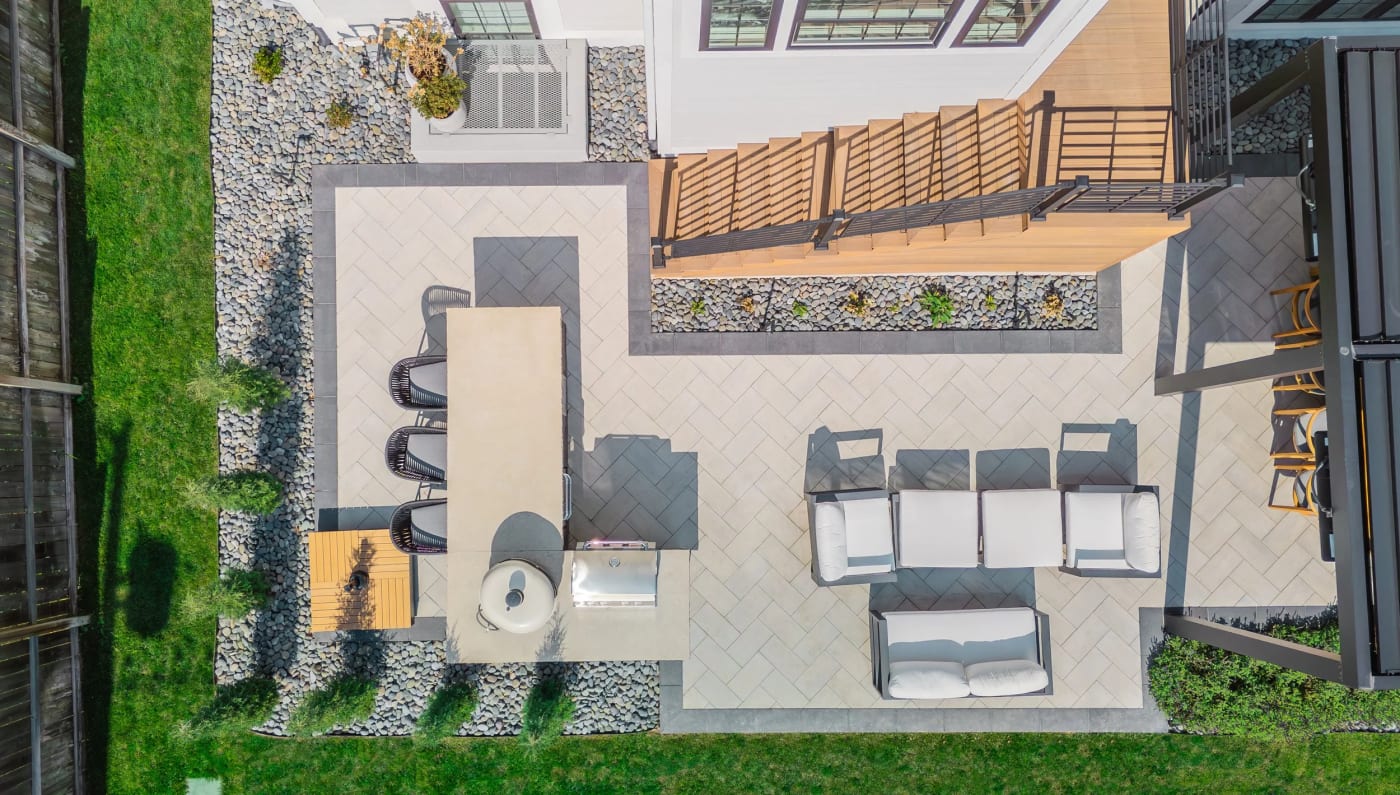
Real hardscape project ranges in Kansas City.
Numbers below are typical investment ranges for thoughtfully built projects in the Kansas City metro, taken from our own published pricing on each service. Most clients land inside the range listed; the floor is what a smaller, simpler version of the project starts at, and the ceiling is the higher-end builds with premium materials and larger scope.
For a more specific number, the cost calculator on our site walks through the variables and gives a real range for your project before you ever talk to us. For a deeper read on paver patio pricing specifically (the most common project we quote), see our dedicated paver patio cost guide for Kansas City.
Red flags that should end the conversation.
A few of these on their own can be explained. Two or three together usually mean the project will end badly. Trust your gut on these and walk if you see them.
- Cash discount pressure. A real contractor accepts cards, checks, and bank transfers. A 20 percent cash discount almost always means no insurance, no warranty record, and no paper trail when something goes wrong.
- No physical address you can drive to. A shop you can visit means the company exists in a real place with real overhead. A PO box and a cell number means they can close up and disappear.
- The quote is hand-written on a notepad. A professional quote arrives as a real document, usually through a tool like PandaDoc or DocuSign, with itemized materials, broken-out labor, and the company's information clearly listed. A scratched-out total on a legal pad means the contractor is hoping you will not pay attention.
- "We can start Monday." Good hardscape contractors in Kansas City are booked four to six weeks out in spring and summer. A company with immediate availability either just finished a project that ended poorly or does not have enough work to be busy. Both are bad signs.
- Won't put the warranty in writing. A verbal warranty is worth what verbal contracts are worth. If the contractor will not write the warranty into the contract, the warranty does not exist.
- Demands more than 50 percent down. Industry standard for hardscape work is a deposit between 10 and 30 percent at signing, with progress payments tied to milestones. Anyone asking for 70 or 100 percent up front is asking you to fund their other jobs.
- The estimate is dramatically below the other two. Most quotes for the same project should land within 15 to 25 percent of each other. A quote 40 percent below the others is missing materials, missing labor, or is going to come back as change orders the moment the work starts.
- Subs everything out without telling you. Some subbing is normal for specialty work like electrical or plumbing. Subbing the entire build, especially the base prep, is a quality control problem dressed up as a business model.
Hire a hardscape contractor, not a landscaper.
The biggest hiring mistake we see in Kansas City is not picking the wrong hardscape contractor. It is picking a landscaper to do hardscape work. The two trades look related from a homeowner's perspective. They share the backyard. They show up in the same advertising. Plenty of landscape companies will quote your patio happily. They are not the same trade and the work is not the same work.
Landscaping is plants, lawn, mulch, irrigation, seasonal cleanup. The skills are about living systems: which trees survive the soil, when to prune, how to keep the turf green. A great landscaper in Kansas City is a real expert at all of that.
Hardscape is engineering. The base under the patio, the compaction depth, the drainage plane, the way the stone is set so it does not move when the ground does, the way a retaining wall resists thousands of pounds of soil pressure for thirty years. The skills are about geometry, materials science, and crews who have laid a few hundred patios. A landscaper offering hardscape as a side service almost always cuts the part you cannot see: the base. The patio looks great on day one. By winter three it tells a different story.
The simple test: ask how much of the company's revenue comes from hardscape versus plant work. If hardscape is most of it, you are talking to a hardscape company. If it is a smaller side of a larger landscape business, you are talking to a landscaper who builds patios when the calendar has room.
The thing nobody tells you: what happens when something needs attention later.
Even the most carefully built hardscapes can have a thing happen to them. A tree root grows under a corner of the patio. A delivery truck clips a wall. A joint shifts after an unusually wet winter. A paver chips because someone dropped a smoker on it. Honest base prep and good materials make these moments rarer. They do not make them impossible. Everyone in this business who tells you otherwise is selling you something.
What separates a contractor worth keeping is what happens when one of those moments comes. Most homeowners discover, two or three years after the install, that their original contractor is hard to reach. Busy with new work. Has stopped returning calls about old projects entirely. The industry has a name for this. The homeowners on the other end of it call it ghosting.
We do it differently. One person on our crew has a single, dedicated job: punchlist. He drives to past projects, tends to the things that need tending, and treats every callback as a real job instead of an interruption to a new build. Six months after we finished your patio, six years after, his job is the same. We are still here. You can still reach us. That is part of what you are buying when you sign a contract with a real Kansas City hardscape company instead of a number you found on a flyer.
We will not ghost you. We are here for you long after your patio is complete.
Eight questions to bring to every estimate meeting.
If you ask these and the answers feel evasive, you have your answer about the contractor.
- What is going under my patio, exactly, and how deep?
- Is the crew that builds my project employees of your company or subs?
- Who is the foreman on my project, and will I have their phone number?
- What is the warranty, and what specifically is excluded?
- Can I see two or three projects you finished two or more years ago?
- How is drainage handled at the edge of the patio?
- What happens if the project takes longer than the start window in the contract?
- What is your process for change orders, and how do you price them?
None of these questions are gotchas. A good contractor will answer all eight without hesitation. A bad one will give a different answer at the second meeting than they did at the first.