The Journal · Field Notes
Almost every backyard project starts the same way. The homeowner calls the landscape company that already cuts their grass and asks whether they can put in a patio. Sometimes the answer is yes. The patio gets built. Two years later, edges have settled, joints have weeds, and the surface is uneven. The homeowner calls us to fix it, and we have to explain that the only real fix is to rip it out and start over. This post is not about landscape companies being bad at what they do. They are usually excellent at what they do. The point is that what they do is not what we do, and the difference matters more on a hardscape than most homeowners realize until it is too late.
Landscape work is everything that grows and breathes. Lawns, beds, plants, trees, irrigation systems, fertilization, mulch, seasonal cleanup. A landscape company spends every day understanding soil chemistry, plant biology, water cycles, and seasonal care.
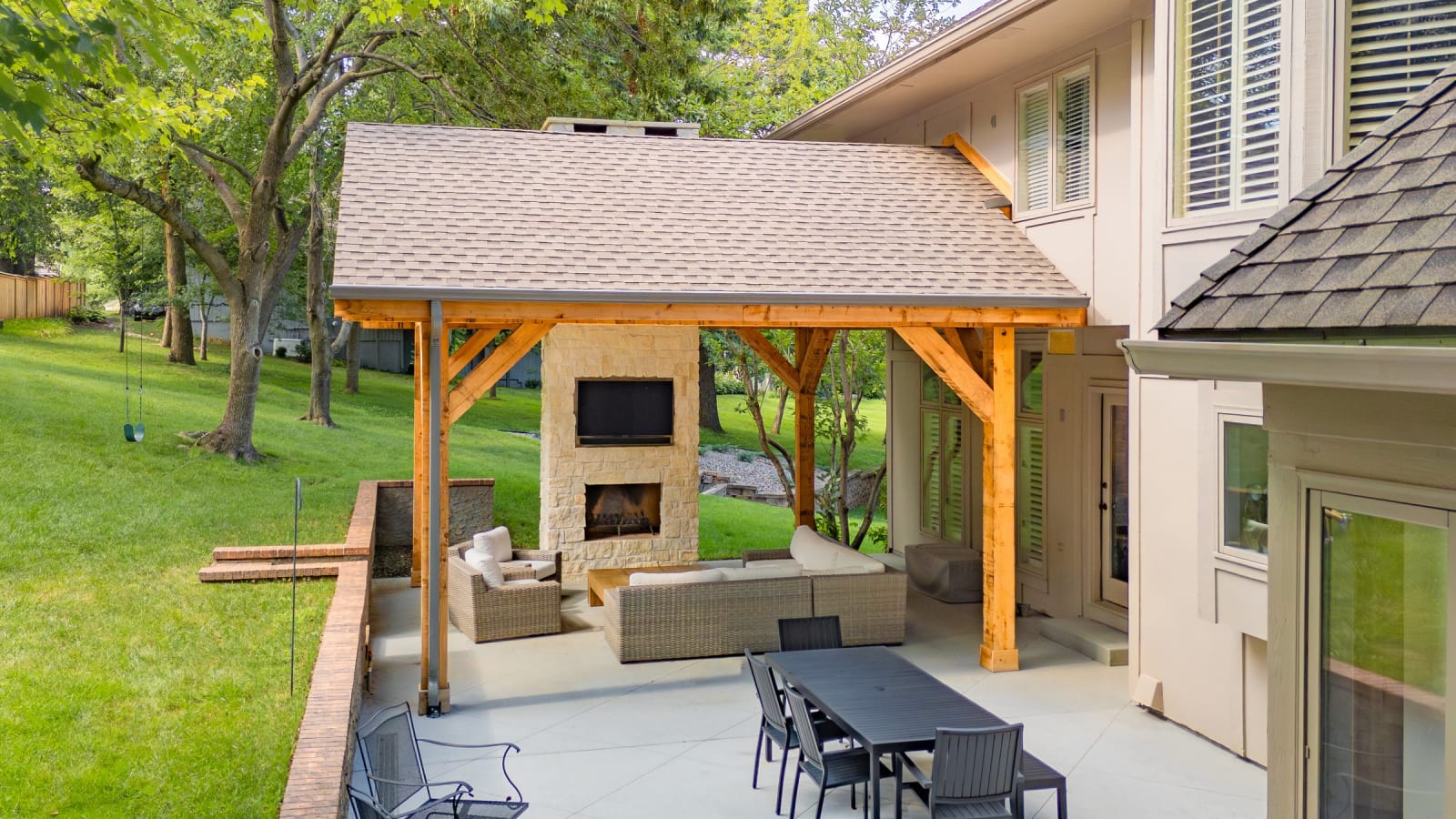
Hardscape work is everything built from stone, concrete, brick, paver, and timber. Patios, retaining walls, fire features, pergolas, outdoor kitchens, driveways. A hardscape contractor spends every day understanding base preparation, drainage, structural engineering, freeze-thaw cycles, mortar chemistry, and load-bearing construction.
The two skill sets overlap less than they appear from the outside. A skilled lawn-care crew is not a skilled paver crew. A skilled stonemason is not a skilled horticulturist. We do not cut grass or install irrigation, because we are not good at it. Most landscape companies that build patios are equally honest about which is their primary craft. But the homeowner does not always know to ask.
The most important things about a hardscape live below the surface, where homeowners never look and inexperienced crews routinely cut corners. A short list of what a real hardscape crew knows cold.
Base preparation. The right depth (6 to 12 inches depending on use), the right material (Class 2 graded crushed aggregate, not random fill), the right method (placed in 2 to 3 inch lifts and compacted between each lift, not dumped and rolled once). We wrote a full post on exactly how we prepare the ground.
Drainage. A hardscape sloped 1/8 to 1/4 inch per foot away from the home, with the slope built into every layer from subgrade up, not just the surface. Geotextile fabric between clay and gravel base.
Joints and edges. Polymeric sand, not plain joint sand. Edge restraint properly spiked, not concrete bond. The right paver setting bed material (sharp angular sand, not playground sand).
Freeze-thaw considerations. Kansas City's freeze line is 36 to 42 inches deep. Footings for permanent structures (pergola posts, fireplaces) go below the freeze line, or they heave and crack with the seasons. Mortar joints in stone work need movement allowance.
Concrete and stone chemistry. When to add accelerator, when to add air entrainment, when to use sand-cement versus type-S mortar, when stone needs to be sealed and when it does not.
A typical landscape crew that does occasional patios will know some of this and miss other parts. The patio they build looks fine for the first 18 months. The problems start in year two.
A real hardscape operation owns equipment a landscape company has no reason to invest in.
Plate compactors of different sizes. Concrete saws. Paver splitters. Masonry mixers. Skid steers with hardscape attachments. Truck-bed compactors. Mortar sprayers. Stone-cutting wet saws. Laser levels. Total stations for large-grade work.
A landscape crew showing up to install a patio with a rented plate compactor and a hand-held grinder is not under-equipped because they are cheap. They are under-equipped because the equipment costs more than the volume of hardscape work justifies for their business. The same is true in reverse. We do not own a fleet of mowers because we do not mow lawns.
The patio you get is partly a function of the equipment used to build it.
Hardscape construction has a sequence that matters. Demo. Excavation. Subgrade prep. Geotextile. Base in lifts. Compaction. Setting bed. Pavers. Edge restraint. Polymeric sand. Cure. Each step depends on the previous one being right. Skip a step or do it out of order and the patio fails, sometimes invisibly.
Landscape companies that take on occasional hardscape projects often have to schedule them around their core business (mowing, spring cleanup, irrigation startup, fall leaves). The hardscape project pauses for two days when storms put the crew behind on lawn work. The base sits exposed to rain. The compactor goes back to the rental place. The schedule extends from a planned 10 days to 4 weeks.
A dedicated hardscape crew runs the project to completion because hardscape is the only thing on their calendar. The patio gets built in the time it should take, not the time the lawn schedule allows.
The administrative side of the question is also real.
Insurance. A landscape company carries general liability and worker's comp scoped to lawn and garden work. Building a hardscape involves different risks: heavy equipment, deep excavations, structural construction, working below grade. The policies need to match the work. A landscape contractor's policy may not cover a hardscape claim.
Licensing and certification. ICPI (Interlocking Concrete Pavement Institute) certification is the industry credential for paver installers. A real hardscape contractor maintains ICPI certification on their crew. Belgard, Unilock, and Techo-Bloc all offer manufacturer-specific training programs that give installer certifications for warranty eligibility. Most landscape companies that occasionally do patios do not maintain these credentials.
Warranty. Manufacturer paver warranties (often 25 years to lifetime) are only valid when the pavers are installed by a manufacturer-certified contractor. A landscape crew that installs the same pavers without certification voids the manufacturer warranty. The homeowner does not find this out until something goes wrong.
A few specific questions and signals that separate a serious hardscape contractor from a side-business one. Use these whether you are evaluating us, a competitor, or a landscape company offering to do the work.
Ask to see a portfolio of completed hardscape projects. A real hardscape contractor has dozens to hundreds. A landscape company offering hardscape services often has 3 to 10. Look at the photos. Look at the joint lines, the edge work, the seating wall caps, the transitions between materials. The details show the experience.
Ask about the proposal's base prep specs. A serious quote will name the base depth, the compaction method, the geotextile fabric, the setting bed material, and the edge restraint type. A vague quote that says "install patio for $X" with no specifications is a red flag.
Ask about ICPI certification. Real hardscape contractors maintain it. Real hardscape contractors are also willing to show you their certifications.
Ask about manufacturer training. Belgard, Unilock, and Techo-Bloc all maintain authorized contractor programs. Ask which the contractor is authorized through and at what level.
Read recent Google reviews carefully. Filter for hardscape-specific reviews. Look for mentions of patio settling, drainage problems, or repair callbacks. A pattern of complaints about hardscape projects from an otherwise well-reviewed company is a tell.
Ask about insurance specifically scoped to hardscape construction. Get a certificate of insurance and check that the policy covers the type of work being done.
To be clear, there are many things landscape companies do better than we do.
Lawn care, fertilization, and aeration. Specialty work that requires equipment, knowledge, and crews we do not maintain.
Plant selection and installation. A good landscape designer brings horticulture knowledge to the project that we do not.
Irrigation system design and installation. Specialized trade requiring its own certifications.
Seasonal cleanup, spring prep, fall leaves. Recurring maintenance work that fits a landscape company's schedule.
Tree work, pruning, removal. Often subcontracted to arborists by both us and by landscape companies, but landscape companies have these relationships set up.
A good outdoor living project often involves both a hardscape contractor and a landscape designer working together. We do the patio, the walls, the fire feature, the pergola. The landscape company does the beds, the plants, the irrigation, and the long-term care. Each company brings expertise in their specialty.
We coordinate with several quality landscape companies in the Kansas City Metro and are happy to make referrals.
One reason homeowners pick a landscape company over a hardscape contractor is price. The landscape company's quote is often 20 to 30 percent less than ours. The reason is that they are pricing the project from a different cost basis: rented equipment instead of owned, occasional installation instead of full-time crew, simpler base prep that meets the minimum visual standard rather than the proper structural standard.
Sometimes that price gap reflects actual savings on a project that did not need the extra rigor. Often it reflects a patio that will need to be redone in 3 to 5 years.
The math we have seen play out over and over: a $25,000 patio that costs $32,000 done right and $25,000 done by a less-specialized crew. Five years later the cheaper patio needs $15,000 of work to fix or $30,000 to replace. The "savings" disappear, and the homeowner has lived with a deteriorating patio for half a decade.
We have rebuilt enough of these to know the pattern. Cheaper is not always cheaper, when the work that gets cut is the work nobody can see.
My current landscape company has done patios before. Can I trust their work? Sometimes yes, especially if their portfolio is strong and they have specific hardscape crew dedicated to it. Many landscape companies have evolved into hybrid operations. Ask the questions above, look at the portfolio, and decide based on the evidence rather than the relationship.
What if I want a single contractor to do both? A few hybrid operations in the metro do both well. More commonly, you will get one done well and the other done as an afterthought. Coordinating two specialists usually produces a better result than a one-stop shop trying to be everything.
Will a landscape company void my paver warranty? Possibly. Check the manufacturer's warranty terms. Many require installation by a certified contractor for the warranty to be valid.
Can you fix a patio installed by someone else? Sometimes. If the base is the problem, the only real fix is rebuild. If the surface is the issue, occasional repairs are possible.
Do you offer landscape services if I want to bundle? No. We do hardscape only. We partner with landscape companies and are happy to recommend them.
How long has Kansas City Hardscapes been doing this? Over a decade. Hardscape is the only thing we do. Every crew member spends every working day on hardscape projects.
If you are planning a patio, retaining wall, fire feature, pergola, or any hardscape in the Kansas City metro and want a contractor whose only job is hardscape, we are glad to walk the property with you. If you also need landscape work as part of the project, we will coordinate with a landscape partner so each piece gets handled by the right specialist. Call us at 816-499-2547 or book a free consultation through the Get Started page.
Thirty minutes on site with our designer is all it takes to see what is possible. No pressure, no hard sell.
Schedule a Design Call