The Journal · Field Notes
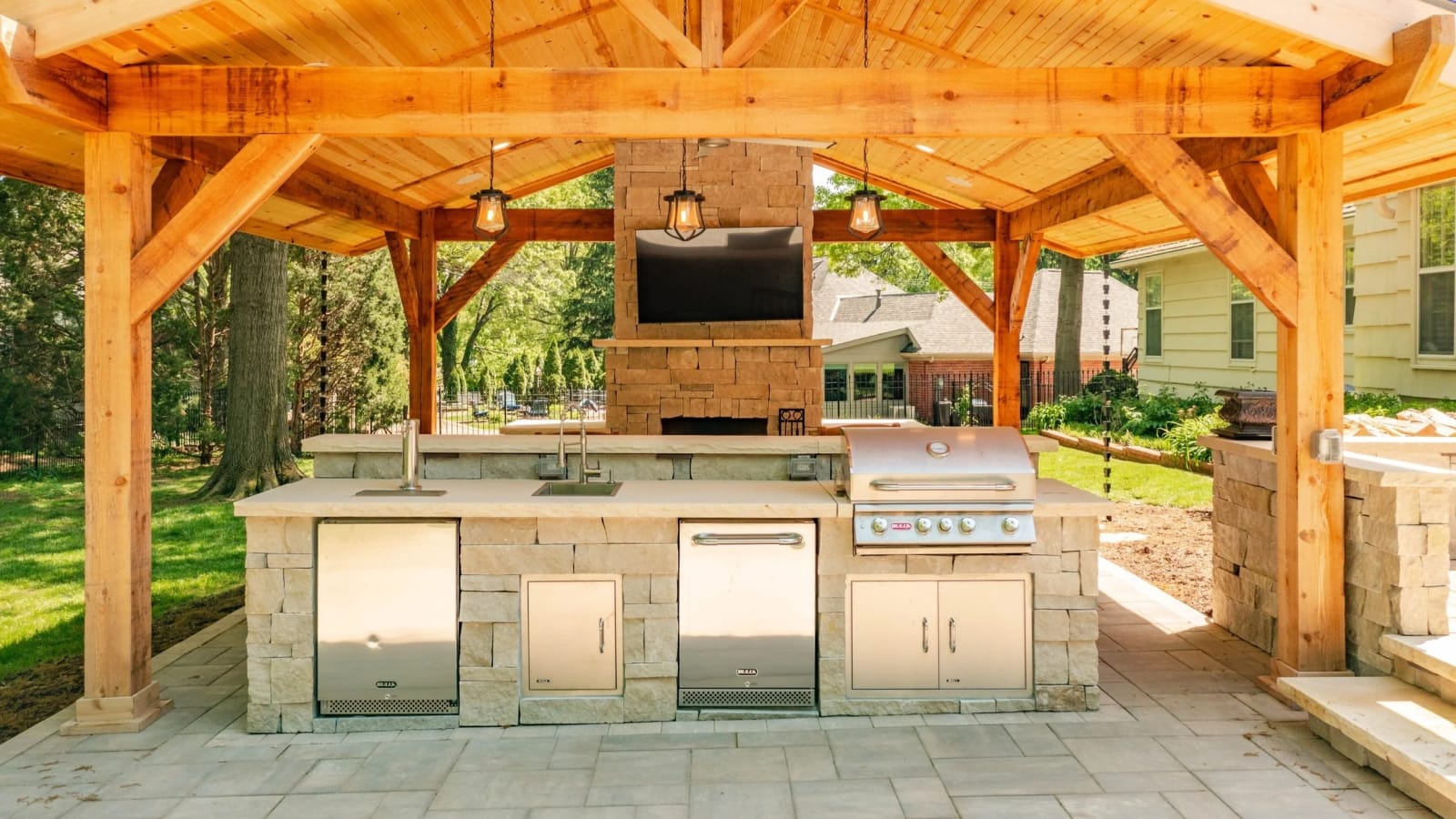
Outdoor kitchens are one of our favorite things to build and also the feature we counsel homeowners about most carefully before they commit. The reason is simple. A well-designed outdoor kitchen owned by someone who actually cooks outside is a remarkable thing. A premium outdoor kitchen owned by someone who grills six times a year is the largest single piece of regret on the patio. Over the past ten years building outdoor kitchens across the Kansas City Metro, we have seen both extremes. Below is the honest framework for figuring out which kind of homeowner you are, what to spec, what to skip, and how to plan a kitchen that will still feel like the right call ten years from now.
Before you spec the grill, the pizza oven, the refrigerator, or the bar, answer one question. How many times a year will you actually cook on this kitchen?
If the answer is 30+ meals a year, including the shoulder seasons and a few cold-weather grills, build a real kitchen. The appliances will earn their keep. The investment makes sense.
If the answer is 10 to 25 meals a year, build a grill island. Grill, side burner, counter space, maybe a small refrigerator for drinks. That is enough. Anything more sits unused most of the time.
If the answer is under 10 meals a year, build a beautiful grill area with no built-in kitchen. A freestanding premium grill on a stone pad, with a counter nearby, will give you 80 percent of the experience with none of the regret.
We have rebuilt enough five-year-old outdoor kitchens for clients to know that the wrong-sized kitchen is the single most expensive hardscape mistake. Too small is fixable. Too big is rip-out-and-redo.
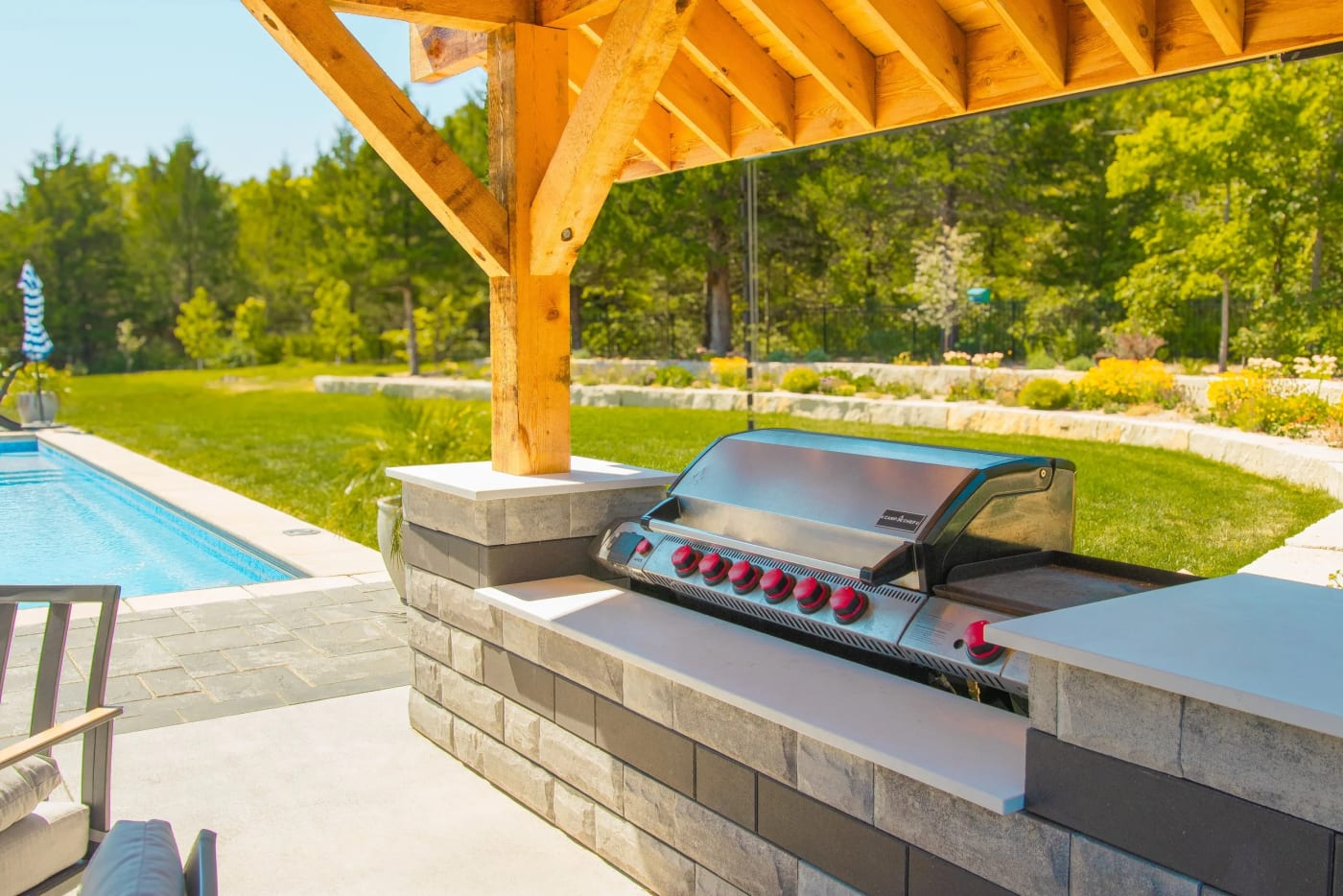
Almost every outdoor kitchen we build falls into one of three sizes.
Grill island (8 to 12 linear feet of counter). A masonry base, premium built-in grill, gas line, side burner, counter space on both sides of the grill, often a small refrigerator. Big enough to cook for 4 to 8 people comfortably. Compact enough to fit on most patios without dominating them. The most common build in our market.
Full outdoor kitchen (14 to 20 linear feet). Grill, side burner, refrigerator, sink with running water, counter space, bar overhang for seating, sometimes a small pizza oven or warming drawer. Cooks for parties of 12 to 20. Becomes a real entertaining space, not just a grill upgrade.
Premium outdoor kitchen (20+ linear feet). Grill with hood, pizza oven, refrigerator, ice maker, sink, dishwasher, premium counter, bar with stools, sometimes a kegerator or beverage center. The kind of kitchen a homeowner will use as the primary cooking space from April through October.
Pick the size honestly. Most clients try to build the premium kitchen and end up wishing they had built a full kitchen with the money saved spent on better surrounding hardscape.
Whatever the size, layout decides whether the kitchen actually works.
Triangle the work zones. Grill, sink, refrigerator. The same triangle that organizes an indoor kitchen organizes an outdoor one. Keep them within 6 to 10 feet of each other so the cook is not walking 15 feet between every step.
Counter on both sides of the grill. Minimum 18 inches on each side. 24+ inches is better. A grill with no counter beside it makes basic cooking miserable.
Bar height versus counter height. Counters are 36 inches. Bars are 42. If you build a bar with stools facing the cook, raise that section to 42 inches so guests are at eye level with the cook.
Traffic flow. Position the kitchen so guests do not walk through the cook's work zone to get to the rest of the patio. The cook should be on the perimeter, not in the middle of the path.
Wind direction. Smoke blows where the wind takes it. Site the grill so prevailing summer winds carry smoke away from the seating area and away from the house. In Kansas City, prevailing summer wind is from the south and west.
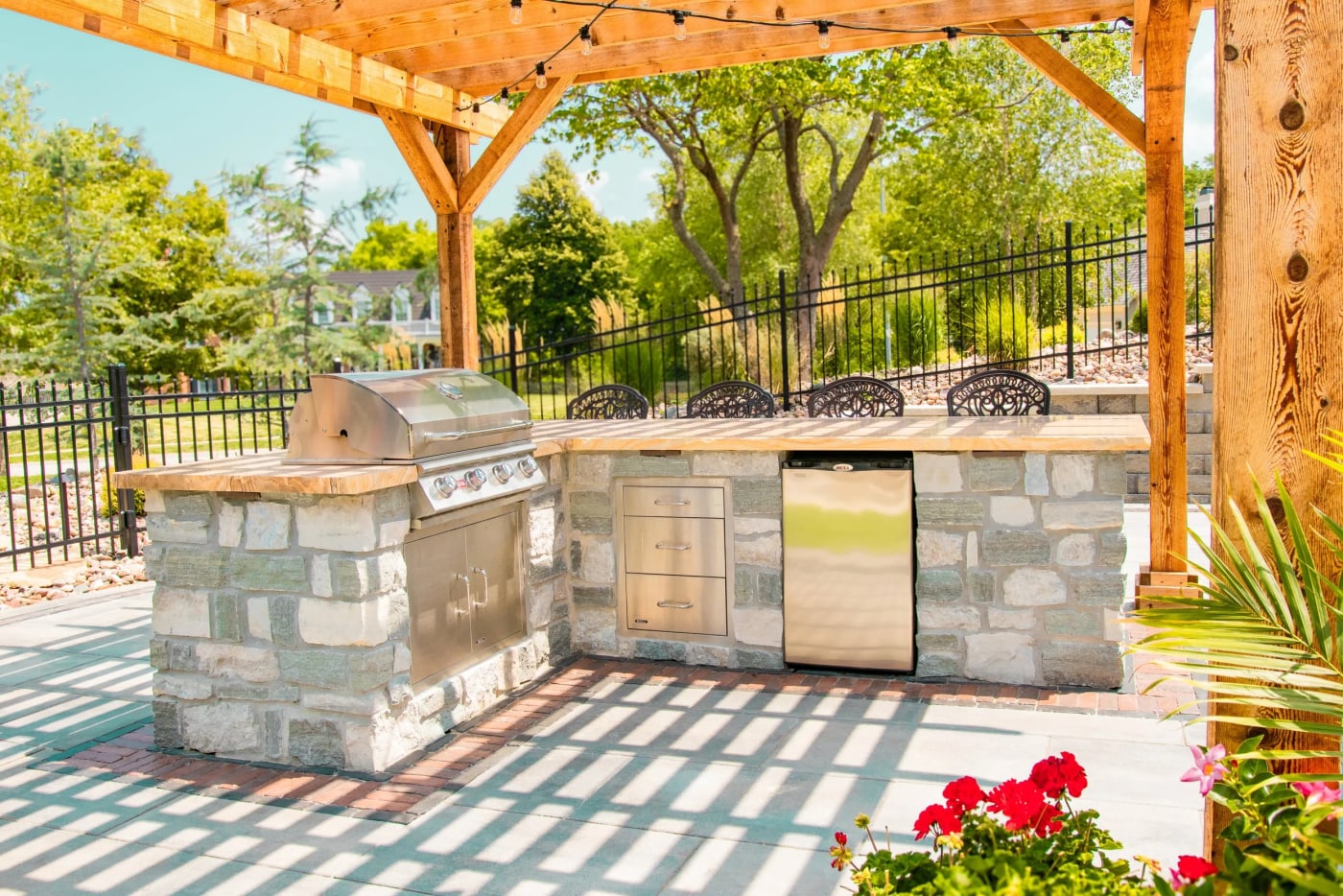
Not every appliance is worth the money. Here is our ranking from highest-value to most-regretted.
Built-in grill. Non-negotiable. Spend on quality (Lynx, DCS, Hestan, Twin Eagles, or Coyote). Cheap built-in grills fail in 3 to 5 years in our climate and replacing them after the surround is built is expensive.
Side burner. High value. Boiling water, simmering sauces, frying. Costs $400 to $1,200. Easy yes.
Refrigerator. High value if you actually entertain. Outdoor-rated, weatherproof, with a real seal. Indoor refrigerators do not survive a Kansas City winter outdoors, so do not buy a standard fridge and assume it will work.
Sink with running water. Medium-high value. Useful for rinsing produce, washing hands, cleaning prep tools. Requires a water line and a drain, which adds plumbing cost. Worth it on full kitchens.
Pizza oven. Conditional. Great for clients who actually make pizza monthly. Expensive ($5,000 to $18,000) and regrettable for clients who use it twice a year. We recommend a $400 to $700 portable Ooni or similar tabletop oven first to see if you actually use it before building one in.
Ice maker. Low value for most. A small countertop unit indoors covers 95 percent of needs. Built-in outdoor ice makers fail more often than other appliances. We rarely recommend them.
Warming drawer. Low value. The grill keeps food warm just fine.
Dishwasher. Low value. The dish trip indoors is one minute and the indoor dishwasher is right there.
Kegerator. High value for clients who actually drink draft beer regularly. Otherwise a $3,000 piece of equipment for occasional use.
Storage cabinets and drawers. Medium value. Outdoor-rated stainless storage costs more than the indoor equivalent and is useful but not essential.
The countertop is the surface you will see, touch, and clean most. Get the material right.
Granite. The default for outdoor kitchens. Beautiful, heat-resistant, holds up to weather, repels stains when sealed. Needs resealing every 2 to 3 years. Runs $50 to $90 per square foot installed.
Quartzite (natural, not engineered quartz). Similar to granite, often more dramatic patterns, slightly harder, holds up well outdoors. $70 to $120 per square foot installed.
Engineered quartz. Looks like granite or quartzite. Do not use it outdoors. The resin binder yellows and degrades under UV, and most manufacturers void warranty for outdoor installations.
Soapstone. Beautiful, soft, will scratch and patina. Right for clients who love the look of well-worn stone and accept the marks.
Stained or polished concrete. A workable budget option ($30 to $50 per square foot installed). Develops cracks over years. Sealing is essential.
Porcelain slab. New material in our market. Comes in large pieces, UV-stable, stain-proof, no sealing required. Premium price ($90 to $150 per square foot installed) but lower lifetime maintenance.
An outdoor kitchen is plumbed, gassed, and wired. The utility runs decide what is possible and what is not.
Gas. A 1/2 to 3/4 inch gas line runs from the home's main, sized for the BTU load of every appliance on the kitchen. We use natural gas wherever the house has it and switch to liquid propane only when natural gas is unavailable. Permits and a licensed gas fitter required.
Water and drainage. A sink needs a water line in and a drain line out. The drain runs either to the home's sewer or to a dedicated grey water line. We freeze-rate the lines for winter and install a shutoff inside the house so the kitchen can be drained before hard freezes.
Electrical. Multiple GFCI outlets, dedicated circuits for the refrigerator and any high-draw appliances, and lighting circuits. All in conduit, all to code.
Drainage of the counter surface. The counter slopes very slightly away from the working surface so spills shed instead of pooling.
Plan utility runs at the design stage. Adding plumbing or gas after the patio is built is dramatically more expensive than installing it during construction.

Cooking under direct Kansas City August sun at 3 p.m. is a punishment. Most of our outdoor kitchens get integrated shade.
Pergola overhead is the most common solution. Open rafters or closely-spaced slats filter the sun while letting heat and smoke rise. Pairs naturally with the kitchen. We covered pergola design in detail in this post.
Pavilion is the upgrade. A solid roof keeps cooking dry and shaded year-round. Right for clients who want to grill in winter. The pavilion's roof needs to be high enough (10+ feet) so smoke can rise and clear without staining the ceiling.
Retractable awning is a compromise. Works for shading the cook on demand. Less integrated into the architecture.
Whatever the structure, the grill exhaust matters. A grill with a hood (built into a covered structure) requires real ventilation. We design exhaust paths carefully to keep smoke out of seating areas.
Outdoor kitchens need task lighting that the rest of the patio does not.
Under-counter task lights. LED strips mounted to the underside of the bar overhang, casting light onto the working counter without glaring at guests. Critical for cooking after sundown.
Above-grill lighting. Most premium grills have built-in halogen or LED lights that illuminate the grates. Worth specifying.
Pendant lights over the bar. Where seating exists, pendants at 36 to 40 inches above the counter make the bar feel like a real entertainment space at night.
Ambient light from the surrounding patio. General light from step lights, wall washes, and tree uplights. The kitchen does not need to be bright in itself, just lit enough to work safely.
Wire all of this on a dimmer. Full bright for cooking, low and warm for entertaining.
Per the service page: outdoor kitchens at Kansas City Hardscapes start around $11,900, with most clients investing $12,000 to $22,000 for a full kitchen build.
Premium kitchens with pizza ovens, hoods, ice makers, and integrated stone work run $22,000 to $50,000+.
What drives cost up: stainless versus standard appliances, granite or quartzite countertops versus stained concrete, gas line distance from the main, water and drain lines for the sink, electrical for outlets and lighting, integration into existing finished hardscape, and any pavilion or pergola structure overhead.
What keeps cost down: planning the kitchen at the same time as the patio (utility runs are dramatically cheaper during the patio build), choosing one well-spec'd zone rather than three half-built ones, and selecting one or two premium appliances rather than every appliance at the high end.
What grill brands do you recommend? Lynx, DCS, Hestan, Twin Eagles, and Coyote are the brands we install most. Each has a different price point and feature set. We help you pick based on cooking style and budget.
Can I use my existing grill? If it is a freestanding cart grill, no, because a cart grill is not designed to be enclosed in a counter and will overheat the surround. If it is a true built-in grill from a quality brand, sometimes yes.
Does an outdoor kitchen add value to the home? Yes, but it depends on the buyer. In neighborhoods where outdoor entertaining is the norm (Leawood, Mission Hills, Prairie Village), a quality outdoor kitchen returns 60 to 80 percent of its cost at resale. In neighborhoods where it is unusual, the return is lower.
Will it work in winter? Yes, with proper winterization. The grill works year-round on gas. The refrigerator should be drained or kept on (manufacturer's recommendation). The sink needs to be drained before each hard freeze. Many of our clients grill on cold-but-clear winter days.
Can you build into an existing patio? Yes, but it costs more because utilities have to be retrofitted under or beside the existing patio. Better to plan it during the original build.
How long does construction take? A grill island is typically 1 to 2 weeks. A full outdoor kitchen is 3 to 5 weeks. A premium kitchen with hood and integrated pavilion is 6 to 10 weeks.
Will you maintain it for me? We are not a maintenance service, but we are happy to recommend trusted local pros for grill cleaning, stone resealing, and seasonal winterization.
If you are planning an outdoor kitchen for a Kansas City backyard and want help thinking through the right size for how you actually cook and entertain, we are glad to walk the property with you and design something honest to your life. We bring appliance specs, counter samples, and 3D renderings to every design meeting so you can see the kitchen before we build it. Call us at 816-499-2547 or book a free consultation through the Get Started page.
Thirty minutes on site with our designer is all it takes to see what is possible. No pressure, no hard sell.
Schedule a Design Call