The Journal · Field Notes
There are many differences between stamped concrete and pavers, and most people don't really understand them, so I wanted to lay out the 5 major reasons why stamped concrete sucks and why pavers are a ton better and actually more economical when you look at the price you pay over a 5+ year time span. I've been building both for ten years across the Kansas City metro, and the pattern is consistent. The stamped concrete patio that looked great in year one is the same patio I get called back to repair in year five. I can't really fix it. That's the problem.
Stamped concrete is a concrete slab, so it cracks, just like concrete. Why? Because it IS concrete. There's nothing over the top of it, and there's no way to fix a cracked stamped concrete patio where you can't see the crack due to the pattern that it is stamped in. It just has to remain cracked until you take out the patio and have it re-installed.
It's worse in Kansas City than in most places because of the freeze-thaw cycle. From November through March our ground temperature swings up and down by thirty or forty degrees, sometimes in a single week. The concrete moves with the ground. A good contractor cuts control joints into the slab to give the cracks a place to happen along a clean line, but on stamped concrete those joints cut right through the pattern that's supposed to look like pavers. So you end up with two kinds of lines: the fake paver lines stamped into the surface, and the real control joints fighting them. And when a crack happens somewhere off the control joint (which it eventually will), it cuts diagonally through the pattern and you've got a permanent eyesore.

Contractors that specialize in stamped concrete won't mention this, but your patio will look great, sometimes amazing when done by a really good company, for about 3 to 5 years (if you seal it every year). But after that it fades fast and looks really old. If you don't seal it every year, it will probably only look good for 2 or 3 years.
Pavers, on the other hand, don't hardly fade at all. Most people say their pavers lasted at least 10-15 years before they noticed any fading.
The reason for the difference is in how the color is applied. Stamped concrete gets its color two ways: an integral color mixed into the concrete itself, and a surface color released onto the stamping mat during the install. The integral color stays. The surface color walks off, fades in the sun, washes off in the rain, and within a few years the patio looks noticeably less rich than the day it was poured. To slow that down you have to re-seal with a color top-coat every two or three years for the rest of the patio's life. Real pavers don't have a surface color. The color of a paver is the color of the paver, all the way through. There's nothing to fade off because the color isn't sitting on top of anything.
Really slick. Slick like people will fall down and hurt themselves slick. Not every day, but a couple times per year someone will fall, and they might sprain a wrist, break an elbow, etc. This is why you shouldn't put stamped concrete around a pool. Too many slip and falls by kids and adults as well. But it will also be slick from morning dew and anytime it rains.
This is the part homeowners don't think about until it happens to them. Stamped concrete has a smooth finish across the whole surface, broken only by the shallow lines stamped to look like paver joints. Water sits on that smooth finish. Add a slight slope toward the pool or a downpour overnight, and the patio behaves like a sheet of wet glass. We've had to deal with slip-and-fall liability after the fact more than a few times when previous contractors put stamped around a pool. Pavers have textured surfaces and joints that drain water down between the stones, which is most of why they're the standard around pools and any patio surface that gets regularly wet.
It will have cracks and it will have faded, but it will still be a usable patio. It won't look like the day after it was installed, but it will still be a concrete patio.
If you want to know what 12 year old stamped concrete looks like, then go look at Nebraska Furniture Mart's front door area. It was installed in 2004 and it's now faded to a pink color (must have been red at some point), it's cracked, and chipping off in a lot of places. Now go look at any paver sidewalk or parking lot of the same age. You'll see some minor fading if you had a new paver in your hand to compare it to, but other than that, it probably looks great, assuming it was installed correctly. There are some installers who do a poor job and the pavers don't look great, but the majority of companies around KC do a great job.
"Usable" doesn't mean "you'll be proud of it." After year ten most homeowners stop having people over on the patio because they're embarrassed by how it looks, even though the patio still functions. That's the part that doesn't show up in the manufacturer's literature.
Not much choice or design options really. Some hardscape companies will tell you that there are 20 colors and 30 patterns, but that's only if you include the reds, yellows, blues, etc, which no one uses except preschools and daycares.
Everyone either gets light brown, brown, dark brown, light gray, or dark gray. And most people get the choice between Ashlar Slate and Monster Slate on the patterns. That's really the choices. Those choices actually look really nice, but it's nowhere near the options that pavers give you.
With pavers you've got hundreds of styles, dozens of colors per style, multiple textures, multiple sizes, and dozens of laying patterns you can mix within a single project. You can do a border in one color and a field in another. You can pull a paver color that matches the brick on your house. You can use the same paver in two different sizes for visual rhythm. That kind of design flexibility just doesn't exist with stamped concrete, which is locked into whatever five patterns the manufacturer cut into the rubber mats.
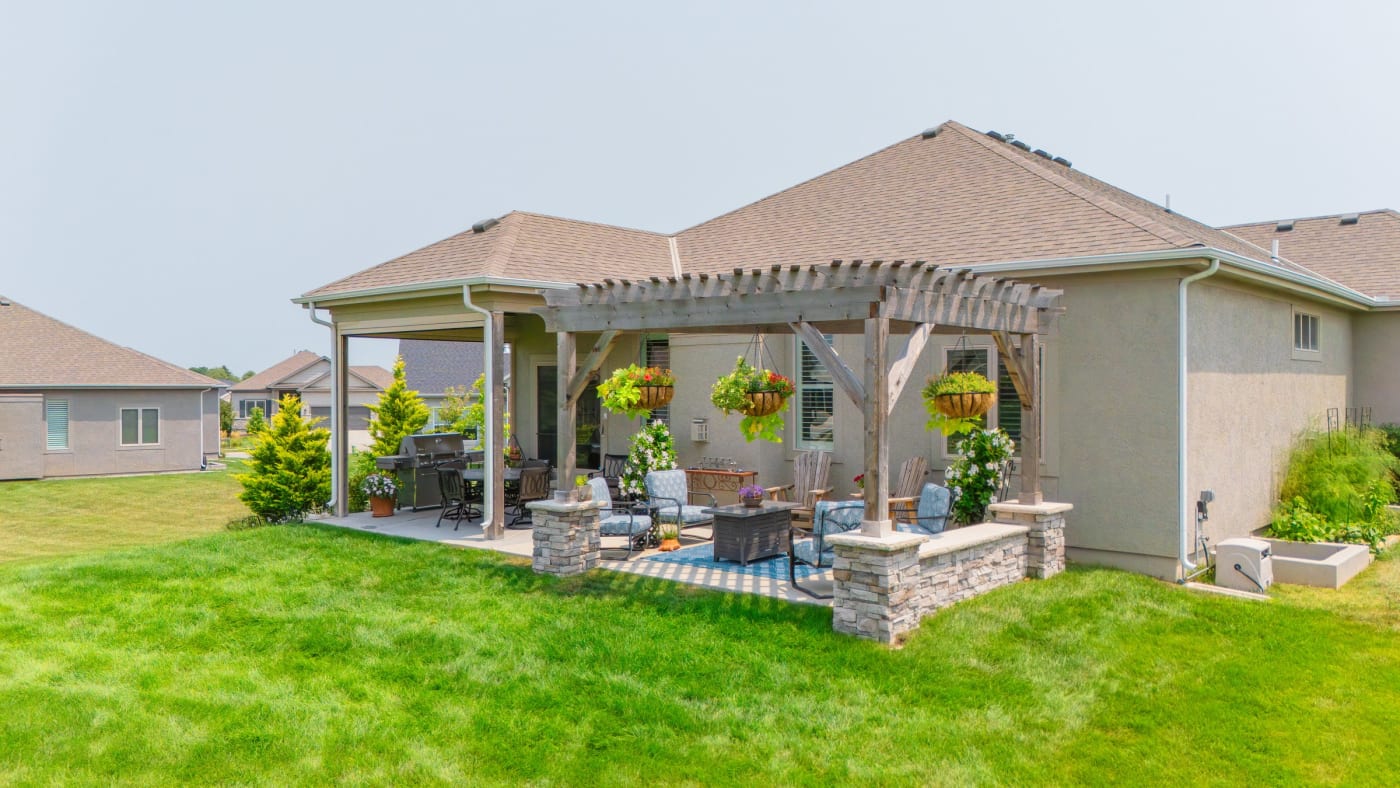
Pavers are easy to fix because they are individual blocks. If one cracks because someone dropped something on it, you simply take that one out and reinstall a new one. No cracking due to the individual nature of them.
Pavers don't have to be sealed. That saves the homeowner $300 per year if they do it themselves or $500 per year if they hire it out. That's a big savings when you think about 5-15 years of ownership. Don't get me wrong, you can seal pavers, and some people do it to get the "glossy" look they like, but we've seen paver patios that are 10-15 years old and have never been sealed and they look great.
Pavers have anti-slip built right in, so they are perfect around the pool or anywhere. No worries of them getting slick and people falling after a rain or in the morning dew.
A properly installed paver patio should last 25-40 years with no maintenance. Some companies actually give a lifetime warranty on their pavers. Enough said.
Pavers have endless design options due to the fact that there are hundreds of different paver types and hundreds of different colors, not to mention the endless patterns you can do with pavers. Stamped concrete can't compare.
I've been hard on stamped concrete this whole post and I'll stand by every word, but there are a few situations where it's actually the right call and I won't try to talk you out of it.
The first is when you have an existing stamped concrete patio and you're extending or replacing a section, and you want the new piece to match the old piece. Pavers next to stamped concrete look strange. If you've already got stamped concrete and you're just expanding it, matching with more stamped concrete keeps the project visually consistent.
The second is a very large flat surface where the homeowner specifically wants the look of a continuous floor with subtle pattern, like a driveway apron or a long walkway. Stamped concrete in those spots, done by a contractor who knows what they're doing on the integral color and the control joints, can look great for a long time.
The third is a short-horizon situation, where the homeowner has a five-to-eight-year window in the house and the goal is "looks good for the listing photo, doesn't fall apart before we sell." Stamped concrete delivers that. It does not deliver the thirty-year version of the same patio, but if you're not planning on being there for thirty years, that doesn't matter.
For everyone else, especially anyone planning to stay in the house ten years or longer, pavers are the answer.
If you put pavers on top of a 4 inch thick concrete base you don't have to worry about weeds, insects, or anything growing up through it. You don't have to worry about the pavers shifting, and you don't have to worry about the concrete cracking because the pavers are on top. Here in the Midwest where we get freezes and thaws, it's the best way to install pavers so that your patio area lasts for 30+ years without any issues.
Pavers do cost more than stamped concrete. Typically about $3-$5 more per sq ft. On a typical 400 sq ft patio, you're talking somewhere around $1,500 more than stamped concrete. But when you factor in the sealing that you have to do, it doesn't take long for pavers to be a better choice and a more economical one over the long term of 4+ years.
For me, I would never put in stamped concrete at my house or any of my friend's or family's houses. It's just not worth it. Do we sell it? Yes, on occasion I get a homeowner that just really wants it, or wants to match an existing stamped concrete patio they have, so we do it. But I try to talk everyone out of it. It's just not a good product for outdoors. On indoor applications I think it's great, but that's it. On an outdoor patio, walkway, or driveway, pavers are the only way to go.
The only benefit of stamped concrete is that it saves you $3-$5 per sq ft on the price when you get it installed. After that, pavers win every time, and they win on price after about 4 years.
How long does stamped concrete actually last in Kansas City? It'll still be a functional surface for 10 to 15 years. It'll look great for about 3 to 5 of those if you re-seal religiously, and rough by year ten. Pavers built on the right base will give you 25 to 40 years and still look the same as the day they went in.
Is stamped concrete cheaper than pavers? On the install quote, yes, by about $3 to $5 per square foot. Over five-plus years it's not cheaper once you add in sealing every 2-3 years. By year ten the math has flipped completely.
Can you fix cracks in stamped concrete? Honestly, not in a way that looks good. You can patch a crack but the patch won't match the existing color or pattern. The only real fix is to remove the cracked section and re-pour, and the new pour also won't match what's around it. With pavers, you pop out the broken stone and pop in a new one. Invisible repair.
What about stamped concrete around a pool? Don't. It gets too slick. We've replaced more than one stamped pool deck after a slip-and-fall sent someone to the emergency room. Pavers have built-in texture and drain through the joints. They're the standard around pools for a reason.
Will my homeowner's insurance cover an injury on stamped concrete? Probably, but you'll likely face a premium increase or get notice afterward. That's a conversation worth having with your agent before choosing pool deck material. The cheaper install isn't actually cheaper if it changes your insurance situation.
How much does a paver patio cost in Kansas City? A 400-800 square foot paver patio runs $25,000 to $60,000 typical, with the build-on-concrete-base method we use. We have full pricing on our paver patios service page and a cost calculator that gives you a real range for your specific project.
Do you ever recommend stamped concrete? Yes, in three cases: when matching an existing stamped patio, for very long continuous surfaces like driveway aprons, and for homeowners with a short horizon in the house (5-8 years). For most everyone else, pavers.
If you've made it this far, you probably already know which way I'd vote. If you want to talk through your specific project or get a real number, browse our portfolio for finished paver examples, run your project through our cost calculator, or check out our hardscape contractors guide for what to look for in any contractor's quote. Or call us at (816) 499-2547 and we'll talk through it together.
Thirty minutes on site with our designer is all it takes to see what is possible. No pressure, no hard sell.
Schedule a Design Call