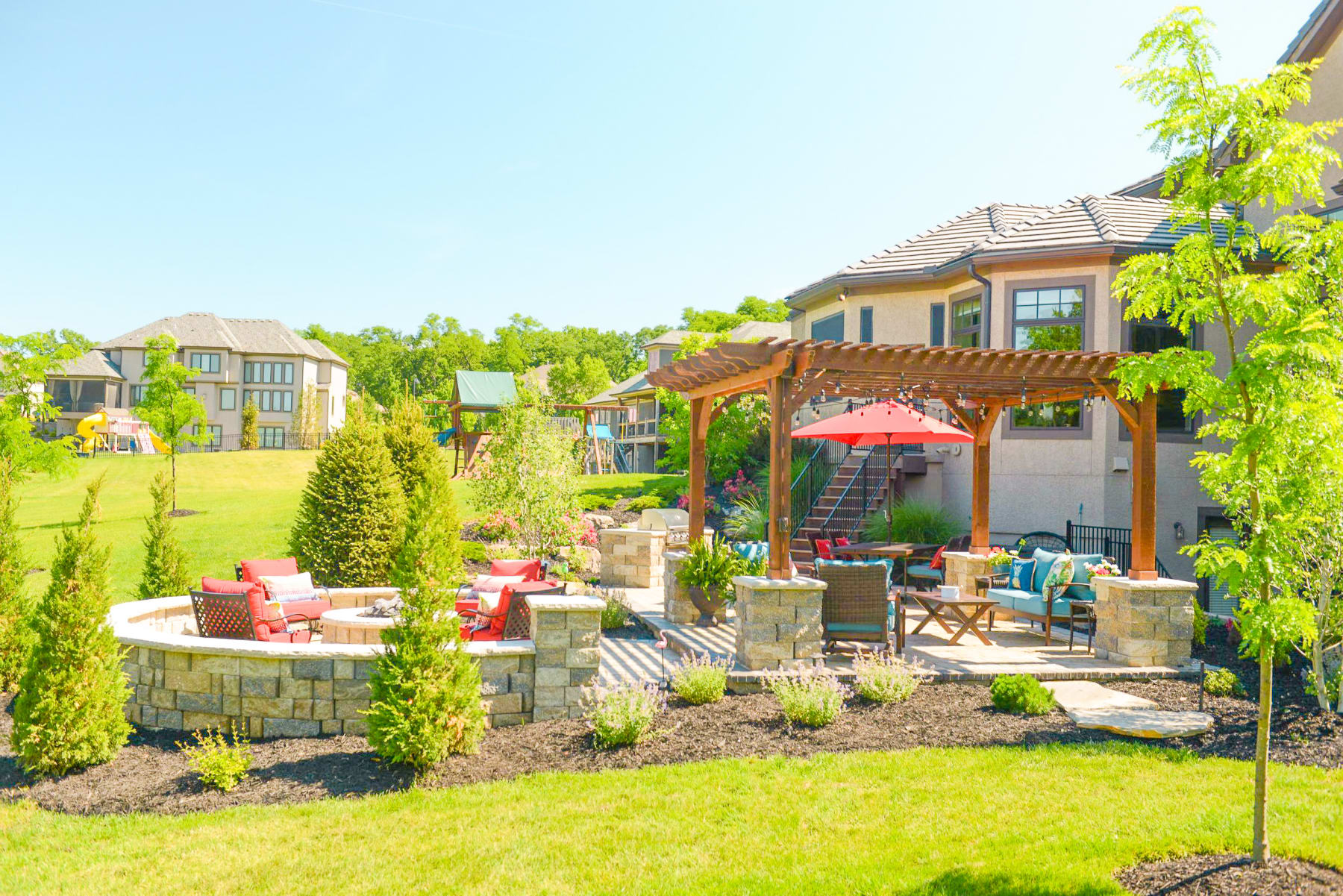
Blue Springs is the Eastland's growth story. New construction in Adams Pointe, Chapman Farms, and Sunny Pointe over the last decade, paired with established neighborhoods (Adams Dairy Estates, Brookshire, Cardinal Woods) that turn over to younger families ready to invest in the outdoor living space. The build is usually a paver patio plus a pergola or pavilion plus a fire feature, sometimes with a pool in the mix. The cost is reasonable for the metro because the lots are generous and the homes are well-sized to carry the build.
What changes the project is two specific Blue Springs rules and a deep HOA bench. The pool barrier minimum is 6 feet (taller than the typical 4-foot default), the pool and the equipment both have to sit at least 8 feet from any side or rear property line, and Adams Pointe, Chapman Farms, and Sunny Pointe each run an architectural review with real teeth. None of it is hard once a contractor knows the rules. All of it slows a contractor who doesn't.
What requires a permit in Blue Springs.
Blue Springs adopted the 2018 International Building Code and the related 2018 family for residential work. The Building Code Adoption sits in Chapter 500 of the city code, and applications run through the Codes Administration Division at 816-228-0118. For residential hardscape work, expect to pull a permit for:
- Pergolas, pavilions, outdoor kitchens, and outdoor fireplaces on footings, under the 2018 IRC accessory-structure rules.
- Decks over 30 inches above grade or attached to the home.
- Swimming pools, spas, and hot tubs. Permit required for construction, installation, enlargement, or alteration.
- Retaining walls over 4 feet measured from the bottom of the footing to the top of the wall, or any wall supporting a surcharge.
- Fences over 4 feet, with the 8-foot ROW setback described below.
What's exempt from a building permit:
- One-story detached accessory buildings (sheds, playhouses) up to 250 square feet of floor area. The local amendment is more generous than the 120-square-foot default of the base IRC.
- Retaining walls 4 feet or under measured from the footing, with no surcharge load behind them.
6 feet and 8 feet are the numbers.
Blue Springs Chapter 510 on swimming pools is tighter than the metro average on two specific points. Both matter at design:
6-foot barrier minimum
Every outdoor pool has to be completely enclosed by a barrier (fence, wall, building wall, or combination) that is at least 6 feet tall measured on the exterior side of the barrier. The standard 4-foot pool fence used in most metro cities is too short to satisfy Blue Springs. Plan for the taller fence at the bid stage.
8-foot setback for the pool and the equipment
The pool itself, and any associated appurtenances (pumps, filters, disinfection equipment), cannot sit less than 8 feet from any side or rear property line. The equipment-setback piece catches homeowners who pictured the pool pad against the property line and the pump tucked into the corner. Both rules apply, and both inspectors check.
On a Blue Springs pool project we walk the lot before quoting to confirm the pool fits inside the setbacks AND the 6-foot barrier fits inside the yard. On a tight Adams Dairy Estates lot, the math sometimes shows the pool wants to move 5 feet from where the homeowner envisioned it.
The easement is the rule that matters.
Routine removal of a tree on private property in Blue Springs generally does not require a permit. The two specific tree rules that come into play on hardscape work:
- Trees in public utility easements cannot be removed, cut, or altered without written permission from the appropriate authority. The utility easement is often the back 10 feet of a Blue Springs lot, which is also where homeowners want to put a patio or fire pit. Removing a tree in that strip without permission carries fines.
- Tree limbs overhanging a sidewalk or street have to be trimmed to a minimum height of 8 feet above the surface. This is a maintenance obligation on the homeowner, not a design constraint, but it shows up when an existing tree's canopy is close to the planned access path for equipment.
Our crews work the standard tree-protection protocol on every Blue Springs build: barrier fencing at the dripline, hand excavation inside the critical root zone, no compaction inside the protected area, and no piled debris. On lots where the utility easement is wooded, we map the easement before the patio gets drawn.
The 8-foot ROW setback for tall fences.
Fences over 4 feet in height must be set back at least 8 feet from the right-of-way line. Wrought iron fences are exempt from the exterior side setback requirement. Standard 4-foot-or-under residential fence sits on the property line without the setback requirement, but corner lots still trigger sight-triangle restrictions.
Retaining walls over 4 feet measured from the bottom of the footing to the top of the wall require a building permit and engineered drawings prepared by a Missouri-licensed Professional Engineer. Walls supporting a surcharge load (driveway, structure, sloped fill behind them) require a permit at lower heights. The footing-to-top measurement is the rule that catches the most homeowners: a wall that reads as 3 feet above grade can be a 4-plus-foot wall under code once frost depth is included.
A deep bench of named Blue Springs associations.
Blue Springs maintains an official HOA contact database on the city website (bluespringsgov.com). The associations we run into most often on hardscape projects:
- Adams Pointe. Newer master-planned community on the east side of town. Active architectural review with structured submittal expectations.
- Chapman Farms. Established subdivision with strong resale demand and an active HOA. Submittal review is real.
- Sunny Pointe. Established neighborhood with active review, especially on visible exterior structures.
- Adams Dairy Estates, Apple Valley, Badger Woods, Brittany Hills, Brookshire, Cardinal Woods, Chapel Ridge, Hidden Pointe. Each runs its own architectural review for visible exterior work. A standard package usually clears the first round.
For an HOA not on this list, we pull the covenants for the specific lot at the design step and budget the submittal time into the schedule. The city's HOA contact database is a useful starting point if you're not sure which association covers your address.
Real ranges from real Blue Springs builds.
These are the numbers we've been hitting on Blue Springs and Eastland projects through 2026. The cost mix is favorable for the metro because the lots support a useful outdoor living footprint without forcing premium-tier prices.
Full outdoor living builds are where most Blue Springs inquiries land. The Eastland's growth pattern (newer-build family homes on lots that can carry a real patio) makes Blue Springs one of the metro's best ratios of finished space to total cost.
Blue Springs homeowner questions.
How long does a permit take in Blue Springs?
Do I need HOA approval before the city permit?
Is my pool plan going to fit my Blue Springs lot?
Can a homeowner pull the permit themselves?
How soon can you start a build in Blue Springs?
Do you handle the HOA submittal too?
Blue Springs and the surrounding metro.
Our shop sits east of the river in Kansas City, Missouri. We build across Blue Springs and the surrounding cities every season. The map below shows the area we cover most often.