Brookside and Waldo are the two adjoining KCMO neighborhoods that everybody pictures when they say "old Kansas City": brick streets in places, Tudor-revival homes, sycamores and oaks that went in with the original plats, and a walkable commercial spine through Brookside Plaza and Waldo. The neighborhood pattern was designed by J.C. Nichols in the 1920s and 1930s, and the deed restrictions Nichols wrote influenced KCMO residential design for the next century. A 2026 hardscape build here is a build inside that pattern, not on top of it.
The practical implications for a homeowner: KCMO permits the work (2018 IBC, 2018 IRC for residential), the Wornall Homestead Overlay District adds neighborhood-specific rules in part of Brookside, the Historic Preservation Commission can have jurisdiction depending on the address, and the trees in the public right-of-way belong to the city. None of it stops a beautiful patio. All of it changes how a contractor designs and sequences the build.
KCMO is the building department.
Brookside and Waldo are KCMO neighborhoods, so permits run through the Kansas City, MO City Planning and Development Department. The applicable code is the Kansas City Building Code 2018, based on the 2018 International Building Code, effective June 28, 2020. Residential work is governed by the 2018 IRC under the same KCMO ordinance, with one notable exception: pool barrier rules reference the 2012 IRC specifically, which the city retained when other articles updated.
For residential hardscape work in Brookside or Waldo, expect to pull a permit for:
- Pergolas, pavilions, outdoor kitchens, and outdoor fireplaces on footings, under the 2018 IRC accessory-structure rules.
- Decks over 30 inches above grade or attached to the home.
- Pools, spas, and hot tubs, with the barrier and overhead-conductor rules below.
- Retaining walls over 4 feet measured from the bottom of the footing to the top of the wall, or any wall supporting a surcharge.
What's noteworthy for tight 1920s and 1930s lots specifically:
- Setbacks were drawn for the original Nichols pattern, which can be tighter on the rear yard than newer subdivisions.
- Mature ROW trees often sit right where construction access wants to be. We design with that in mind from the start.
- KCMO permit-issuance times vary; for a standard hardscape we plan on 3 to 6 weeks on the front end depending on whether the overlay or Historic Preservation review applies.
The Wornall Homestead Overlay District.
The Wornall Homestead Overlay District is the first residential overlay district in Kansas City, MO outside of the formal historic overlays. It became effective August 3, 2017, and covers 392 homes in the Wornall Homestead Homes Association area of Brookside. The overlay was passed after the Homes Association researched the original J.C. Nichols deed restrictions from the 1920s, recognized that the deed restrictions had long since expired, and worked with the KCMO Planning Department to encode the character protections into a zoning instrument that survives.
What the overlay actually preserves:
- Density. Original lot-to-home ratios and the basic feel of how houses sit on the block.
- Setbacks. The original front, side, and rear setbacks Nichols specified, even where current zoning would allow tighter.
- Architectural character. Material and style expectations consistent with the original neighborhood, especially on anything visible from the street.
For a hardscape project inside the overlay, that translates to: backyard work that stays fully behind the house and below the existing fence line generally reads as a non-issue. A pavilion taller than the eave line, a chimney visible over the rear roof line, or any structure that changes how the house presents from the street is reviewed against the overlay character expectations. We plan accordingly at the design step.
Other parts of Brookside have their own Homes Associations (Brookside Homes Association and others) that run their own reviews without the formal overlay backing.
West of Main Street is different.
Homes located west of Main Street in Brookside are recognized by the KCMO Historic Preservation Commission. For homes in that area, approval is required from the HPC for additions and rebuilds of homes. For a backyard hardscape project that is fully behind the house and not visible from the street, the HPC review is typically lighter and faster. For any structure that is visible from the public way (a pavilion taller than the existing fence line, an outdoor fireplace with a chimney that reads from the street, a freestanding pergola that sits forward of the rear corner of the home), the HPC weighs in on scale, material, and visual continuity with the historic character.
The HPC review is its own line item on the schedule, and it runs before the city permit can pull. We sequence accordingly: design first, HPC submittal second, KCMO building permit third, mobilization fourth.
Three different tree rules apply.
Tree work in Brookside and Waldo runs through three different jurisdictions depending on where the tree is and what you're doing:
- Private tree, no development. A homeowner removing a tree on private residential property generally does not need a permit. You can hire a tree service and have it done without filing with the city.
- Private tree, development triggering land disturbance. When the project triggers a land-disturbance permit (significant grading, a pool, certain additions), the KCMO Zoning and Development Code (Chapter 88, Article VIII) tree preservation review applies. Specimens with a diameter at breast height (DBH) of 30 inches or more are flagged for review.
- Right-of-way tree. The curb strip and parkway trees between the sidewalk and the curb are owned by the city and managed by KC Parks. Removing or significantly trimming a ROW tree without authorization carries fines and replacement requirements. Brookside and Waldo are dense with mature ROW canopy; this is a real risk on a tight build where equipment wants to use the parkway.
Our crews protect mature private trees with barrier fencing at the dripline, hand excavation inside the critical root zone, and no soil compaction inside the protected area. ROW trees we don't touch without an authorized arborist on the job.
2012 IRC for pool barriers, plus the 10-foot conductor rule.
KCMO residential pool barriers reference Chapter 18 (Building & Rehabilitation Code), Article III, 2012 International Residential Code, plus the zoning rules in Sections 88-305-07 and 88-305-02-B. The 2012 IRC reference for pool barriers specifically is unusual; KCMO kept it while updating other articles to newer editions. The rules:
- 4-foot barrier. Around the pool, fence or wall, the minimum.
- Self-closing and self-latching gate. Required hardware on any gate through the barrier.
- Above-ground pool wall as barrier. An above-ground pool wall that is 4 feet or greater can serve as the required protective enclosure.
- No overhead conductor above or within 10 feet horizontally. No electrical power line can run over the pool or within 10 feet of the pool's edge. This catches Brookside pool projects more often than newer-build pool projects, because the original lot grid was not laid out for backyard pools and overhead service drops can run right where the homeowner pictured the pool.
We walk the lot before we draw on a Brookside or Waldo pool project, specifically to confirm the conductor clearance and the setbacks against the tight lot geometry.
4 feet front, 6 feet side and rear.
KCMO Chapter 27 governs fences and walls. For a Brookside or Waldo residential lot:
- Front yard fence: maximum 4 feet.
- Street-side yard on a corner lot: maximum 4 feet.
- Interior side yards and rear yard: maximum 6 feet.
The Wornall Homestead Overlay can add expectations beyond these baseline KCMO rules. Historic Preservation review can restrict material and style in the protected sub-areas. We confirm both at the design step.
Real ranges from real Brookside and Waldo builds.
These are the numbers we've been hitting on Brookside, Waldo, and adjacent KCMO neighborhoods through 2026. The cost mix here is different from the new-build suburbs: the patio footprint is usually smaller because the lot is smaller, but the careful handwork (tree protection, navigating the original architecture, sequencing through the overlay or HPC review) takes time. Premium material expectations (natural stone, mature pavers, stone veneer that reads with the original Tudor and bungalow architecture) are common.
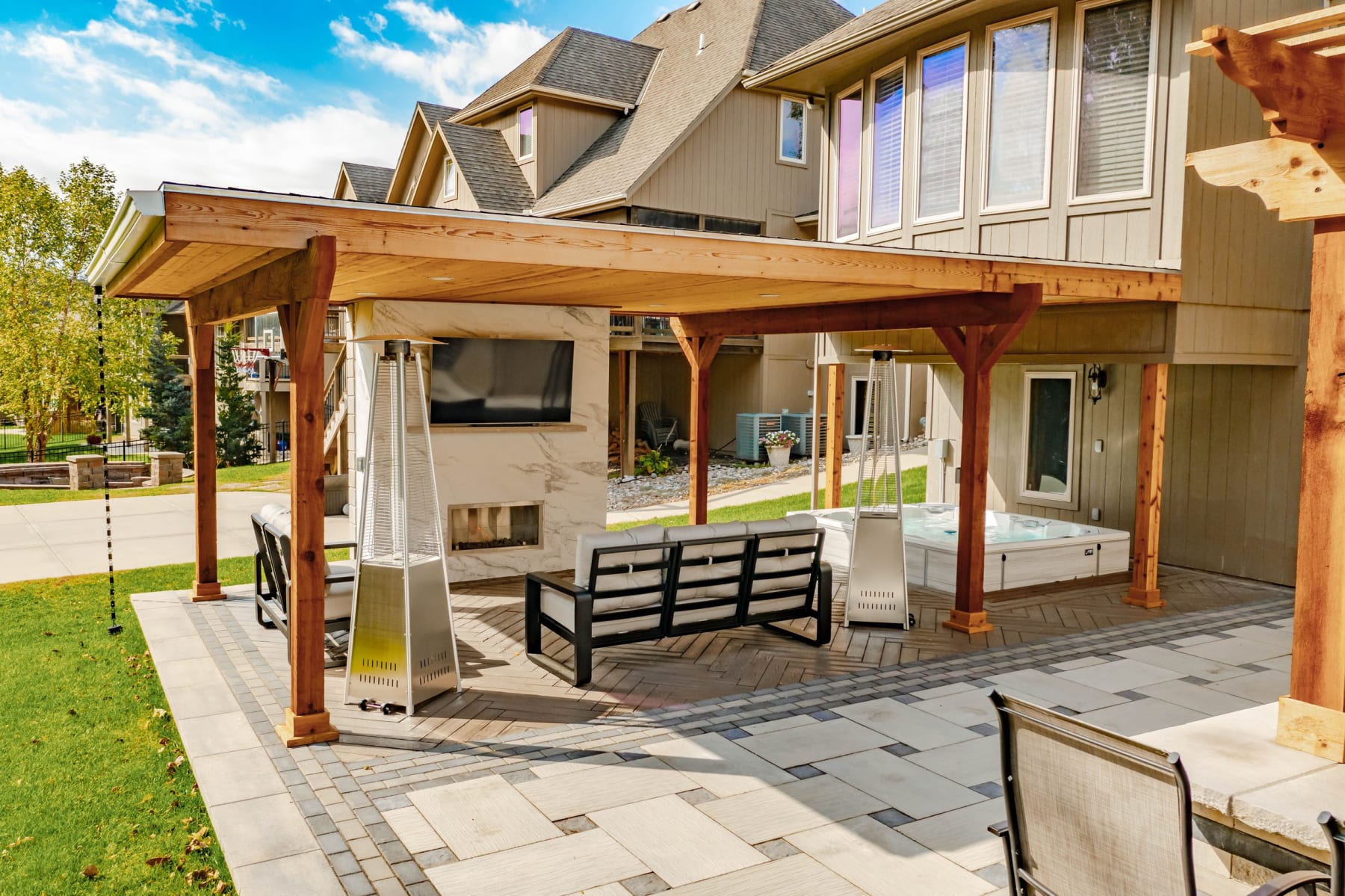
The full outdoor living range is where most Brookside and Waldo inquiries land. A natural stone patio with a pergola, a fireplace, lighting, and a small outdoor kitchen designed to fit the rear yard of a 1930s Tudor is the typical brief. Pool projects are less common because of the lot geometry and the conductor rule, but they happen on the larger lots toward the south end of Waldo.
What changes on the build side.
The Brookside or Waldo build is different from a suburban-subdivision build in a few specific ways:
- Material staging. The lot does not have a five-car driveway. The neighbor's lot is 20 feet away. We stage materials in the smallest footprint possible, schedule deliveries for the tightest window, and break the project into phases so the yard is not a disaster zone for the whole build.
- Access for equipment. Some Brookside backyards have an alley behind them, which solves a lot of access problems. Some do not, and the only path for equipment is around the side of the house through a 5-foot gap. We size equipment to the access we have.
- Tree protection. The mature canopy is the reason the homeowner bought the house. Compaction, trenching, and root cuts inside the critical root zone are not negotiable.
- Material that reads with the architecture. A Tudor or a bungalow does not want a Hardscape-Catalog 2026 paver. We match material tone and texture to the original architecture, often pulling stone veneer that picks up the existing chimney or limestone foundation.
- Brick-street neighbors. Some Brookside streets are still original brick. Construction loads near those streets get extra care.
Brookside and Waldo homeowner questions.
How do I know if my house is in the Wornall Homestead Overlay?
How do I know if my house is in the Historic Preservation Commission's review area?
How long does a KCMO permit take in Brookside?
Can I work on a tree in the curb strip myself?
Do you handle the overlay or HPC submittal too?
How soon can you start a build in Brookside or Waldo?
Brookside and Waldo and the surrounding metro.
Our shop sits east of the river in Kansas City, Missouri. We build across Brookside and Waldo and the surrounding cities every season. The map below shows the area we cover most often.