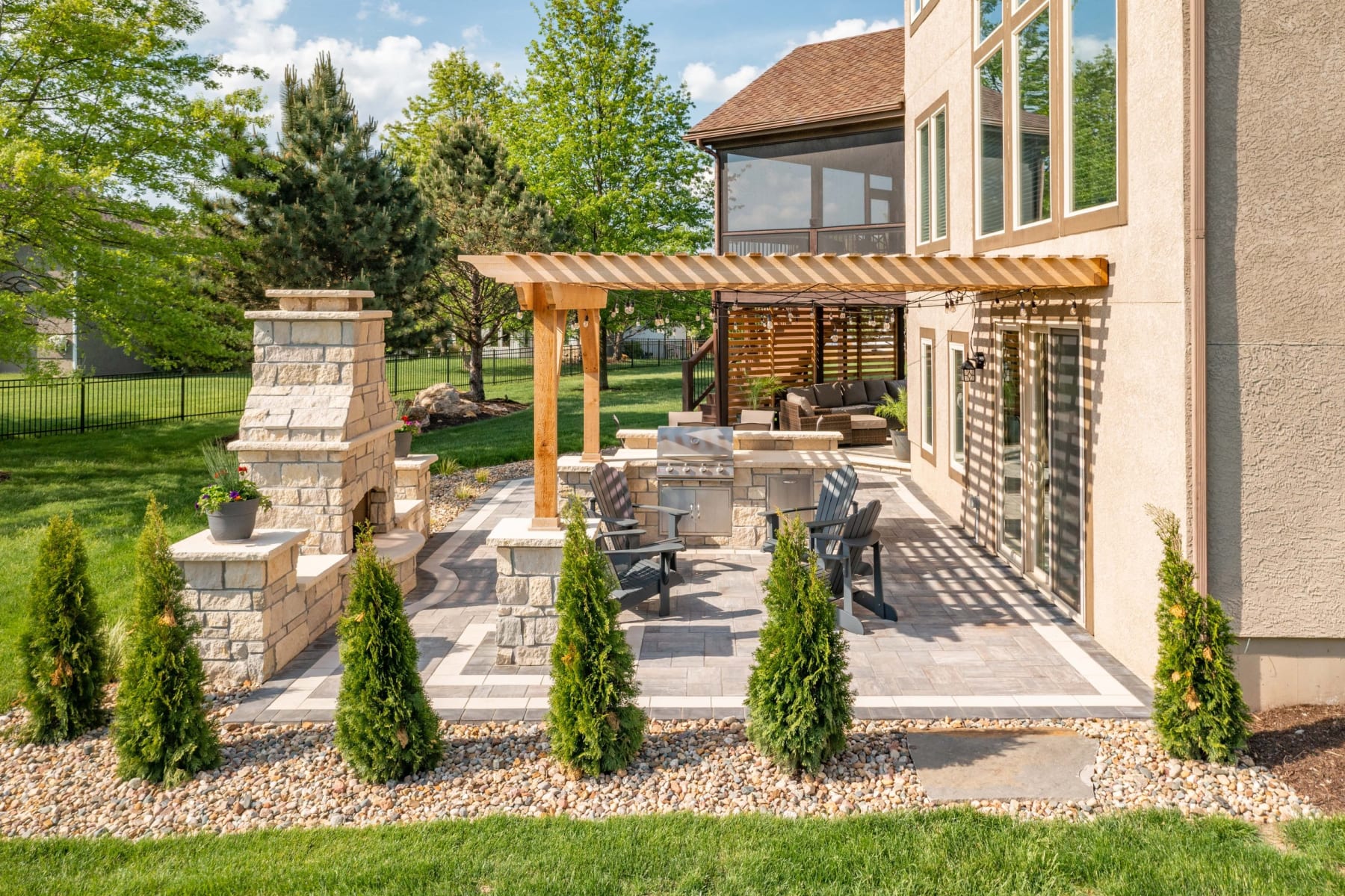
Kearney sits at the north end of the Northland, far enough out that the town still feels like a town and the lots get bigger the further from the square you go. The build is usually a paver patio plus a pergola or pavilion, sometimes with a pool, and the design typically takes advantage of the larger lots that Kearney's neighborhoods carry. Kearney Manor, Southbrook, the Addition-named older subdivisions (Bogart, Pence, Cuthbertson, Arnold's, Porter's), and newer master-planned communities like Sycamore all work the standard suburban pattern. The acreage side of town, around the edges, is rural enough that the construction context shifts to septic-and-well territory.
Two specific Kearney rules matter at design. The city adopted the 2018 International Residential Code for residential work, and uniquely in the metro it also adopted the 2018 International Swimming Pool and Spa Code as a standalone code for pool work. The other rule that catches outsiders: every fence in Kearney needs a permit, regardless of height or material.
2018 IRC plus the 2018 ISPSC.
The City of Kearney adopted the 2018 Edition of the International Residential Code for residential construction in one and two-family dwellings and townhouses up to three stories. The 2018 IRC is the same edition Liberty and Parkville use, but Kearney additionally adopted the 2018 International Swimming Pool and Spa Code (ISPSC) as the controlling document for pools, spas, hot tubs, and aquatic facilities. The ISPSC has its own technical provisions, distinct from the base IRC pool article.
For residential hardscape work, expect to pull a permit for:
- Pergolas, pavilions, outdoor kitchens, and outdoor fireplaces on footings, under the 2018 IRC accessory-structure rules.
- Decks over 30 inches above grade or attached to the home.
- Pools, spas, and hot tubs under the 2018 ISPSC. Pool fencing is reviewed and approved by the Community Development Director.
- Retaining walls over 4 feet measured from the bottom of the footing to the top of the wall, or any wall supporting a surcharge.
- Every fence, regardless of height.
What's notable about Kearney's accessory rules:
- Detached accessory structures (non-garage, non-carport): 200 square feet maximum gross floor area. That caps freestanding sheds and similar at a tighter number than Blue Springs (250 sf) but more generous than Lenexa (120 sf).
- Additions and accessory buildings: under 5,000 square feet AND less than 50 percent of the existing square footage on a site plan of record. The 50-percent rule keeps the structure proportional to the existing footprint.
The ISPSC and the Director's approval.
The two specific things to know about a Kearney pool project:
- The 2018 ISPSC is the controlling code, not the base IRC pool article. The ISPSC governs design, construction, alteration, repair, and maintenance for residential pools, spas, hot tubs, and aquatic facilities. Pool contractors who work other Northland cities and assume the same code applies in Kearney can be off on specific provisions. We work to the ISPSC on every Kearney pool job.
- The required fence is a "security-type fence" approved by the Community Development Director. Above-ground and below-ground pools both require the fence. The Director's approval is a real review step that considers material, height, gate hardware, and the fence's relationship to the lot. We submit the fence detail with the permit application so the review happens up front, not after the pool is in the ground.
Every fence needs a permit.
Kearney's fence rule is that no fence may be erected or replaced without an application and a permit issued by the Community Development Department. That's stricter than most Northland and Eastland cities, which exempt standard residential fences from the permit requirement. In Kearney every fence gets the permit. The other rules:
- Maximum residential fence height: 6 feet.
- Front-yard fences: maximum 4 feet, OR lattice or open-screen with no more than 50 percent visual density (the lattice exception preserves the open feel of front yards while still permitting some screening).
- Corner lots: sight triangle has to stay unobstructed at the intersection.
We pull the fence permit as a line item on any Kearney hardscape project that includes perimeter fencing. The permit is straightforward when the application is clean; the review catches the homeowners who tried to skip it.
The Northland mix in one city.
Kearney's residential pattern is two cities in one. Inside the platted subdivisions:
- Kearney Manor, Southbrook. Established subdivisions inside the city.
- Bogart, Pence, Cuthbertson, Arnold's, Porter's, Second Addition. The historic Addition-named subdivisions, suburban classic in character, tall trees and sidewalks.
- Sycamore (Hearthside Homes builds), newer master-planned phases. Newer construction, often with an active architectural review.
On the acreage side of town:
- Septic and well, not city utilities. The pool siting respects the septic field. Patio drainage routes to a code-compliant outfall on the property.
- No HOA for most acreage lots. The build proceeds without architectural review, which speeds the front end but doesn't reduce the building code requirements.
- Mature canopy as design centerpiece. Older oaks, walnuts, and hickories on five-acre lots are the reason the homeowner bought the property. We protect them.
For an address we don't recognize, we verify jurisdiction (city of Kearney vs unincorporated Clay County) at the address-check step before quoting. If the address is in unincorporated Clay County, the permit jurisdiction shifts to the county.
Real ranges from real Kearney builds.
These are the numbers we've been hitting on Kearney and broader Northland Clay County projects through 2026. Kearney pricing skews to the metro middle for the in-town subdivisions and toward the upper end on the acreage builds where lot size and project scope scale up.
Full outdoor living builds are where most Kearney inquiries land. The pool category is larger on acreage lots; the in-town builds run more toward patio-plus-pergola-plus-fire-feature. We scope all the permits (building, fence, pool if applicable) into the budget up front.
Kearney homeowner questions.
How long does a permit take in Kearney?
What if my address is in unincorporated Clay County, not the City of Kearney?
Can a homeowner pull the permit themselves?
Does the ISPSC really change anything on a residential pool?
How soon can you start a build in Kearney?
Do you handle the fence permit too?
Kearney and the surrounding metro.
Our shop sits east of the river in Kansas City, Missouri. We build across Kearney and the surrounding cities every season. The map below shows the area we cover most often.