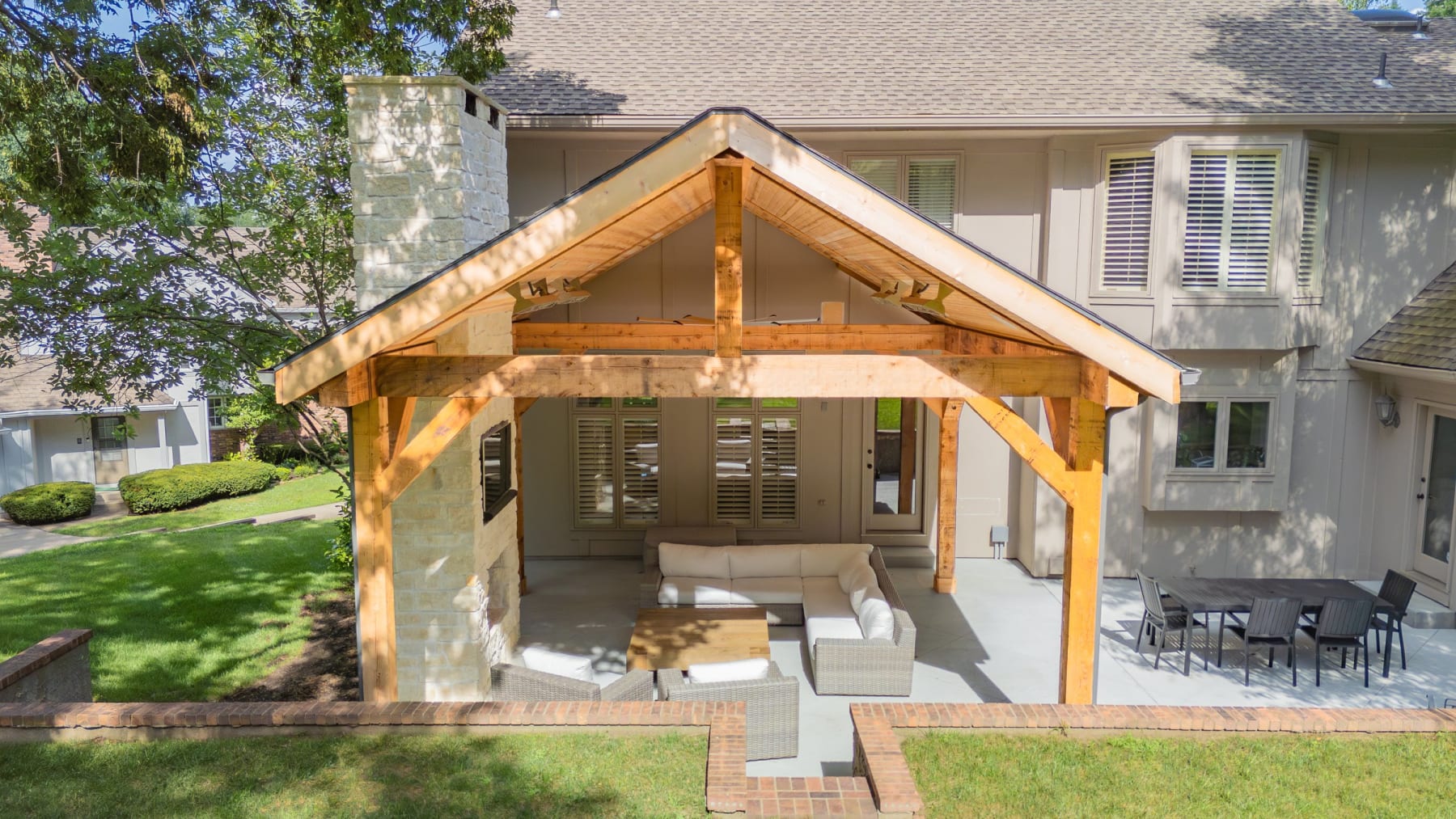
Liberty is the Northland's anchor. Older streets around the square, newer subdivisions sprawling north and east, plenty of walkout basements working real grade, and a city government that takes its building code seriously. That last part matters more than homeowners usually expect. Liberty adopted the 2018 International Codes via Ordinance 11358 and the 2018 Fire Codes via 11359, and every contractor working in town has to be licensed with the city before the building department will even pull up an application. It changes who can take the job and what gets built.
What follows is what we'd tell a Liberty homeowner before they sign anything, whether you're on a course-adjacent lot near Shoal Creek, in the older streets by the historic square, or in one of the newer subdivisions out toward Pleasant Valley. Real permit rules, real ordinance numbers, the difference the Dougherty Historic District makes if your house is in it, and what to actually budget.
What requires a permit in Liberty.
The plain answer is: most things that matter. The 2018 IRC is the spine of the residential rules, and the city building division uses a SmartGov portal for applications. The Chief Building Official is Jeremy Adams. Permit applications run through 816.439.4534. Inspections through 816.439.4541. Office hours are Monday through Friday, 8 to 5.
Specifically, in residential work you should expect a permit for:
- Decks sitting more than 30 inches above grade, or any deck attached to the home. Site plan plus building plans required at submittal.
- Pergolas, pavilions, outdoor kitchens, and outdoor fireplaces on footings. These are accessory structures under the IRC and the city wants the structural drawings.
- Swimming pools and hot tubs over two feet in depth, with a separate set of pool-specific rules covered below.
- Retaining walls over four feet tall (measured from the bottom of the footing to the top of the wall), or any wall with a surcharge behind it like a driveway, slope fill, or structure.
- Lawn irrigation systems, plus a Right-of-Way permit if any sprinkler head sits within 11 feet of the curb.
- Detached storage buildings and garages in most residential districts (setbacks apply).
Fencing is the notable exception. Liberty does not require a building permit for a fence, but you still have to meet city code on height and material, and a corner lot brings sight-triangle restrictions you can fall on the wrong side of without realizing. The Dougherty Historic District treats fences differently. More on that below.
Fees in Liberty are based on the valuation of the project, not a flat number. The city publishes a Building Permit Fees PDF you can request from the building division, and for any meaningful outdoor living build the fees are a rounding error compared to the cost of the project. The line that homeowners get tripped up on is the contractor licensing requirement: if your contractor isn't on the city's licensed list, the permit will not issue, period. That ends a lot of bids that looked good on price.
5 feet, 20 feet, and a 4-foot fence.
If a pool is part of the plan, Liberty's setbacks are tighter than most homeowners assume. Any pool or in-ground water feature deeper than two feet has to sit:
- At least five feet from any property line.
- At least twenty feet from any neighboring primary structure.
- Enclosed by a minimum four-foot fence around the pool area or yard.
The site plan submitted with the building permit application has to show the fence location and call out every distance from the pool edge to the lot lines and to the nearest adjoining home. Manufacturer's equipment information for the pool gets attached too. The fence rule is the one that catches Liberty homeowners building on tighter lots, because a yard that looked like it had room for a pool sometimes does not have room for a pool plus a code-compliant fence and the setbacks at the same time. We solve this on the site walk before quoting, not after demo.
Twenty feet from the neighbor's house is the line we measure first. If it isn't there, the pool moves before the patio gets drawn.
Section 30-97.4 and Tree City USA.
Liberty has been a Tree City USA continuously since 2005. The community forestry program is active, the city has a Tree Board, and tree preservation and replacement rules live in Section 30-97.4 of the Liberty Unified Development Ordinance. For private residential work near a planned hardscape, the line you want to draw early is around the critical root zone of any protected tree. Compaction from equipment, trenching for footings, and grade changes during patio construction are the three things that kill mature trees on hardscape jobs in this town.
The right-of-way trees (the curb strip, the parkway between sidewalk and curb) are technically owned by the city, but by ordinance the adjacent property owner maintains the grass, vegetation, sidewalks, curb, and gutter in that strip. Hazardous removals on the city side go through the Parks Department. For private trees, the UDO drives the preservation requirements that apply when a parcel is being substantially redeveloped. On a single-yard patio build the rules are looser than a full new-construction site, but the tree-protection plan our crews follow is the same either way: barrier fencing at the dripline, no soil compaction inside it, no piled debris, root cuts only by hand and only where a permit allows.
If a tree is going to be in the way of a build, the conversation happens before the contract, not during excavation.
Four feet, footing to top, with engineered plans.
Liberty's residential lots in the newer subdivisions north and east of town are working real grade. Walkout basements, sloped backyards, two-tier pool areas. A meaningful share of our Liberty estimates include at least one retaining wall, and the rule we work from is this: any wall over four feet measured from the bottom of the footing to the top of the wall requires a building permit and engineered drawings prepared by a Missouri-licensed Professional Engineer.
The footing-to-top measurement matters because what shows above grade often isn't the full wall. A "three-foot wall" with a six-inch base and a footing buried another twelve inches below grade is a real four-foot-six wall under the IRC, and that triggers the engineering requirement. We design and disclose this up front so the engineering fee is in the contract, not a surprise three weeks in.
Walls that carry a surcharge (a driveway above, a structure above, sloped fill behind them) can require permits and engineering at lower heights. Manufacturer block walls under four feet with no surcharge typically don't require a permit, but they still have to be built on the right base depth with the right backfill, or they fail the same way unpermitted walls fail everywhere else.
If you live inside Dougherty.
The Dougherty Historic District in the older part of Liberty has the extra step. Beyond the standard building permits, exterior work that's visible from the public way (and a number of fencing and hardscape elements that change the character of the property) requires a Certificate of Appropriateness. The review board considers material, scale, and visual continuity with the historic character of the district before approving.
That's not a problem if you sequence it correctly. It is a problem if your contractor doesn't know it exists and starts work first. The Certificate review adds time to the front of the project, not the back, and we route the application before any demolition or excavation begins. For homeowners outside the district, none of this applies. For homeowners inside it, the entire timeline shifts a few weeks earlier on the calendar.
$25, 14 days, reflective tape.
A roll-off dumpster on private property (your driveway, your yard) does not require a permit. The moment that dumpster sits in the street or any public right-of-way, Liberty requires a Right-of-Way Permit. The fee is $25 and the permit is valid for up to 14 days. Reflective tape on the dumpster is required, and placement cannot block traffic, mailboxes, hydrants, storm inlets, or sight lines at intersections.
The small fee belies how often this trips up homeowners doing a self-managed remodel: a city inspector or a neighbor calls it in, the dumpster has to move, the project loses days. Our project managers pull the ROW permit on Liberty jobs where the only practical placement is the street, and we document the reflective tape and the placement before the truck leaves.
The associations you're likely dealing with.
Liberty doesn't have the single dominant homes association that some Johnson County suburbs do. What it has instead is a tapestry of named neighborhood groups and homeowners associations covering most of the platted subdivisions, plus the historic district overlay in the older part of town. The City of Liberty maintains an official map of homes associations and neighborhood groups, and the city's Community Development office (Jeanine Thill, 816.439.4537) can confirm whether a specific street falls under one.
Named associations and neighborhood groups we see most often in Liberty work include:
- Bent Oaks
- Clay Meadows
- Clay Ridge
- Claywoods
- College Place West
- Creekwood
- Dougherty Historic District (overlay, not an HOA but operates like one for exterior work)
- Hills of Oakwood
- Homestead of Liberty
- Middlemarch Estates
- Parkview Meadows
- Woods of Logsdon's Ridge
- Liberty on the Lake
Each one runs its own architectural review process for visible exterior work. Some require submittals for any structure visible from the street (pergolas, fences, outdoor fireplaces). Others only care about new construction. Before we draw a final design we pull the covenants for the specific lot, identify what triggers review, and budget the submittal time. The HOA process in Liberty is generally less complex than what Mission Hills or Leawood put owners through, but it isn't nothing and skipping it is the fastest way to get a stop-work letter on a Tuesday.
Real ranges from real Liberty builds.
These are the numbers we've been hitting on Liberty and broader Northland projects through 2026. Ranges, not quotes. Final pricing depends on site complexity, retaining wall scope, drainage, demo of any existing concrete or wood deck, material tier, and the size of the finished project. We share the calculator below for a quick directional number, and a walk of the property turns that into something binding.
The full outdoor living range is where most of our Liberty inquiries land. Paver patio plus a pergola, a fireplace, a fire pit lounge, and outdoor lighting designed as one space. The cost ceiling moves with the size of the home, the slope of the yard, and how much retaining wall the grade demands.
What changes on the build side.
Liberty's soil and grade are different from the Johnson County clay we describe on the Leawood and Overland Park pages. Northland soils are still high in clay content, but the topography brings a second variable: real elevation change on most lots. A walkout basement lot is the default in newer Liberty subdivisions, not the exception.
What that means at the patio level:
- Deeper base on the high side of the slope. We build the aggregate base thicker where the slope shed water into the patio area, so the surface stays true after the first wet spring.
- Drainage tied to the city storm system. Liberty's stormwater rules are inherited from the broader Northland regional approach. Surface water from the patio cannot simply dump on the neighbor's lot. We grade and pipe to a code-compliant outfall.
- Retaining wall as a design element, not an afterthought. On a sloped Liberty lot the retaining wall is often the most expensive element on the bid. Designing it into the patio geometry instead of fighting the grade keeps the cost honest and the build clean.
- Tree protection where mature oaks and walnuts dominate. Older Liberty neighborhoods have serious mature canopy. The roots run wide and shallow. We protect them with barrier fencing and hand excavation inside the dripline, every time.
Liberty homeowner questions.
How long does a permit take in Liberty?
Can I do my own permit pull as the homeowner?
What's the rule on a basketball hoop or sport court?
Do you build in Liberty on Clay County roads (unincorporated)?
Does Liberty require a soil test?
How soon can you start a build in Liberty?
Liberty and the surrounding metro.
Our shop sits east of the river in Kansas City, Missouri. We build across Liberty and the surrounding cities every season. The map below shows the area we cover most often.