The Journal · Field Notes
Almost every patio we build in Kansas City ends up with fire somewhere. A pit, a fireplace, a built-in fire bowl, an outdoor pizza oven. Sometimes more than one. There is a reason for that. Without fire, a patio is a summer-only piece of the house. Add fire and the same patio gets used in March, April, October, and November when the air has bite to it but the sky is still beautiful. That is the difference between using a backyard four months a year and using it eight. Below is the honest menu of fire options we install, what each one is actually for, what each costs in this market, and how to decide what your space needs.
Our climate has a real fall and a real spring, but they are short. The temperature is bearable on the patio for maybe seven good months without help. Add a fire feature and that window opens up on both ends. A 50-degree October evening with a wood fire going feels like the best night of the year. A 38-degree March morning with coffee and a propane bowl feels like a stolen one.
Fire also fixes the most common complaint we hear about new patios, which is that they feel empty. A patio without a focal point is just a slab. Fire gives the eye and the conversation somewhere to land. It is the cheapest way to turn a finished patio into an actual room.
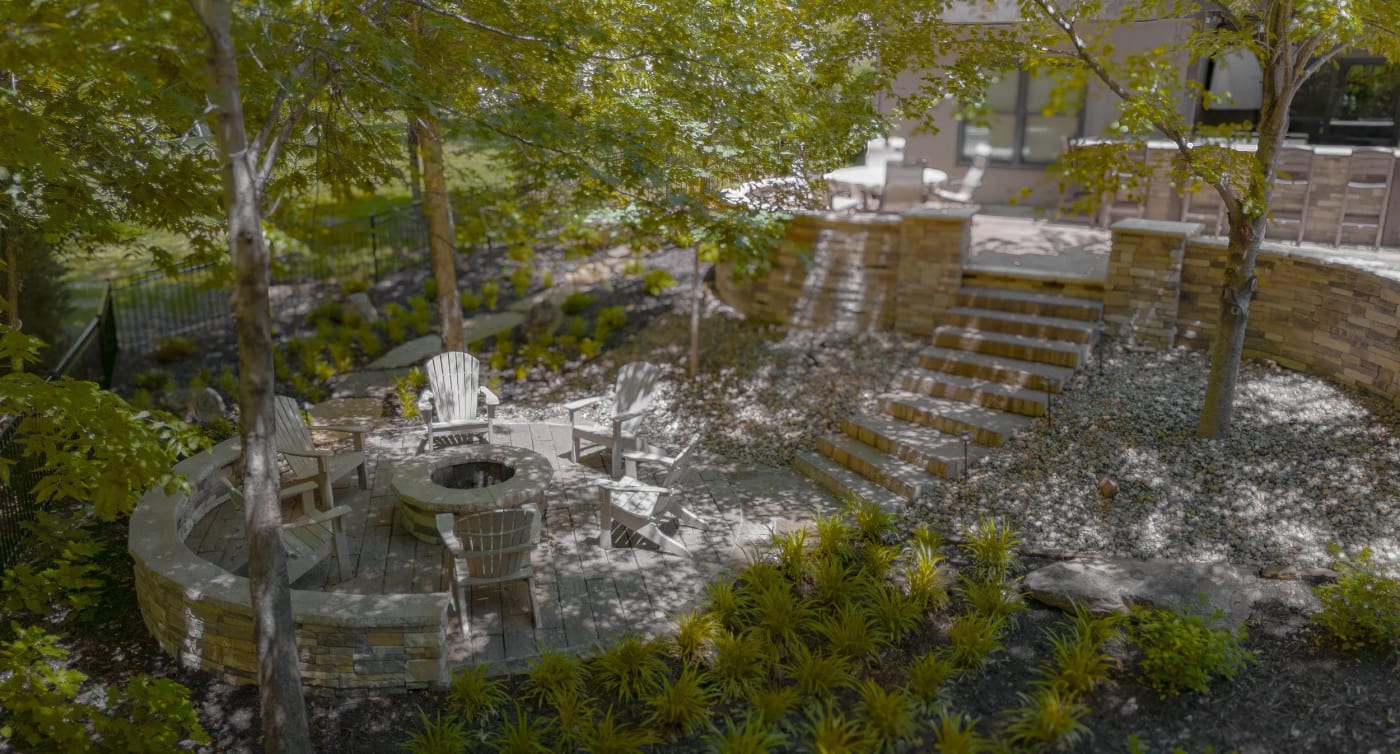
The catalog has a hundred products. In practice, almost every backyard fire feature we build for a Kansas City home is one of four things.
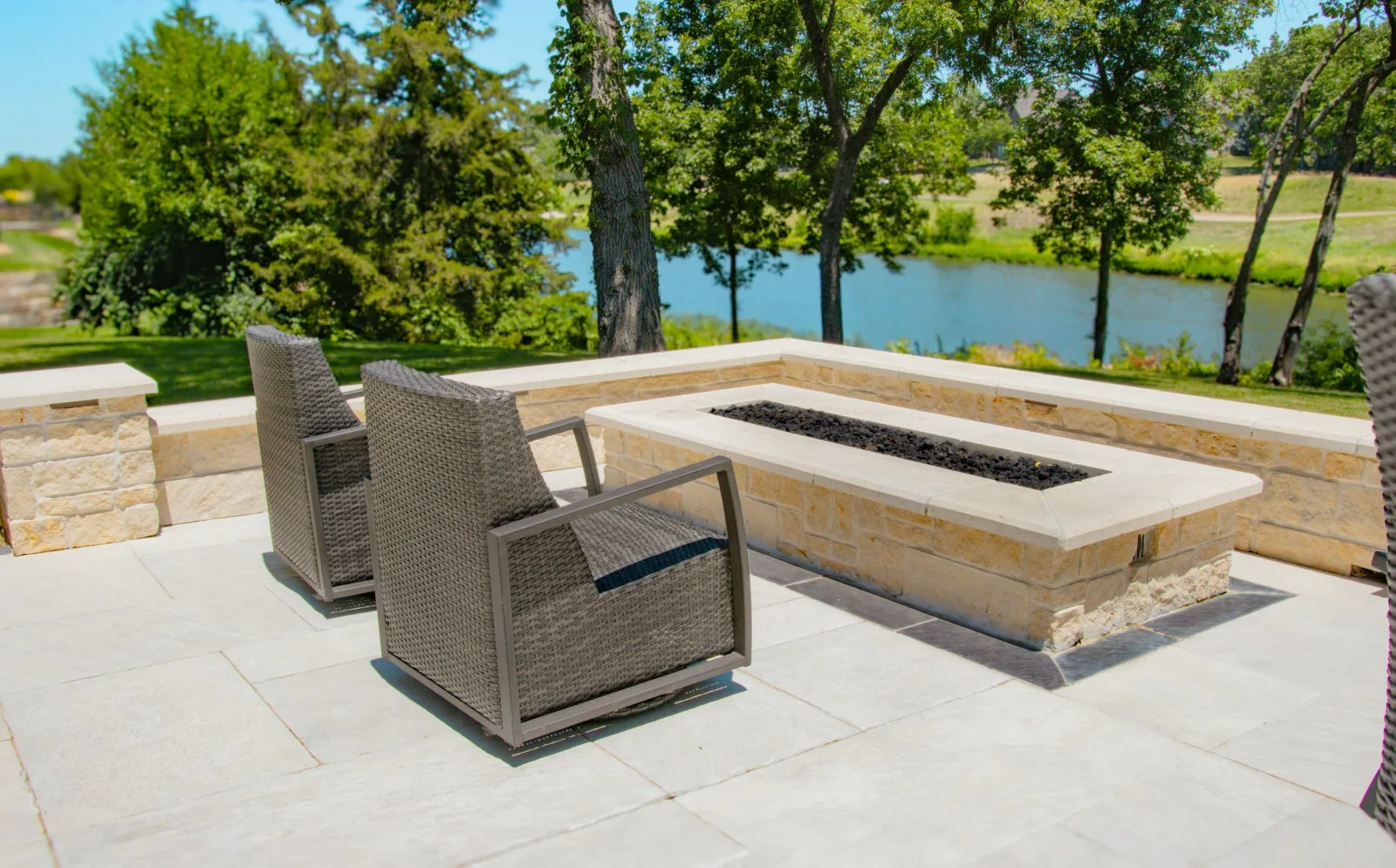
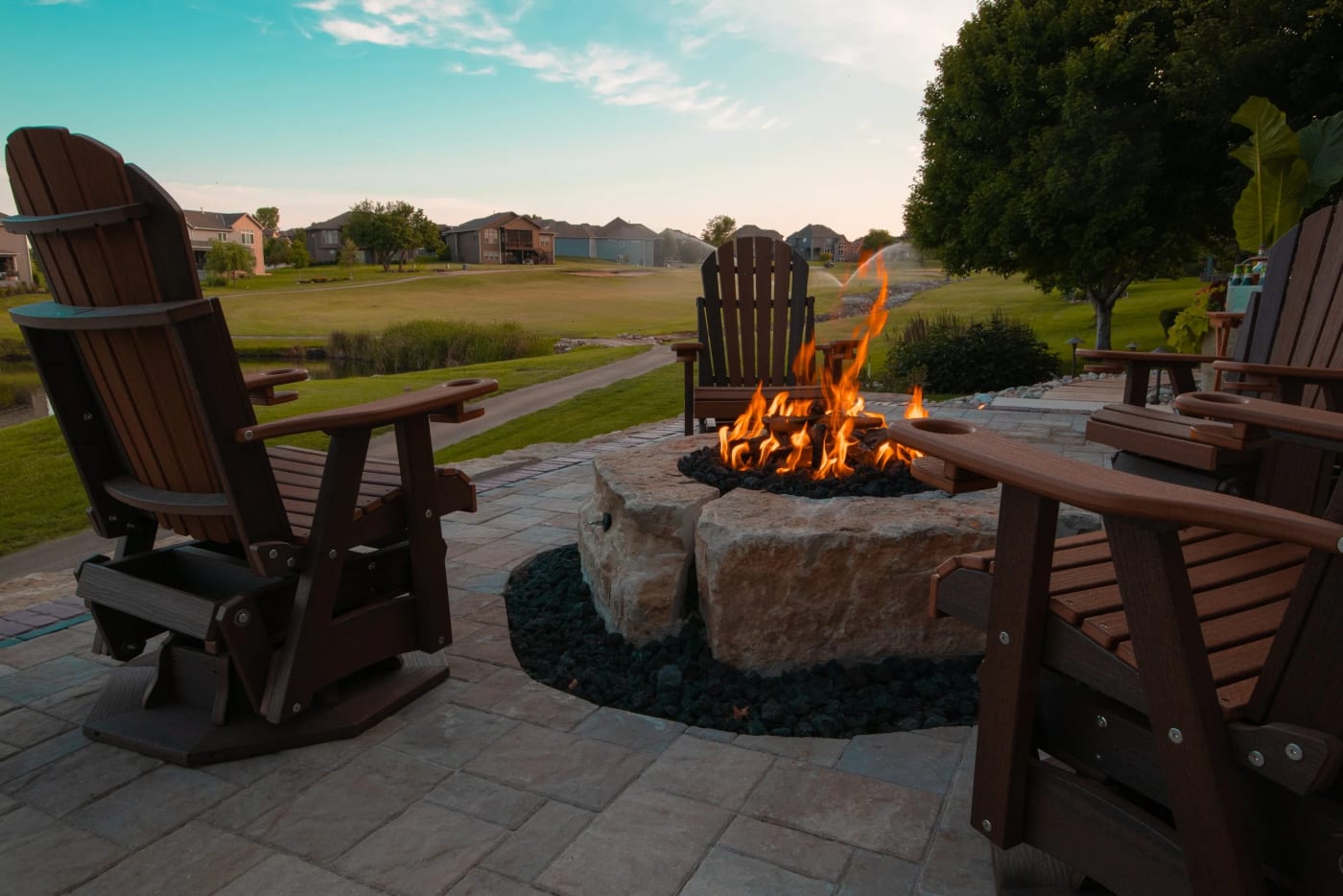
Built-in fire pits are a low circle or square of stone or block surrounding a flame, designed for everyone to sit around. The classic backyard fire feature. Wood or gas. The thing that makes it work is the seating relationship: low enough to see across, wide enough that the heat reaches people without scorching them, and surrounded by patio space or a seating wall that makes the conversation feel like a circle.
Outdoor fireplaces are vertical structures with a hearth, a firebox, and a chimney, anchored against a wall, the back of the patio, or freestanding. They throw heat in one direction and create a clear focal point. They are architectural in a way a pit is not. The patio organizes around the fireplace the way a living room organizes around a fireplace indoors.
Fire bowls and freestanding pieces are the lower-commitment middle option. A propane bowl on a finished patio costs a few hundred dollars and provides 80 percent of the experience of a built-in for a fraction of the cost. Good if you are not sure what you want long-term, or if you rent, or if you want something portable.
Pizza ovens are the specialty option. Wood-fired or gas. They are a real cooking appliance, not just an entertainment piece, and they reward homeowners who actually use them. More on these below.
For a deeper dive on choosing between a pit and a fireplace, we wrote a full breakdown in fire pit vs fireplace, which is better for your space.

This is the question every homeowner asks, and the honest answer depends on how you actually live. Both are good. Neither is wrong.
Wood-burning gives you the smell, the crackle, the dancing flame, and the marshmallows. It also gives you a wood pile to manage, ash to clean out, smoke that can drift to a neighbor's window depending on wind, and a fire you have to build before every use. If you grew up around campfires and the ritual is part of what you want, wood is the right answer. About 30 percent of our clients choose wood.
Natural gas is the convenience option. Flip a switch or push a button, the fire is on, no smoke, no smell, no cleanup. It runs off your home's gas line so you never refill anything. It is the choice we make for clients who want fire on demand, who entertain a lot, or who have HOA or municipal restrictions on open flames. About 60 percent of our clients choose this.
Liquid propane is the third option, usually for properties without a gas line at the feature location or for portable bowls. Works exactly like natural gas but runs off a tank you swap or refill. Tank should be hidden in a cabinet or behind the structure.
You do not have to choose one for the whole yard. We have done plenty of patios where the main fireplace is gas (for daily use) and a second pit on the lower level is wood (for the once-a-month full campfire experience).
Pizza ovens are wonderful and they are also one of the most regret-prone purchases in hardscape if you do not actually cook. Here is the truth: a built-in masonry pizza oven is an investment between $4,000 for a basic gas-fired unit and $15,000 or more for a custom wood-fired dome with a real chimney and surround. They take 45 minutes to an hour to come up to temperature on wood, they get cleaner and more efficient with practice, and they produce pizza that no oven in your kitchen can match.
They reward the homeowner who cooks. If you make pizza monthly, you will love it. If you make pizza twice a year, the simpler portable option (a $400 Ooni or a similar tabletop unit on the patio bar) gives you 80 percent of the experience with none of the regret.
The integration into an outdoor kitchen is where the built-in option earns its keep. If you are already building a kitchen with a grill, a sink, a counter, and a hood, adding a pizza oven to that run makes the whole setup feel like a real culinary tool, not a backyard novelty.
Pricing varies with materials and complexity, but here are the honest ranges we quote in the metro.
A portable propane fire bowl on a finished patio: $300 to $1,200. No installation cost beyond placing it.
A custom built-in gas or wood-burning fire pit with seating wall: starts around $2,450, with most clients investing $4,000 to $8,000. The most popular fire feature in our market.
A modest outdoor fireplace, basic block construction with stone veneer: starts around $13,950, with most clients investing $18,000 to $30,000.
A statement fireplace with a tall chimney, premium stone, hearth, and wood storage built in: $30,000 to $60,000 or higher depending on size and finish.
A built-in gas pizza oven: $5,000 to $9,000 installed.
A wood-fired masonry pizza oven with dome and chimney: $10,000 to $18,000.
What drives prices up: premium stone selection, custom shapes, taller chimneys, gas line runs through a finished patio, and chase work for hidden propane tanks.
The chimney height on an outdoor fireplace matters more than the firebox size. A short chimney lets smoke roll back out the front opening on any day with even mild wind. Our minimum is 8 feet above the firebox for outdoor fireplaces, and we go to 10 or 12 on larger builds.
Gas fire features need a key valve, not just an igniter. The key valve is a manual shutoff outside the firebox. Without it, a gas leak inside the unit has no way to be stopped at the source. This is code and it should be there, but on cheaper installs it sometimes is not.
Concrete cracks under direct flame. A wood-burning fire pit needs a proper firebrick liner inside the block surround. Skipping this is a common builder shortcut that leads to the pit failing after a couple of seasons.
Seating wall caps need to be at the right height for the pit. Cap height should be 18 inches, give or take. Lower and people slouch. Higher and feet dangle. The pit height should match so people can sit and warm their hands without leaning.
Is a fire pit safe on a wood deck? Not directly. Wood decks need a heat-resistant pad rated for fire and a fire pit specifically designed for deck use. We generally recommend any built-in or larger fire feature go on a stone or paver patio, not a deck.
Do I need a permit? For most residential fire pits in the metro, no. For gas line work and for outdoor fireplaces above a certain size, yes. We pull permits as part of every install where they are required.
Can I cook on a gas fire pit? Not really. The gas burner is for ambiance and warmth, not for cooking. Most have a glass or stone media that prevents direct cooking. For cooking, use a wood pit, a grill, or a pizza oven.
What about smoke and neighbors? Wood fires produce smoke, which drifts with the wind. We site wood pits away from neighbor windows where possible. If your lot is small and your neighbors are close, gas is the more neighborly option.
Will an outdoor fireplace work in winter? Yes. They are designed for it. A well-built outdoor fireplace will throw enough heat to keep a small patio comfortable down to about 30 degrees. Below that, you need to layer up.
How long does construction take? A built-in gas fire pit is typically 3 to 5 days. A standard outdoor fireplace is 1 to 2 weeks. A large statement fireplace can be 3 to 4 weeks.
If you are a homeowner in Kansas City or the surrounding metro and you want fire in your backyard but are not sure which option fits your space and how you actually live, that is exactly the kind of conversation we like having early. We will come walk the yard with you and sketch out the options. Call us at 816-499-2547 or book a free consultation through the Get Started page.
Thirty minutes on site with our designer is all it takes to see what is possible. No pressure, no hard sell.
Schedule a Design Call