
The Journal · Field Notes
The outdoor kitchen category has shifted more in the past three years than in the previous ten combined. Appliances got smarter. Stainless steel got company. Pizza ovens went from luxury to common. And a few things that everyone built in 2018 already look dated in 2026. We design and build kitchens across the Kansas City Metro and pay close attention to where the category is going. Here is what we see right now, what is on the way up, what is on the way out, and the moves that will still look right ten years from now.
Three years ago bar seating at the outdoor kitchen was a "nice-to-have." Today it is the first thing we draw on most kitchens. The reason is social. Indoor kitchens are gathering spaces. Outdoor kitchens should be too. A counter overhang of 14 to 18 inches over the front of the kitchen, with stools at 42 inch bar height, turns the cooking zone into a conversation zone. Guests gather. The cook is not isolated. The patio reads like an outdoor room rather than a deployment of furniture.
Two changes from the 2018 version of this trend. First, the overhang is bigger now (14 to 18 inches versus 8 to 12), giving guests real room to sit without bumping knees on the counter base. Second, the stool count is higher. Where 2 stools used to be the default, 3 to 4 is now standard, with built-in seat walls beside the bar to absorb the larger party.
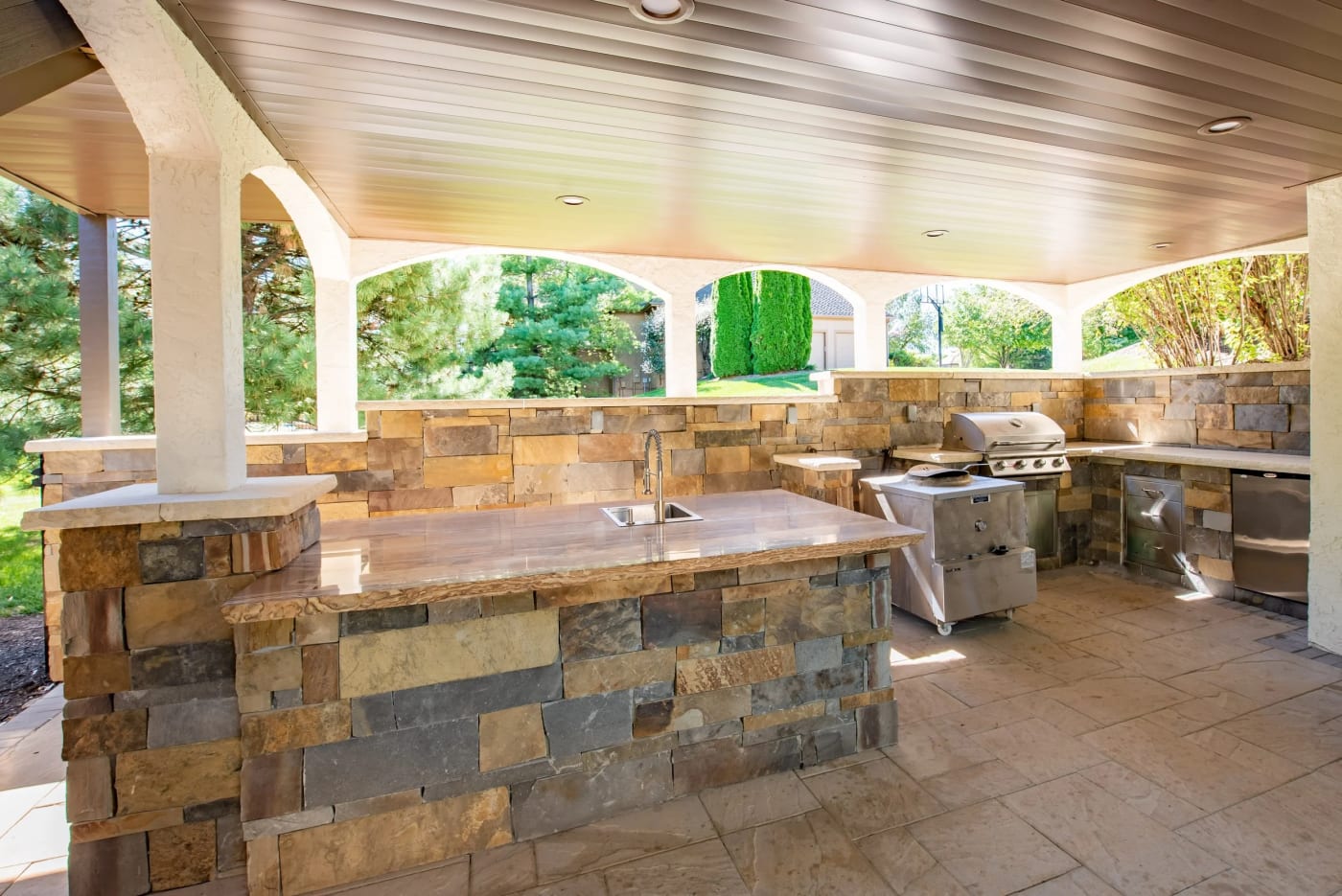
The modern outdoor cook wants multiple cooking surfaces, each tuned to a different food.
Gas grill for fast weeknight cooking. Still the workhorse.
Kamado smoker (Big Green Egg, Kamado Joe, Primo). Charcoal-fueled ceramic smoker that holds temperature for 12+ hours. Built into the kitchen counter with a heat shield, or set into a custom kamado table beside it. The trend that won't quit.
Plancha or flat-top griddle. Smashburgers, hibachi, breakfast. Once a backyard novelty, now a serious cooking surface. Built-in versions from Lynx, Coyote, and Blackstone exist. We get more requests for these every year.
Pellet grill. Wood-pellet smokers with app-controlled temperature (Traeger, Recteq, Weber SmokeFire). Started as a hobby category, now a real kitchen appliance. Cooks low-and-slow and grills hot.
Pizza oven. Wood-fired or gas. Once a luxury, now common.
The pattern: clients used to ask for "a grill." Now they ask for "a grill, a smoker, and something flat." We design kitchens with two or three cooking zones, each in its own counter run, so multiple surfaces can run simultaneously without crowding the cook.
Three years ago we built one pizza oven a year. In 2026 we are building one or more on most full kitchens.
Two reasons. First, the Ooni revolution. Companies like Ooni, Gozney, and Solo Stove made $400 to $900 tabletop pizza ovens that work surprisingly well. Homeowners who never imagined owning a pizza oven bought one, used it, fell in love, and called us six months later to build a permanent version.
Second, the integration got better. Built-in gas pizza ovens from Lynx, Alfa, and Empava now hit 900°F in 20 minutes, cook a Neapolitan pizza in 90 seconds, and look like real built-in appliances. The wood-fired masonry option is still the gold standard for taste and theater, but the gas built-ins are now legitimate and dramatically more practical.
Our recommendation to clients: if you have not made pizza outdoors before, start with a $500 Ooni. If you use it more than twice a month for six months, build a permanent oven. If it sits in the garage, you saved $10,000.
Five years ago an outdoor TV was a gimmick. Today they are real appliances and increasingly common in the kitchens we build.
The category leader is the Samsung Terrace, which is genuinely weatherproof, full-shade or partial-sun rated depending on model, and reads as a real TV at the patio. SunBrite, Furrion, and Peerless make competing models at various price points.
The smart placement is recessed into a covered wall above the bar back. Watch-while-grilling, watch-while-eating, watch the game with the patio crowd. We pre-wire HDMI, power, and a network drop to a recessed location at the kitchen during construction so the install is clean later.
The mistake is hanging an indoor TV on an outdoor wall. Even under a roof, the humidity and temperature swings of Kansas City summer kill an indoor television within 2 to 4 years. Spend on the outdoor-rated version or skip it.
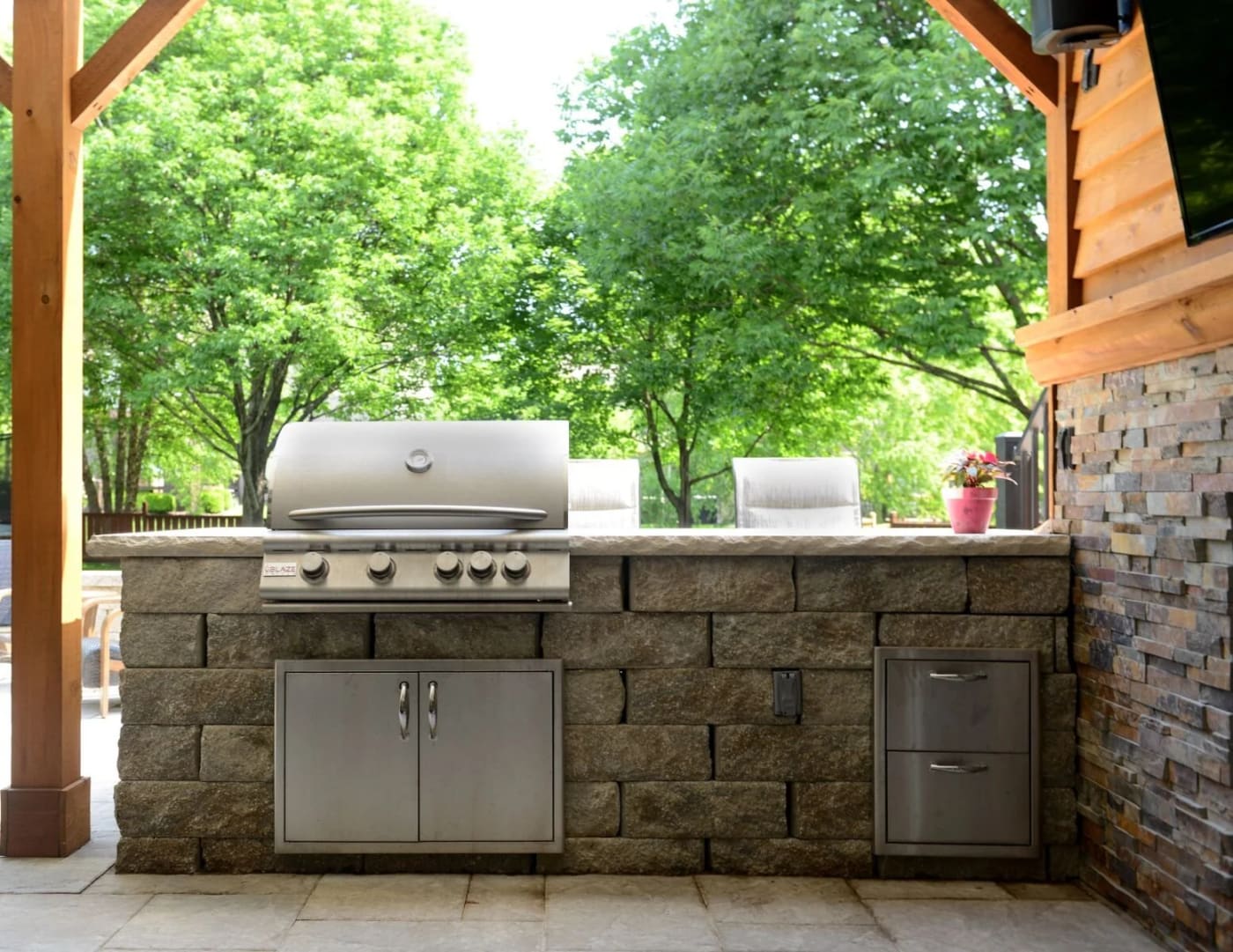
Stainless steel is still the dominant appliance finish, and for good reason (rot, weather, and insect resistance). But the cabinetry is trending toward concealment.
Drawer refrigerators tucked under the counter instead of vertical built-in refrigerators on display. Ice makers behind cabinet panels rather than glossy stainless fronts. Storage drawers below the grill instead of empty space. The trend is making the kitchen feel like a finished piece of architecture rather than a row of appliances.
The visual goal is fewer appliances at eye level. The grill stays exposed because it has to. Everything else gets tucked under the counter, behind matching cabinet faces, or in side runs.
An emerging alternative to plain stainless is blackened steel and powder-coated finishes. Hestan's Aspire line and Coyote's outdoor cabinets are starting to offer these. Still less common, but on the way up.
As more outdoor kitchens get built under pavilions and pergolas with solid roofs, ventilation matters in a way it did not when every kitchen was open to the sky.
A grill under a closed roof produces smoke that does not go away on its own. The ceiling stains. The patio fills with smoke at the worst moments. Beyond comfort, this is a real safety issue with gas grills under low-clearance covers.
The solution is a real outdoor exhaust hood, ducted to the outside, sized to the grill's BTU output. Vent-A-Hood, Best, and Faber make outdoor-rated hoods that handle the heat and the weather. Costs $2,000 to $6,000 for the hood plus $1,000 to $3,000 for the ducting and electrical, depending on the run.
Worth every dollar if the kitchen is under a roof. We will not build a covered kitchen without one.
App-controlled grills are no longer a novelty. Traeger, Weber SmokeFire, Recteq, and others ship with full app integration, allowing the cook to monitor and adjust temperature from anywhere in the yard or the house.
For long smokes, this is genuinely useful. Setting a 14-hour brisket and walking inside to sleep is now a real workflow.
Other connected features creeping in: meat thermometer probes that text when the food hits target temperature, refrigerator alarms when the door is left open, and integrated audio that syncs with home Sonos systems. Not every client wants this, but the option is now standard rather than premium on quality appliances.
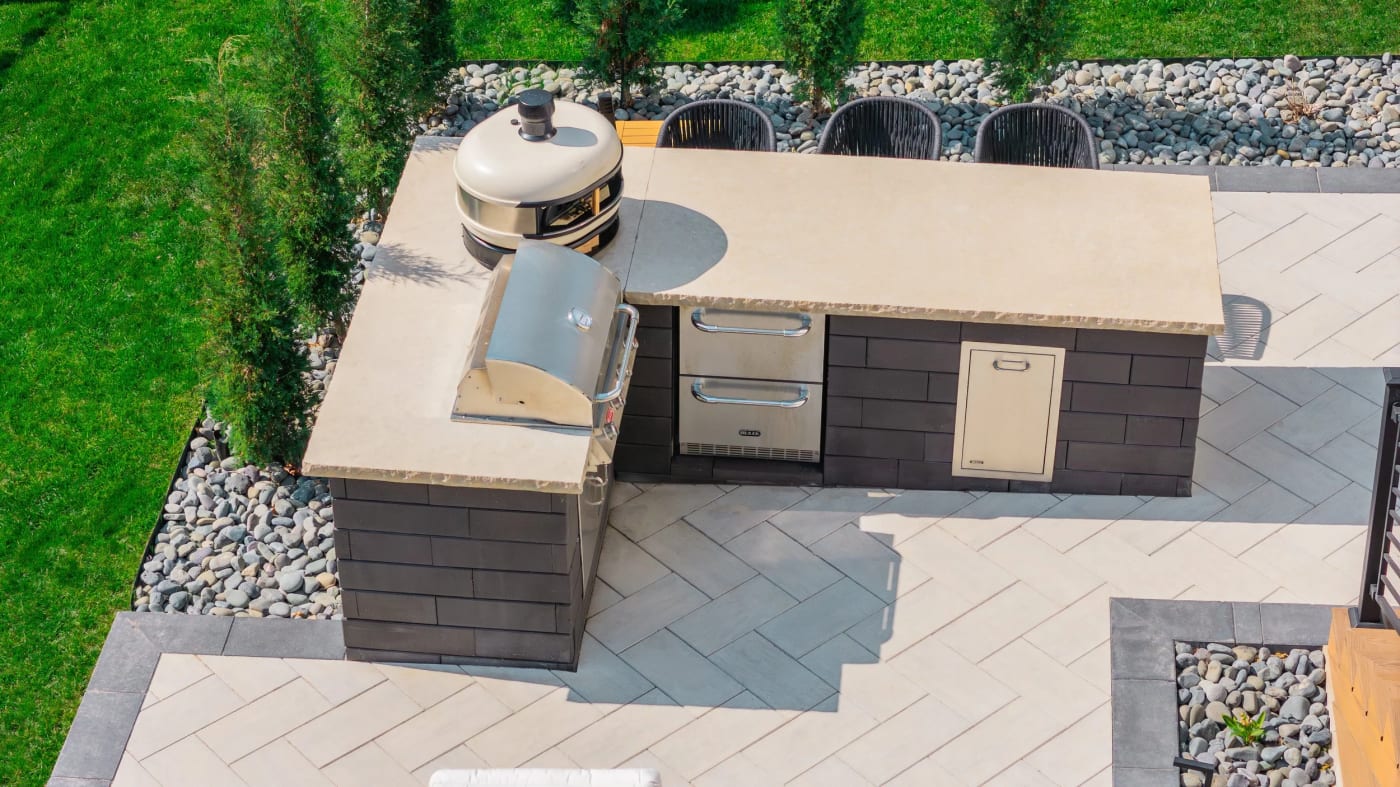
For years, seat walls were a fire pit feature. Built around the pit, the wall gave guests a place to gather.
The new pattern is to extend the seat wall around the kitchen as well. A short stone wall (18 inches tall, the universal "comfortable bench" height) along the back or side of the kitchen, providing additional seating, defining the kitchen zone, and creating a visual edge that organizes the patio.
Done right, the kitchen seat wall reads as part of the kitchen architecture, not a separate add-on. We integrate matching stone caps, height transitions where the wall meets the kitchen counter, and lighting along the wall face.
This is a trend we expect to dominate the next 5 years of outdoor kitchen design.
Modular kitchen units like the Belgard Elements line and the Werever modular cabinets give homeowners a faster path to an outdoor kitchen. Pre-built sections ship from the factory and install in days instead of weeks. Costs are lower because the labor is concentrated at the factory rather than on-site.
The tradeoffs are real. Modular kitchens have fewer customization options. Sizes are fixed. Counters and appliance positions follow the manufacturer's grid. Stone and finish options are limited to what the line offers.
For a homeowner who wants a quality outdoor kitchen at the most efficient price and is willing to accept the design constraints, modular is a legitimate option. For a homeowner who wants the kitchen to feel built specifically for the space, with custom dimensions and integrated stone work that matches the rest of the patio, full custom is the answer.
We build both. We help clients pick based on budget and design goals.
A short list of things that were popular in 2015-2020 and now read dated.
Tropical or rustic stone veneer wrapping the entire kitchen. The "lodge" look. Replaced by cleaner architectural finishes that match the home.
Massive single-grill kitchens with no other cooking surface. Now reads as under-spec'd or behind the times.
Round bar-height bars protruding from the kitchen. Looked great in 2018, now reads like a hotel lobby attempt at a backyard.
Bright orange bbq accent tile. Mediterranean villa fantasy that did not age well in Kansas suburbs.
Pegasus or "tropical" granite countertops. Busy patterns that fight everything around them.
Beer tap towers sticking up from the bar. Beer geeks who do not actually keg loved them. Almost nobody used them.
Smoker boxes built into the grill counter. Mostly replaced by quality standalone pellet smokers.
None of these are deal-breakers if they exist in your current setup. They just signal an older design when seen in a 2026 photo.
The moves we believe will age well based on what we are seeing in design publications and what our highest-end clients are requesting.
Clean architectural lines. Counters that read as built, not assembled. Right angles, clear edges, intentional proportions.
Stone finishes that match the home. Limestone or quartzite counters and column wraps that complement the home's existing material palette.
Concealed appliances. Refrigerators in drawers. Ice makers behind cabinet faces. The kitchen reads as a finished room rather than an appliance row.
Multiple cooking zones. Real cooks want real flexibility. Plan for it.
Integrated lighting. Under-counter task lights, recessed cans in the structure above, ambient lighting elsewhere on the patio. Done together at design time.
Seat walls that extend the kitchen into the patio. Continuous architecture rather than an island stuck on its own.
Quality over quantity. One great grill instead of three mediocre ones. A real pizza oven instead of a kit. The right counter material rather than the cheapest one.
The kitchens that age best are the ones designed for how the homeowner actually lives, with each piece earning its place in the design.
This post covers what is trending. For the practical "how do I actually plan one" guide, including the right size for how you cook, layout principles, and appliance value rankings, see our inspiration for your outdoor kitchen post. And per our service page, outdoor kitchens at Kansas City Hardscapes start around $11,900 with most clients investing $12,000 to $22,000.
Ready to talk through a real build for your space? Call us at 816-499-2547 or book a free consultation through the Get Started page.
Thirty minutes on site with our designer is all it takes to see what is possible. No pressure, no hard sell.
Schedule a Design Call