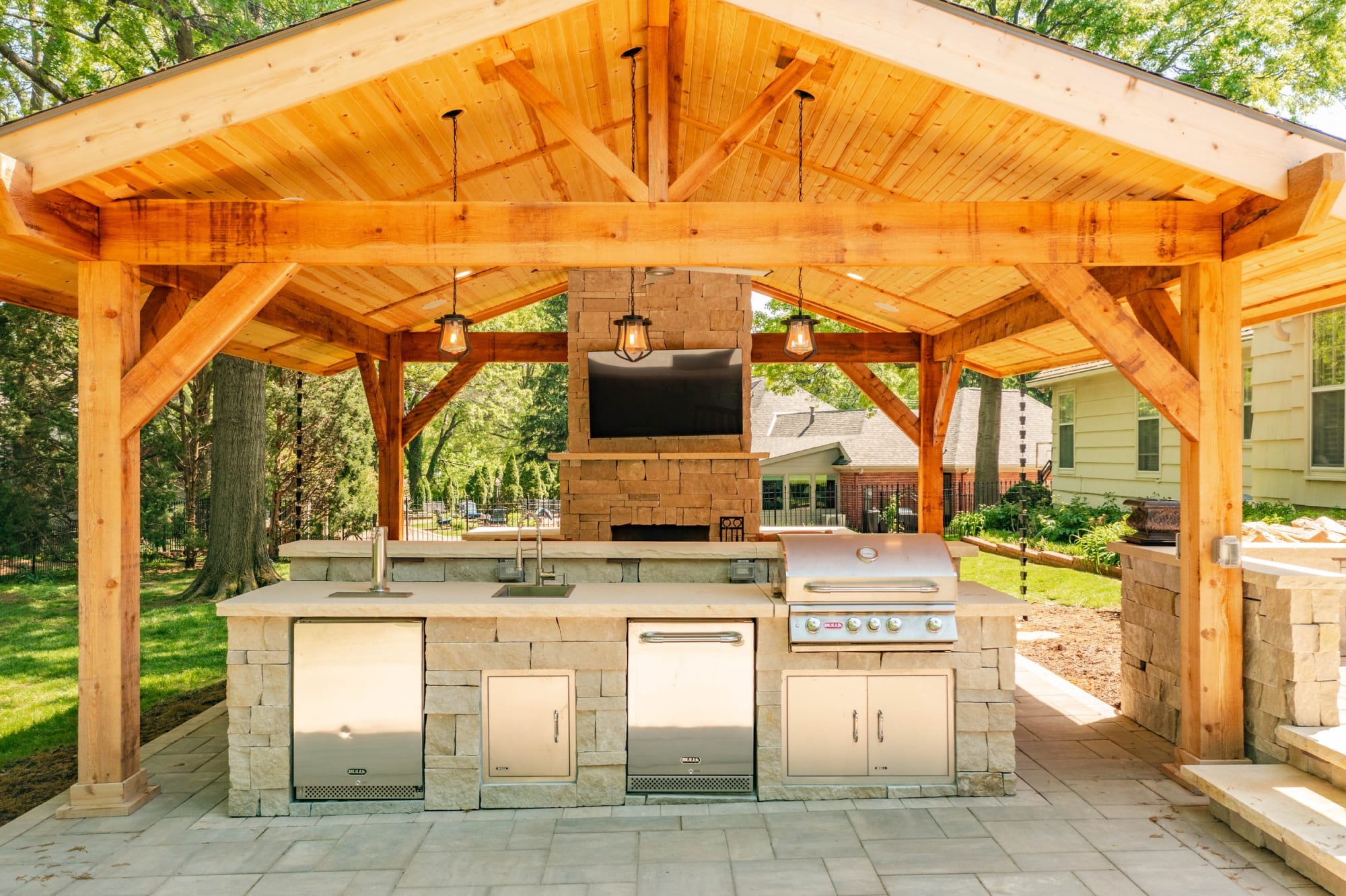
Prairie Village is the original master-planned community in the Kansas City metro. J.C. Nichols platted it in 1941, the Prairie Village Homes Association is one of the first homes associations in the world, and the city was named the best planned community in America in 1949. Eighty years of careful governance and a 2021 Tree Protection Ordinance shape every hardscape build here. This is what we have learned in ten years of building in Prairie Village.
Why hardscaping in Prairie Village is not the same as hardscaping anywhere else.
Prairie Village's character is the product of a planned community that has been governed continuously since 1941. Two specific things shape every hardscape build in the city.
The Tree Protection Ordinance is the strictest mid-tier rule in the metro.
Chapter 19.47 of the Zoning Regulations, effective June 1, 2021, classifies protected trees in four categories: right-of-way trees, frontage trees, lot trees, and buildable area trees. Three thresholds define what is protected:
- All trees 3 inches DBH or greater located within 20 feet of the front lot line.
- Any tree 20 inches DBH or greater located beyond 20 feet of the front lot line and outside the buildable area.
- Any tree 30 inches DBH or greater located within the buildable area of the lot.
Right-of-way tree removal requires a permit and replacement with at least a 2-inch caliper tree once construction is complete. A tree protection and removal plan must be submitted to Public Works with the building permit application. The practical effect on a hardscape project: the layout has to be designed around the protected trees, not the other way around, and the replacement caliper requirement is a real line item if removal is necessary. For the longer list of ways a hardscape fails when trees are not properly accounted for, see our avoiding failure guide.
Most Prairie Village subdivisions have an active homes association.
The Prairie Village Homes Association (PVHA) covers a large portion of the original Nichols plat and has been operating since 1941. Several subdivision-level associations operate alongside it: Prairie Hills, Corinth Hills, Corinth Meadows, Corinth Estates, Somerset Hills, Ridgeview Heights, Town and Country Estates, Calvin Crest, Prairie Fields, and Prairie Ridge. Many require approval before the city permit can be issued. Each operates with its own forms and standards. The Prairie Hills Declaration of Restrictions is one of the older sets and worth reading before sketching a build there.
Clay subsoil and Johnson County frost depth.
Prairie Village sits on the same expansive clay subsoil that runs across most of Johnson County. Johnson County requires structural footings to sit at least 36 inches below grade, below the frost line, and we plan structural footings accordingly. On the patio base itself, we go deeper than code minimum and lay geotextile between the clay subgrade and the base aggregate so the two layers stay separated for the life of the patio.
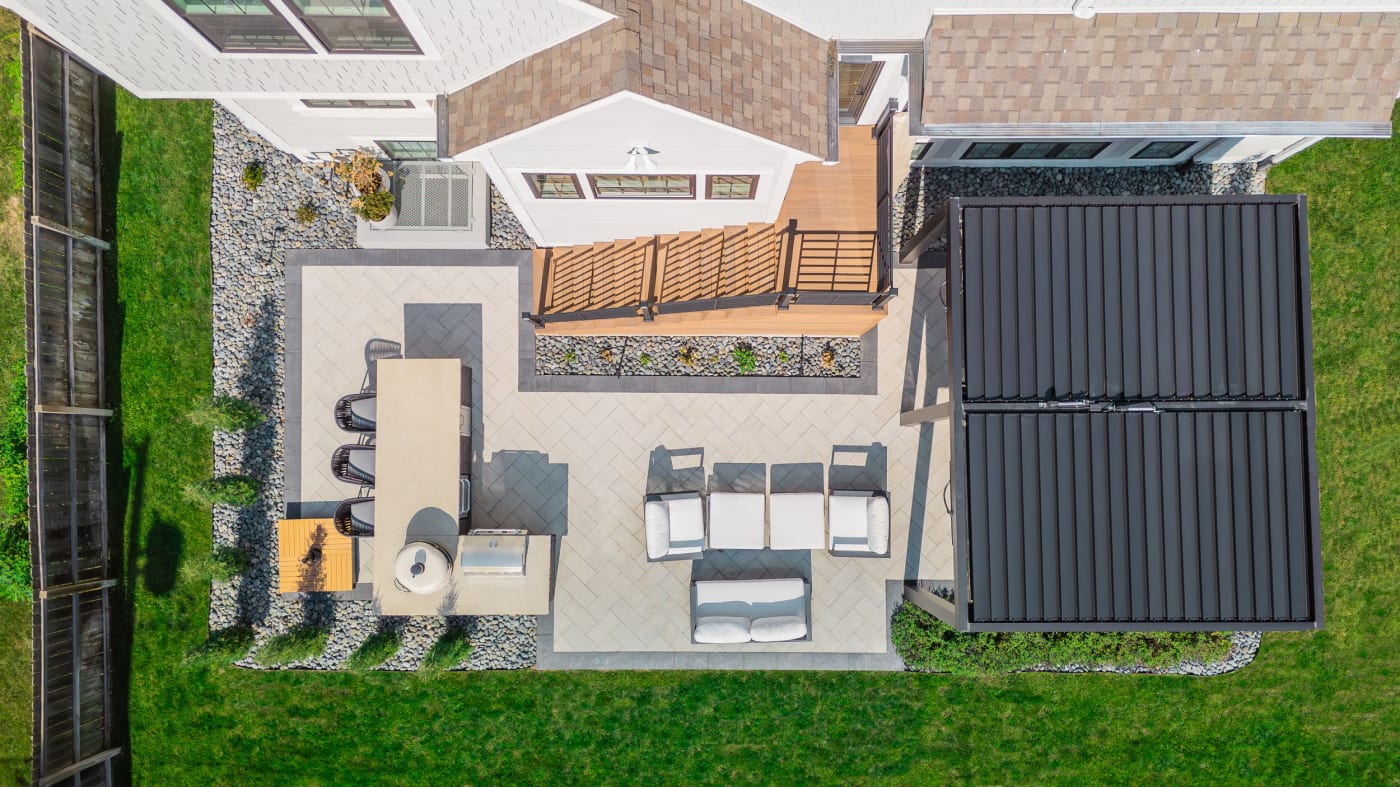
Four finished projects, all in Prairie Village.
These are the kinds of builds we do across Prairie Village. Browse the full portfolio for projects across the metro.
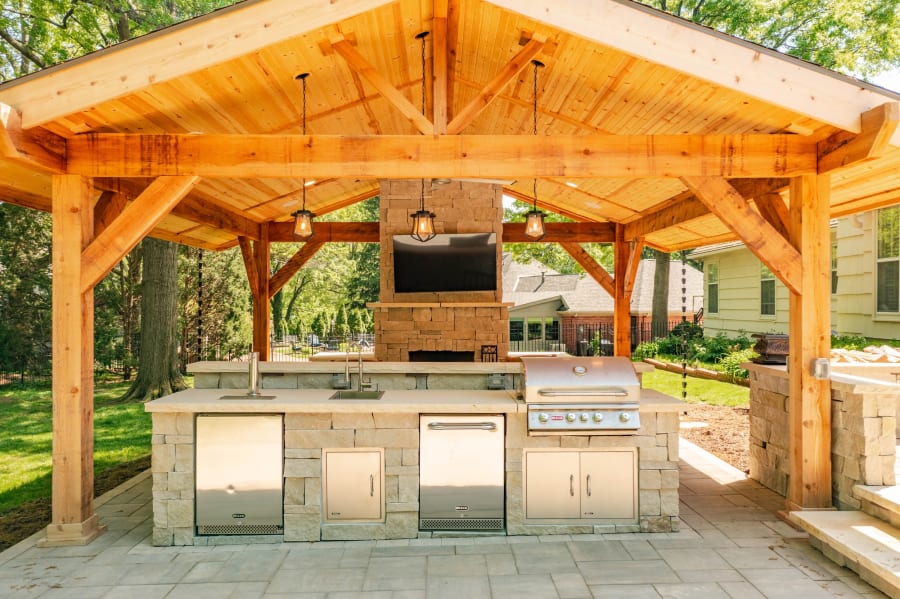
Pavilion, Patio & Fireplace
A pavilion with an integrated fireplace, large paver patio, retaining wall, and grill station. Sited around the existing tree canopy.
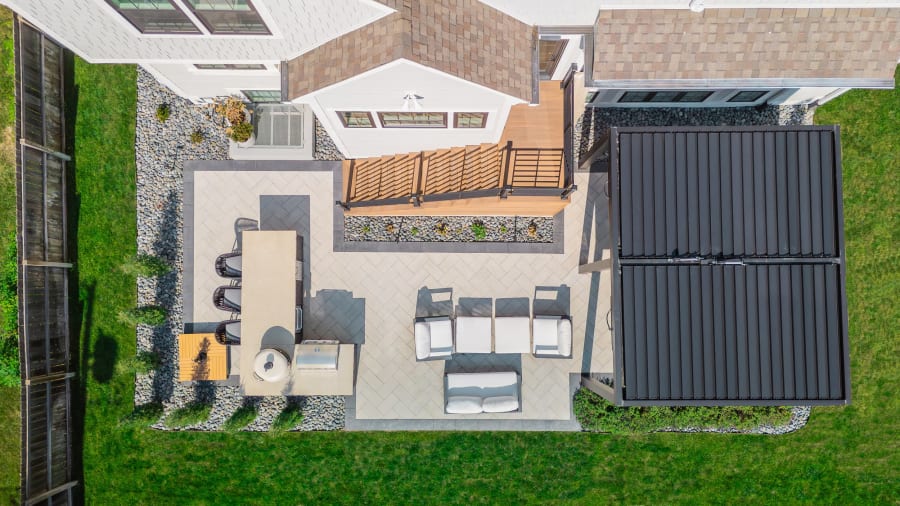
Heated Pergola & Outdoor Kitchen
A heated pergola anchored to an outdoor kitchen with a grill station, paver patio, and integrated lighting for cooler-month use.
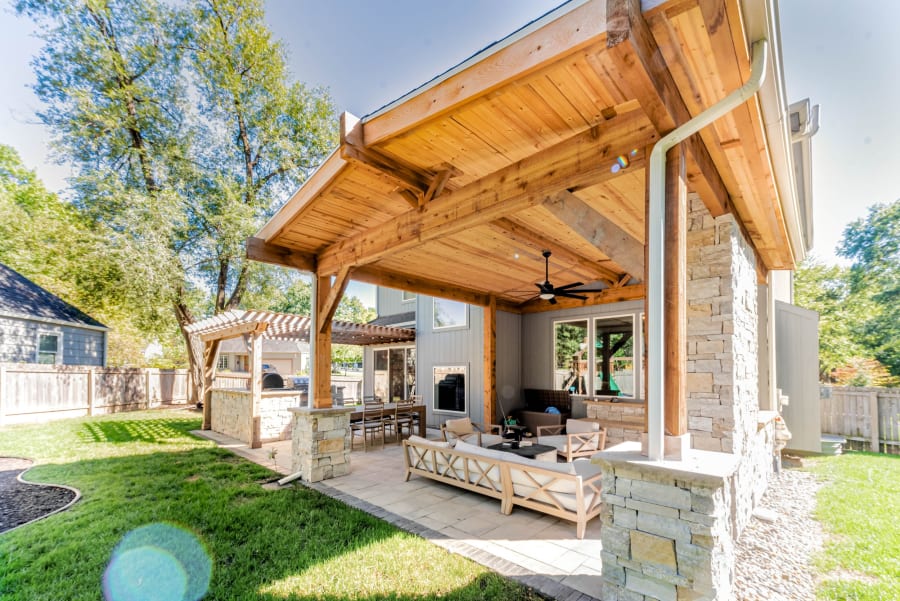
Pavilion, Pergola & Grill Station
A covered pavilion with a pergola extension, a built-in grill station, and a paver patio designed for entertaining.
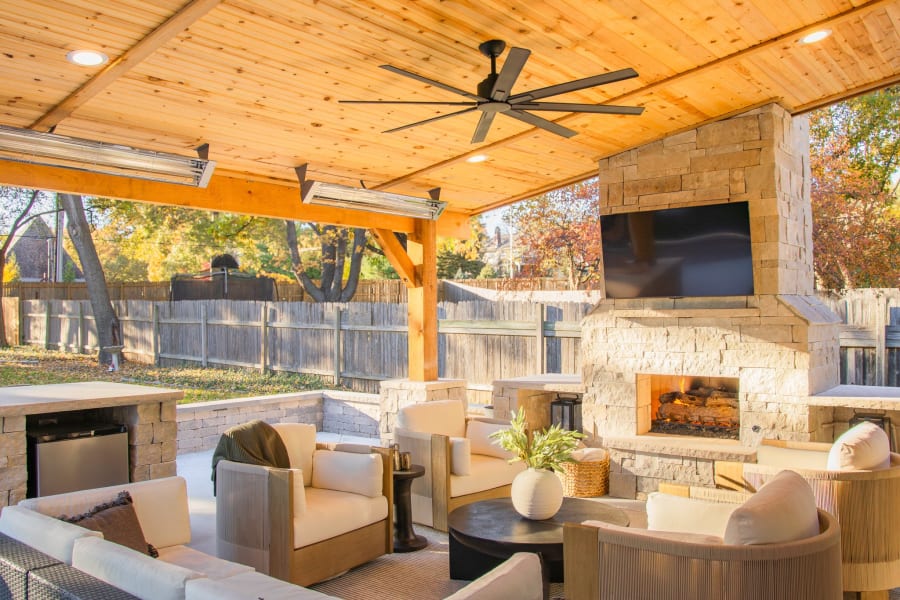
Covered Structure, Fireplace & Concrete Patio
A diamond-cut concrete patio under a covered structure with a stone fireplace, bromic heaters, and a bar station.
Real hardscape ranges for Prairie Village projects.
The ranges below are the starting points from our service pages and apply across the metro. Prairie Village projects typically land in the upper half of each range because of the homes association coordination and the Tree Protection and Removal Plan requirements.
What pushes a Prairie Village project higher.
Prairie Village's cost drivers come from the homes association coordination and the Tree Protection Ordinance more than from the build itself.
- Permit administration: $1,450. Our flat fee to prepare the application, the HOA submittal where applicable, the city-required drawings, the OpenGov submittal, and to manage the inspection sequence.
- City of Prairie Village permit fee: varies. Paid directly to the city, based on project scope and valuation.
- Engineered structural plans: $2,500. Required for most structures with footings (pergolas, pavilions, outdoor fireplaces, retaining walls over four feet, anything tied to the house).
- Tree Protection and Removal Plan. Required with the building permit application under Chapter 19.47. Typical cost $500 to $1,500 by a certified arborist or landscape architect, depending on lot size and protected tree count.
- Replacement tree caliper. If a right-of-way or protected tree is removed, a 2-inch caliper replacement tree is required at minimum. That is a real number to add to the budget, not a token.
- Dumpster placement. Prairie Village enforces noise and parking rules. Plan the dumpster location with the contractor before delivery so we do not lose a day.
For a more specific number on your project, the cost calculator walks through the variables and gives a real range before you ever talk to us. To see what your space could look like before you commit, the patio visualizer renders a design from a photo. We also offer financing options on most builds. For a deeper read on paver patio pricing specifically, see our paver patio cost guide.
The paperwork side of a Prairie Village build.
The permit fees are in the cost section. The process side is here. Prairie Village uses OpenGov and ViewPoint Cloud for application and tracking. Permits expire on the IRC standard 180 days after issuance, so sequencing matters: if the project sits too long between contract signing and the build window, the permit can expire before the first shovel.
Homes association review.
The named associations homeowners ask about most: Prairie Village Homes Association (covering much of the original Nichols plat), Prairie Hills Homes Association, and the subdivision associations across Corinth Hills, Corinth Meadows, Corinth Estates, Somerset Hills, Ridgeview Heights, Town and Country Estates, Calvin Crest, Prairie Fields, and Prairie Ridge. Each operates independently of the city with its own forms and standards. Most require approval before the city permit can be issued. Plan on submitting site plans, drawings, material samples, and a written description. Approval typically lands in one to four weeks.
Tree Protection and Removal Plan.
Submitted to Public Works with the building permit application. The plan identifies all protected trees on and adjacent to the lot, the proposed protection measures during construction, and any required tree removal with the replacement plan. Skipping it is not an option; the permit does not issue without it for most hardscape projects.
Setbacks, easements, and utilities.
Prairie Village lots have defined setbacks from property lines and easements for utilities and drainage. A patio or structure that crosses an easement, even slightly, can be rejected or stop-worked. Pull the plat, locate the easements before design, and call 811 to mark utilities.
Inspections.
Footings get inspected after reinforcing steel is placed and before concrete is poured. Framing gets inspected before close-up. Final inspection at completion. Each one has to pass before the next stage proceeds.
The contractors who lose Prairie Village projects treat the homes association and the Tree Plan as someone else's problem.
A five-star Prairie Village client, twice over.
Real homeowners, real projects, real words. More reviews from across the Kansas City metro are on our testimonials page.
★★★★★"Kansas City Hardscapes was one of three who quoted us on an outdoor project. They did such an awesome job we had them come back and knock out an old retaining wall."
Jeff KendallPrairie Village, KS
★★★★★"Reliable, great follow-up and transparency. We had them come back for a second project."
Jeff KendallPrairie Village, KS
Frequently asked about Prairie Village hardscape projects.
Do I need a permit for a patio or pergola in Prairie Village?
Yes, for most hardscape structures with footings, including pergolas, pavilions, outdoor fireplaces, and outdoor kitchens. Two specific exemptions: retaining walls under four feet measured from the bottom of the footing to the top of the wall do not require a permit unless they support a surcharge, and small flat surfaces do not. Permits are submitted through OpenGov or ViewPoint Cloud. If your subdivision has a homes association, HOA approval is typically required before the city permit can be issued.
How much do permits and engineered plans cost in Prairie Village?
Our flat permit administration fee is $1,450, which covers preparing the application, the HOA submittal where applicable, the city-required drawings, the OpenGov submittal, and managing the inspection sequence. The City of Prairie Village permit fee is separate and varies by project. Engineered structural plans are $2,500 for a standard residential structure. A Tree Protection and Removal Plan certified by an arborist or landscape architect is required with most hardscape applications and typically runs $500 to $1,500.
What is the Prairie Village Tree Protection Ordinance?
Chapter 19.47 of the Zoning Regulations, effective June 1, 2021. Three thresholds define what is protected: all trees 3 inches DBH or greater within 20 feet of the front lot line; any tree 20 inches DBH or greater beyond 20 feet of the front lot line and outside the buildable area; any tree 30 inches DBH or greater inside the buildable area. Right-of-way tree removal requires a permit and replacement with at least a 2-inch caliper tree. A Tree Protection and Removal Plan goes to Public Works with the building permit application.
Will my Prairie Village HOA need to approve the project?
Most likely yes. The named associations include the Prairie Village Homes Association (founded 1941, one of the first in the world), Prairie Hills Homes Association, and subdivision associations across Corinth Hills, Corinth Meadows, Corinth Estates, Somerset Hills, Ridgeview Heights, Town and Country Estates, Calvin Crest, Prairie Fields, and Prairie Ridge. Each operates independently of the city. Plan on submitting site plans, drawings, material samples, and a written description. Approval typically takes one to four weeks.
How does Prairie Village's clay soil change how a patio is built?
Prairie Village sits on the same expansive clay as the rest of Johnson County. The clay swells when wet and contracts when dry, and that movement transfers to anything built on top. Johnson County requires structural footings to sit at least 36 inches below grade, below the frost line. A correctly built hardscape goes deeper than the minimum on the base, uses geotextile to keep the clay subgrade from migrating up into the base material, and is graded to shed water before it can pool.
How long do hardscape projects in Prairie Village take from contract to finish?
Simple patios run a few days of build time once we are on site. Larger builds with a pergola, fireplace, or outdoor kitchen run up to three or four weeks. Total time from signed contract to finished project is longer because of design, permits, HOA review, the Tree Protection and Removal Plan, and our build schedule, which runs three to four months out at any given time.
What should I ask a contractor before signing in Prairie Village?
Four questions surface most of what matters in Prairie Village specifically:
- How many projects have you built in Prairie Village, and can I drive past two of them?
- Who handles the building permit, the HOA submittal, and the Tree Protection and Removal Plan?
- How are you protecting the existing trees during excavation and build?
- How is drainage handled at the edge of the patio and away from the house?
A good contractor answers all four without hesitation. A bad one gives different answers at the second meeting than the first.
Building across Prairie Village and the Kansas City metro.
Our shop sits east of the river in Kansas City, Missouri. We build across Prairie Village and the surrounding Johnson County suburbs every season. The map below shows the area we cover most often.
The shameless plug.
You made it this far. We respect that. So here it is:
- Family-owned. Ten years across Prairie Village.
- Same crew quotes it and builds it.
- Plat before layout. Drainage before patio. Tree plan before excavation.
- We do not sub the build. 10-year warranty on our scope of work.
- Punchlist guy lives close enough to come back same week.
We hope you consider us.